

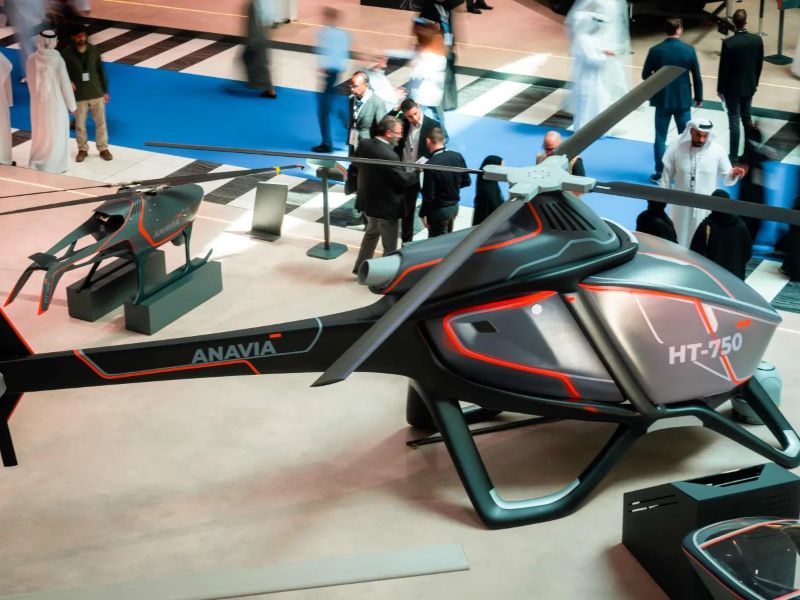
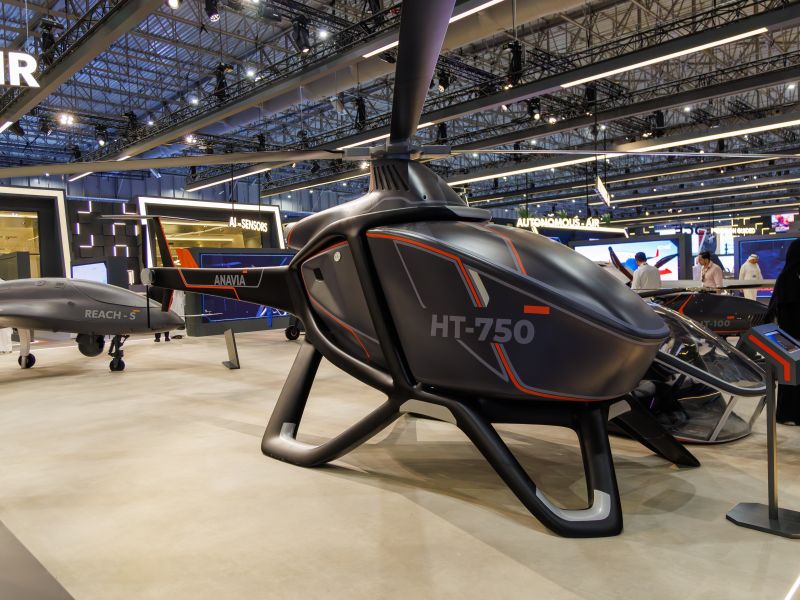
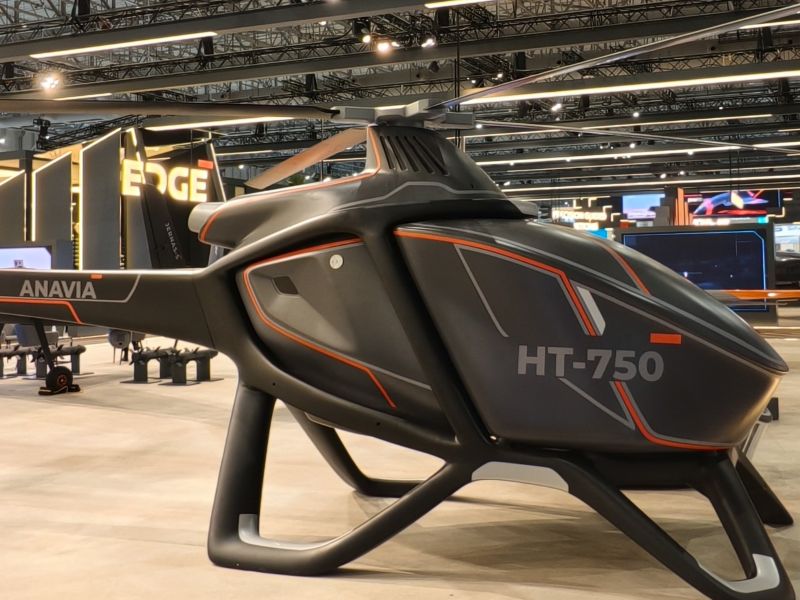
The HT-750 is an autonomous uncrewed vertical take-off and landing (VTOL) helicopter developed by Swiss robotics company ANAVIA, which is 52% owned by defence technology company EDGE Group.
The aircraft was unveiled at IDEX 2025 at the Abu Dhabi National Exhibition Centre (ADNEC) in Abu Dhabi, United Arab Emirates (UAE).
Recommended Buyers Guides

The multi-role helicopter is intended for intelligence, surveillance, and reconnaissance (ISR), inspection, tactical and logistics missions, including the transport of heavy payloads. It can operate in manually assisted mode or as a fully autonomous platform.
Design and features of the HT-750
The HT-750 has an overall length of 10m (32.8ft), a width of 2.58m, and a height of 3.35m. Its rotor diameter is 7.5m, and its fuel capacity is 900 litres (238 gallons).
The aircraft has a typical empty weight of 400kg (882lb) and a maximum take-off weight of 1,150kg, including 750kg allocated for payload and fuel.
For maritime missions, it incorporates a fully autonomous deck-landing system and a harpoon deck-lock mechanism compatible with Nato Grid. Optional emergency flotation devices are available for open-sea recovery.
Control and communication capabilities
The HT-750 uses a fully encrypted MESH IP data link that includes satellite communication (SATCOM), dual multiple-input multiple-output (MIMO) radios with up to 100Mbps data rate and AES-256 encryption.
The autonomous helicopter incorporates anti-jamming protection for its global positioning system (GPS) and a radar altimeter. Safety features include redundancy across GPS, DATA-Link, DAAS, ADS-B, and key sensorics, as in manned aviation.
The system supports beyond-visual-line-of-sight (BLOS) operations through long-term evolution (LTE) and SATCOM connectivity.
Its flight-control system manages autonomous take-off, flight, and landing. This reduces the level of direct control required from ground personnel during routine operations.
Payload configuration and sensors aboard the HT-750
The HT-750 aircraft can use a configurable cargo container with different sizes and fixation layouts depending on the requirement.
Cargo enclosures may be armoured, reinforced, or insulated, and an active cooling system can support the transport of temperature-sensitive supplies. The external cargo configuration includes a skyhook with a 70m rope and net, as well as a remote drop system.
Sensor options include the Epsilon 180 / 140 LC / 140Z G2, Trakka TC-300, and L3 Harris Wescam MX10.
The aircraft can also interface with the TK-8, PT6, P8-D, and P8-DN wide-area motion imagery (WAMI) system, as well as the T-Stamp XR electro-optical and infrared (EO/IRC) payload.
Propulsion and performance
The HT-750 is powered by a gas turbo-shaft engine which provides 250 shaft horsepower (SHP) of take-off power and 230SHP of maximum continuous power. The engine drives a semi-rigid four-blade bearing-less rotor assembly.
The aircraft’s fuel consumption is 60 litres an hour and primarily uses Jet A1 fuel, with JP-8 and JP-5 available on demand.
The HT-750 has a maximum airspeed of 222km/h, an operating ceiling of 4,000m, a maximum flight time of 15 hours, and a range of 2,500km.
Endurance is dependent on the payload, and it can carry 794kg for one hour, 500kg for four hours, 360kg for eight hours, or 30kg for up to 15 hours.
The aircraft is designed to operate in temperatures ranging from -25°C to 55°C and in ambient wind speeds of up to 56km/h (30 knots).
Mission applications of the HT-750
The HT-750 is intended for logistics operations in dispersed, remote, and offshore environments. Potential roles include battlefield resupply, the transport of mission-critical components, and delivery of time-sensitive cargo.
The platform can support cold-chain logistics for temperature-sensitive pharmaceuticals and medical supplies. It may also be configured to transport emergency healthcare and troops in difficult terrain.
In the ISR role, the helicopter can be deployed for border and coast control, aerial inspections, and fire prevention.
Orders and deliveries
In January 2026, EDGE was awarded contracts to supply ANAVIA HT-100 and HT-750 uncrewed helicopters to the UAE Ministry of Defence (MoD). Under the agreements, ANAVIA is expected to produce and deliver 76 HT-100 and 92 HT-750 rotary-wing UASs to the UAE MoD.
