

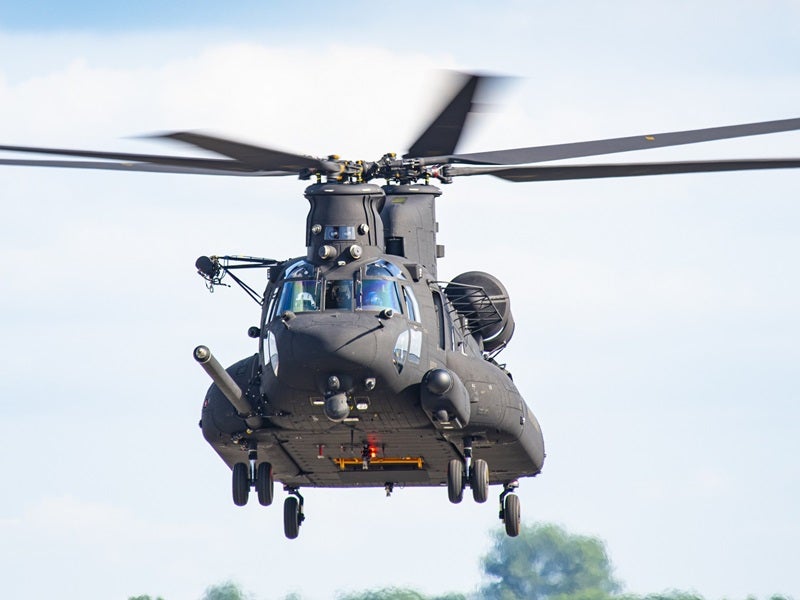
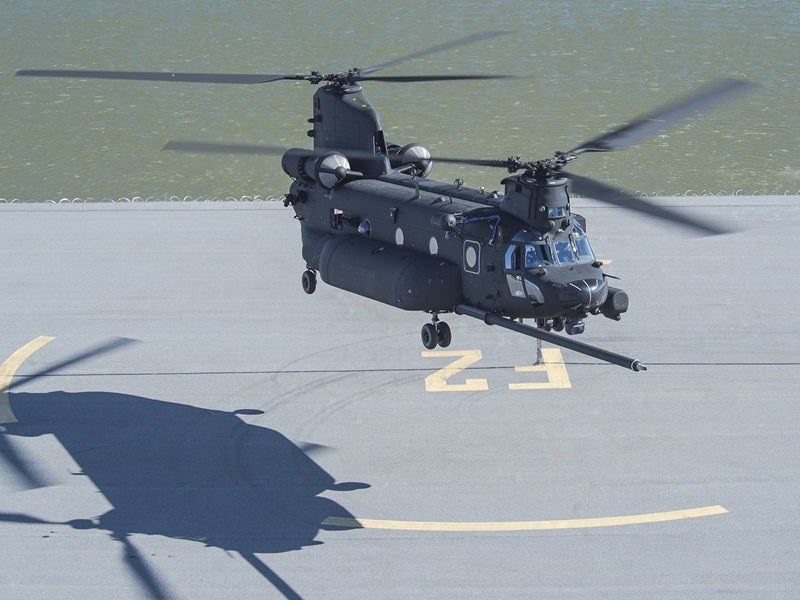
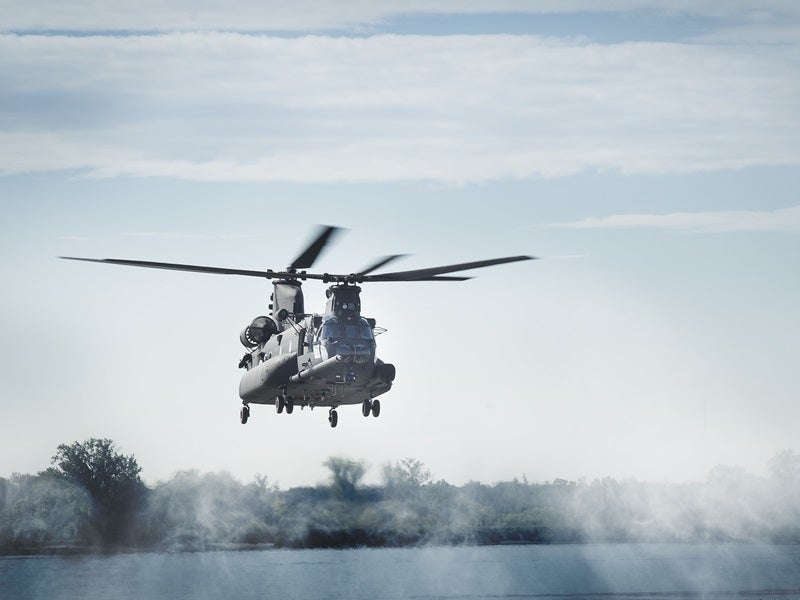
The Boeing MH-47G is a special operations variant of the CH-47 Chinook multi-role, heavy-lift helicopter. It is in service with the US Army Special Operations Aviation Command (USASOC).
The first new-build MH-47G helicopter was delivered to the USASOC in September 2014.
Recommended White Papers
Recommended Buyers Guides
The MH-47G is used in heavy-lift missions such as the transportation of troops, ammunition, vehicles, equipment, fuel and supplies, as well as civil and humanitarian relief missions.
The helicopter can conduct long-range missions at low level, in adverse weather conditions during the day and at night.
The 160th Special Operations Aviation Regiment (Airborne) of the US Army has the requirement for 61 MH-47Gs. The MH-47G modernisation programme is aimed at delivering a mix of remanufactured and new MH-47Gs to the USASOC.
Boeing also introduced the enhanced H-47 Chinook Block II variants, featuring redesigned fuel tanks, a reinforced fuselage and an upgraded drivetrain that collectively enable personnel to fulfil current heavy-lift mission demands.
MH-47G design and features
The MH-47G incorporates a monolithic, machine-framed fuselage integrating long-range fuel tanks and an extendable refuelling probe to receive fuel mid-air from fixed-wing tankers. The helicopter also possesses advanced cargo-handling capabilities.
The airframe houses a rear ramp for loading/unloading of troops, supplies and vehicles. The port side of the fuselage features a gunner’s window/firing port. The helicopter offers seating for five crew, including two pilots and three crew chiefs or aerial gunners.
The helicopter can be fitted with special operations equipment such as a fast rope insertion extraction system (FRIES), a special patrol insertion and extraction system (SPIES), a rope ladder, an electrically powered rescue hoist, and a personnel location system (PLS).
The fuselage of the MH-47G measures 15.9m in length and 4.8m in width. The overall length of the helicopter with unfolded rotors is 30.18m. It has a maximum gross weight of 24,494kg and can transport a useful load of 11,340kg.
Cockpit and avionics of the MH-47G Chinook
The Chinook helicopter variant features a fully integrated digital cockpit management system. The cockpit accommodates a pilot and a co-pilot in a side-by-side arrangement. The night vision goggle-compatible glass digital cockpit features five liquid crystal multi-function displays (MFDs) and two control display units (CDUs).
The integrated digital common avionics architecture system (CAAS) of the cockpit allows for the integration of global communications and navigation systems, including a forward-looking infrared (FLIR) and a multi-mode radar. The FLIR, along with an electro-optical camera mounted below the chin, enables low-level flights in low-visibility and adverse weather conditions.
The cockpit also houses a digital moving map display, dual digital data buses, an inertial doppler navigational system, an automatic target hand-off system, a GPS receiver and a Rockwell Collins low-frequency automatic direction finder.
The on-board communication systems include a high-frequency (HF) radio, a single-channel ground and airborne radio system, four ultra-high-frequency (UHF) /very high-frequency (VHF) radios, a blue force tracking system, an IFF transponder and a digital inter-communication system (DICS).
MH-47G Chinook helicopter armament and self-protection
The helicopter is armed with two M134 7.62mm electrically operated, air-cooled mini guns and two M240 7.62mm belt-fed machine guns mounted on either side of the fuselage at the forward and rear sections.
The defensive aids aboard the rotorcraft include a common missile warning system (CMWS), an integrated radio frequency countermeasures suite, a laser warning system and XM216 dark flares.
Engines of MH-47G special operations helicopter
The helicopter is powered by two Honeywell T55-GA-714A engines, which each develop a maximum power output of 3,529kW. The engines are equipped with infrared (IR) exhaust suppressors to reduce the helicopter’s IR visibility. The helicopter can carry 7,828l of fuel.
The power plant provides a maximum speed of 315km/h, and long-range fuel tanks ensure a maximum mission radius of 630km.
CH-47F Chinook Block II specifications
The CH-47F Chinook Block II features a rotor diameter of 18.29m with an overall length of 30.14m and 15.47m with rotors folded. The fuselage measures 15.88m in length, a width of 3.78m , an overall height of 5.68m and a fuel capacity of 4,088 litres.
Static forward clearance is 2.29m and idling forward clearance is 3.33m while propulsion is provided by two Honeywell T55-GA-714A engines, each rated at 3,529kW. The series has a maximum speed of 302km/h and a cruising speed of 291km/h.
The CH-47F Chinook Block II has a mission radius of 306km with a service ceiling of 6,096m. The maximum operational gross weight is 24,494kg with a useful load of 12,565kg.
Orders and deliveries of the Chinook helicopter variant
Boeing received a $26.9m indefinite-delivery, indefinite-quantity (IDIQ) contract for the production of Block II MH-47G aircraft in July 2018.
The company was awarded a $194m contract by the UASSOC to deliver MH-47G Block II Chinook helicopters in June 2019.
In September 2020, Boeing delivered the first Block II Chinook helicopter to the US Special Operations Command (SOCOM). The command also awarded Boeing a $578m foreign military sales contract in June 2021, approved by the US Department of State for the delivery of 14 Block II Chinook helicopters to the UK Royal Air Force (RAF).
The US Army announced an order for two more Boeing CH-47F Block II Chinooks in October 2022.
The US Army Special Operations Aviation Command (USASOAC) awarded Boeing a $271m contract to produce six remanufactured MH-47G Block II in December 2023 as a part of the army’s modernisation efforts.
Furthermore, in March 2025, the USASOAC awarded Boeing a $240m contract to remanufacture five MH-47G Block II Chinook helicopters with deliveries due to begin in 2027.
