

The aerospace and defense industry continues to be a hotbed of patent innovation. Activity is driven by developments in artificial intelligence (AI) and machine learning, and the growing importance of technologies such as drones, satellite technology, and big data. In the last three years alone, there have been over 84,000 patents filed and granted in the aerospace and defense industry, according to GlobalData’s report on Artificial intelligence in defense: 3D position detection. Buy the report here.
However, not all innovations are equal and nor do they follow a constant upward trend. Instead, their evolution takes the form of an S-shaped curve that reflects their typical lifecycle from early emergence to accelerating adoption, before finally stabilizing and reaching maturity.
Identifying where a particular innovation is on this journey, especially those that are in the emerging and accelerating stages, is essential for understanding their current level of adoption and the likely future trajectory and impact they will have.
110 innovations will shape the aerospace and defense industry
According to GlobalData’s Technology Foresights, which plots the S-curve for the aerospace and defense industry using innovation intensity models built on over 260,000 patents, there are 110 innovation areas that will shape the future of the industry.
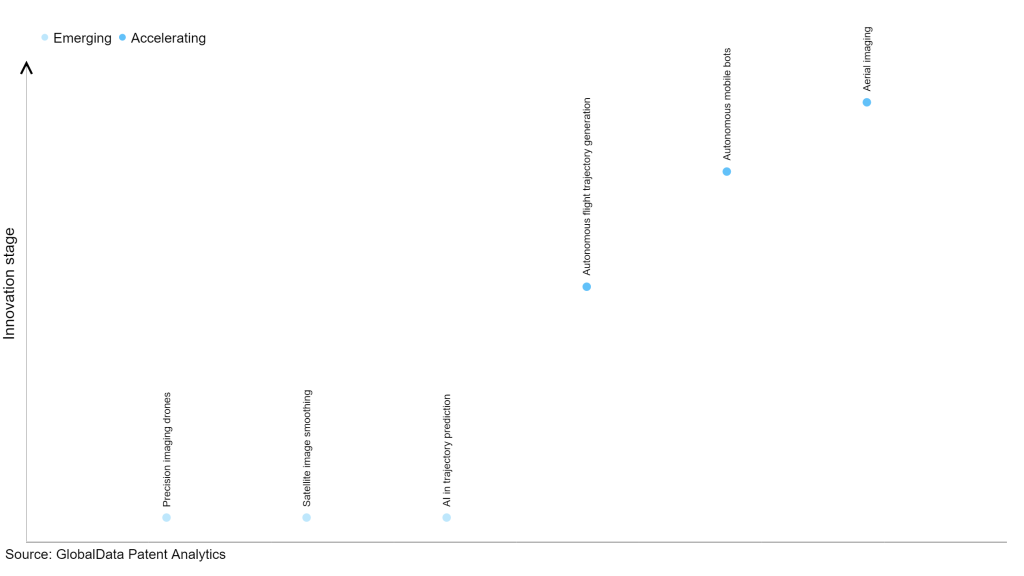
Within the emerging innovation stage, precision imaging drones, satellite image smoothing and AI in trajectory prediction are disruptive technologies that are in the early stages of application and should be tracked closely. Autonomous flight trajectory generation, autonomous mobile bots and aerial imaging are some of the accelerating innovation areas, where adoption has been steadily.
Innovation S-curve for artificial intelligence in the aerospace and defense industry
3D position detection is a key innovation area in artificial intelligence
3D position detection refers to the process of using various sensors, including cameras, light detection and range (LiDAR) systems, and structured light depth systems, to detect an object's position in three-dimensional space. This technology is commonly used in autonomous vehicles for navigation and obstacle avoidance.
GlobalData’s analysis also uncovers the companies at the forefront of each innovation area and assesses the potential reach and impact of their patenting activity across different applications and geographies. According to GlobalData, there are 410+ companies, spanning technology vendors, established aerospace and defense companies, and up-and-coming start-ups engaged in the development and application of 3D position detection.
Key players in 3D position detection – a disruptive innovation in the aerospace and defense industry
‘Application diversity’ measures the number of applications identified for each patent. It broadly splits companies into either ‘niche’ or ‘diversified’ innovators.
‘Geographic reach’ refers to the number of countries each patent is registered in. It reflects the breadth of geographic application intended, ranging from ‘global’ to ‘local’.
[datawrapper id=vD1Px title='Patent volumes related to 3D position detection' type='lgp1']Baidu is one of the leading patent filers in 3D position detection. The Chinese tech giant filed several patents related to methods and systems of LiDAR localization, 3D point clouds registration, and high-definition map generation for autonomous vehicles, using convolutional neural network (CNN) and conditional random field (CRF) models. Some other key patent filers in this space include Faro Technologies, Sony Group, and Alphabet.
In terms of application diversity, Baidu, NVIDIA and Aptiv are some of the leading innovators. By means of geographic reach, some of the leading patent filers include Tom Tom, Halliburton, and Konecranes.
Although most of the patents filed in AI-based 3D position detection and estimation are targeted for commercial applications, the technology, for its superior capability, is expected to witness rapid deployment in unmanned ground and aerial vehicle (UGV/UAV) operations in the defense sector.
To further understand the key themes and technologies disrupting the aerospace and defense industry, access GlobalData’s latest thematic research report on Artificial Intelligence (AI) in Defense.