

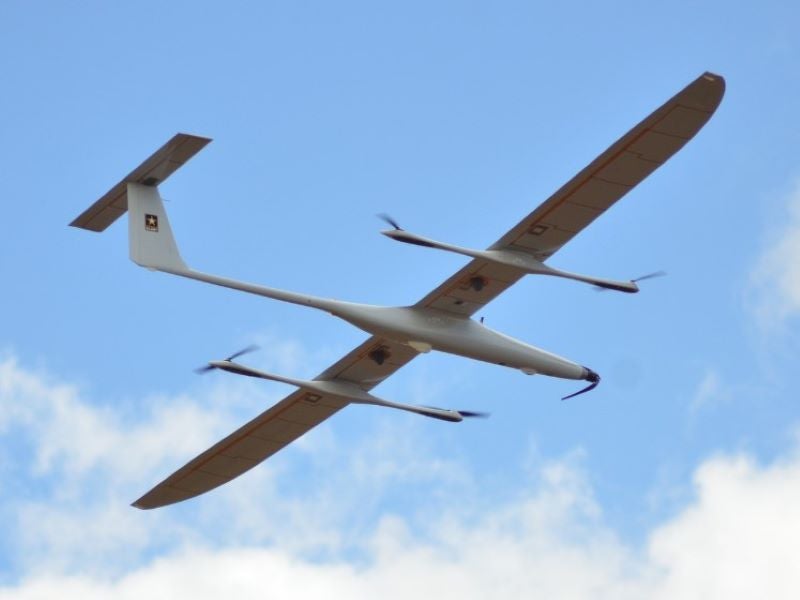
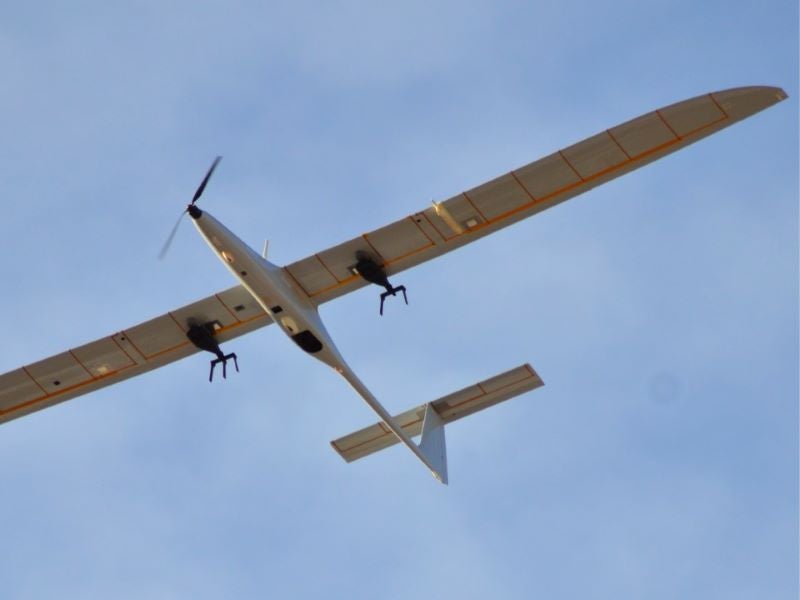
The K1000ULE is an ultra-long endurance, long-range unmanned aerial system (UAS) produced by Kraus Hamdani Aerospace.
The aircraft operates with a low acoustic, visual and radar signature and is designed to reduce the likelihood of detection.
Recommended Buyers Guides

It is positioned for sustained missions over wide, remote or disconnected areas, with limited dependence on ground infrastructure and a smaller support team of up to three people in comparison to what conventional platforms typically require.
The K1000ULE has been integrated into the US Army’s Next Generation Command and Control environment through Anduril’s Lattice platform. It has also been included in the US Department of Defense (DoD), also known as the Department of War’s, Drone Dominance UAS marketplace, increasing access for US forces and partner nations.
In September 2025, the UAS was added to the US DoD’s Innovation Unit Blue UAS Cleared List and Blue UAS Select List.
K1000ULE design and features
The K1000ULE UAS measures 3m (9.8ft) in length with a 5m wingspan and a maximum take-off weight of 19.3kg (42.5lb).
The UAS supports terrain-following using Shuttle Radar Topography Mission data produced by Nasa and can fly in automatic, follow-me and guided modes. It is designed to launch and recover without requiring a runway and is deployable in less than 15 minutes.
The operator interface is intended to control one or more aircraft as part of a networked group, supporting route assignment, communications relay tasks and autonomous teaming functions through a moving-map display and point-and-click mission planning tools.
Propulsion and performance
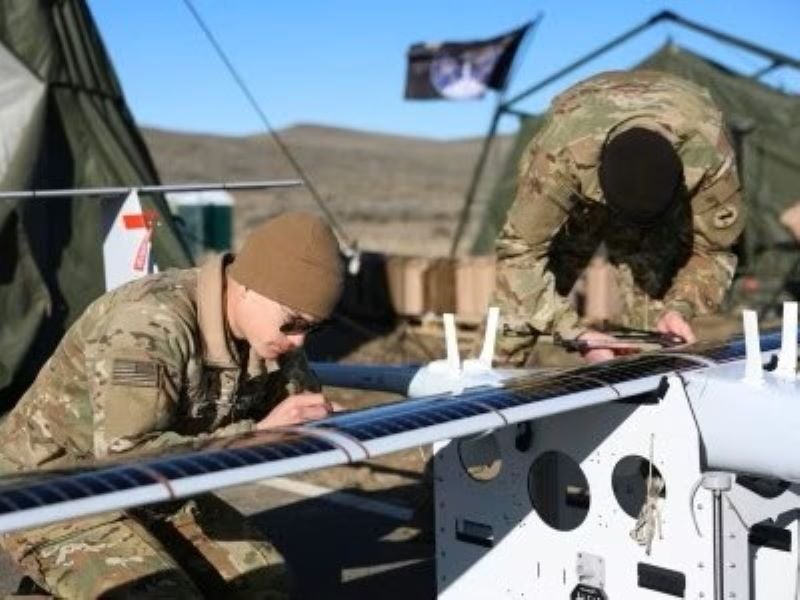
The K1000ULE is electric powered, using lithium-ion batteries augmented by photovoltaic cells and a brushless motor driving a folding propeller with inertial deployment.
The platform can maintain flight for up to 24 hours with a service ceiling of 20,000ft above mean sea level (MSL) and cruise speeds ranging from 30 to 40 knots. It has a maximum range of up to 1,610km.
Navigation
Navigation is provided through a combined Global Navigation Satellite System and inertial system with redundancy designed in.
It supports BeiDou, Galileo, GLONASS, GPS, the Quasi-Zenith Satellite System and the Satellite-Based Augmentation System, alongside anti-jamming and anti-spoofing features intended for contested or degraded conditions.
Communications suite
The UAS is equipped with a National Security Agency (NSA)-certified communications suite. Onboard resilience is supported by duplicated sensors including three accelerometers, three gyroscopes, two compasses and three barometers, with autonomous operation intended for command and control in contested conditions.
The platform also features Aerial Tier Network Extension ++ (ATNE++) capability that functions as an airborne communications node for a mesh-enabled, multi-waveform, self-healing network intended to sustain voice and data links in degraded environments.
The architecture can connect older and newer tactical data links and radio waveforms, with encryption options aligned to NSA Type 1, Type 2 and Type 3 standards, and is aimed at supporting next-generation command and control concepts, including Joint All-Domain Command and Control 2.
The platform is offered with Multi-Domain Autonomous Collaborative Teaming software to provide a shared mission layer across land, maritime and air domains, using AI-enabled swarm coordination to automate selected tasks and reduce crew workload.
K1000ULE payload options
K1000ULE payload options include an electro-optical sensor providing 1080-pixel video with an adjustable field of view from 60° to 0.5° and up to 40x total zoom. The infrared sensor is listed at 1280 × 720 resolution with a field of view from 18.2° to 4.6°, operating at 30Hz or 9Hz for export variants.
For signals intelligence and electronic warfare configurations, the system supports phased-array antennas, while a moving target indicator function is intended to track multiple objects.
Connectivity options include wireless links, 4G LTE and 5G services, mobile ad hoc networking and IP-based services. It can also act as a radio bridge, with integration options cited for systems from Harris, Iridium, Kratos SCISR, Persistent Systems, Silvus and TrellisWare satellite communications.
For special operations configurations, payload options include Spectral Sieve from CACI LGS, LAN Shark from SR Technologies, a G3T payload from G3 Technologies, SnakeEagle from Motorola and ICS from QRC Technologies.
The UAS can carry two payloads concurrently, with a maximum payload mass of 2.49kg supported by 50W of continuous power and up to 1,000W in short bursts.
Ground base equipment
The ground package mission kit includes two air vehicles and a ground control station, supplied in hard-shell Pelican cases and using wearable Android tablets for control.
It includes a data switch, a ground radio such as the Silvus 4200 or an alternative specified for operational needs, a man-portable tracker and a 50W EIRP amplifier, with backpacks and vests provided for carriage.
Wireless power capability trials
In January 2026, Kraus Hamdani Aerospace announced it was working with PowerLight Technologies to integrate a laser-based wireless power capability with the K1000ULE.
The concept is intended to deliver energy to an aircraft in flight, allowing suitably equipped drones to recharge without landing. Early activity indicated the system could maintain accurate tracking and deliver kilowatt-level power via an optical link over longer distances.
This work formed part of the Power Transmitted Over Laser to UAS effort, with US Central Command observing progress as the DoD assessed whether the approach could extend endurance for future operations.
Development tests
Kraus Hamdani Aerospace has been conducting long-endurance electric UAS trials at the Pendleton UAS Range to validate cross-country profiles relevant to distributed missions.
During testing in January 2026, a K1000ULE completed a planned launch and recovery at different locations, using relay-extended communications and an in-flight transfer of control in support of the US Army’s 1st Multi-Domain Task Force.
The event demonstrated a move towards point-to-point electric operations while maintaining connectivity in scenarios where interruptions are unacceptable.
Orders and deliveries
In April 2024, US Navy PMA 263 selected the K1000ULE for deployment under the US Marine Corps Small Unit Remote Scouting System.
In October 2024, the company received a US DoD APFIT award worth $20m linked to ultra-long endurance UAS work, covering production and delivery to US Army Pacific, the 1st Multi-Domain Task Force and Joint Special Operations Command.
In April 2026, Kraus Hamdani Aerospace received a sole-source indefinite delivery, indefinite quantity contract valued at $270m from the US Air Forces Central to support deployment of the K1000ULE.
