

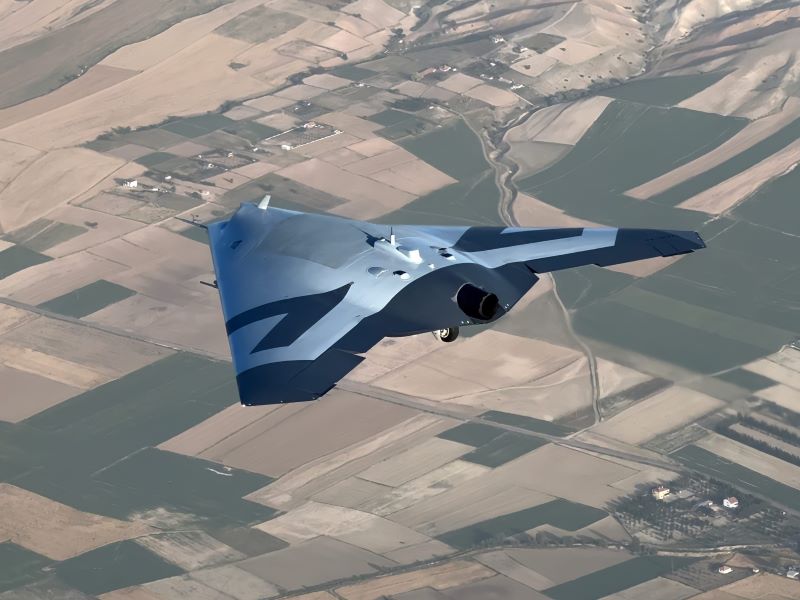
ANKA III is an unmanned combat aerial vehicle (UCAV) developed by Turkish Aerospace Industries (TUSAŞ), a subsidiary of the Turkish Armed Forces Foundation and Türkiye’s Defence Industry Agency.
Intended for intelligence, surveillance and reconnaissance (ISR) and strike missions, the UCAV is designed to improve survivability in contested environments by reducing its radar signature using internal weapon bays.
Recommended White Papers

Recommended Buyers Guides

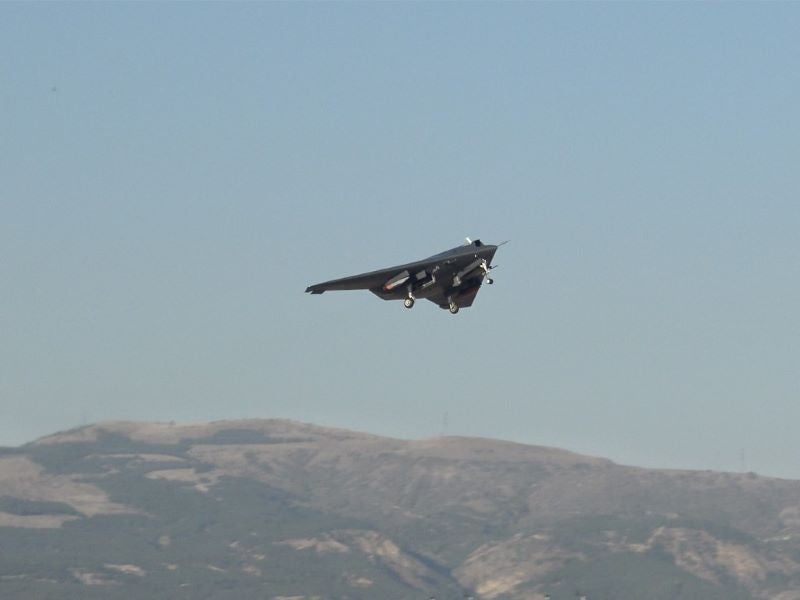
The ANKA III platform is currently undergoing intensive flight testing, leveraging AI-enabled modelling and simulation alongside advanced flight control technologies. In December 2025, the UCAV completed critical autopilot tests.
A second prototype of the ANKA III platform has also entered flight testing.
ANKA III UCAV development background
The development process for the ANKA III UCAV commenced in February 2022, and the system requirements were confirmed in March of that year. The Preliminary Design Review was undertaken in April 2022, and the aircraft’s external geometry was finalised.
The Critical Design Review phase began in October 2022, and the first fully detailed production parts were manufactured in November 2022.
Software requirements for the modified systems were subsequently defined, enabling the release of the initial flight control, airborne and ground software versions for ANKA III during the same month.
Structural assembly was completed in January, and equipment installation was concluded in February. ANKA III was powered on for the first time in March 2023. Taxi trials followed in April, when the aircraft conducted its first runway runs.
ANKA III conducted its maiden flight in December 2023. During the initial flight, it operated autonomously for more than an hour while onboard systems were assessed, before performing an automatic landing.
ANKA III design and features
ANKA III measures 7.9m in length, with a wingspan of 12.5m and a height of 2.5m. It has a maximum take-off weight of 6,500kg and can carry a payload of up to 1,200kg.
The UCAV is designed around a common avionics architecture and ground control segment shared with the ANKA and AKSUNGUR platforms.
ANKA III’s stability and flight control are provided by its wings and wing-mounted ailerons, together with a V-tail configuration and dual-function control surfaces (ruddervators).
The UCAV is designed with low radar observability and is built to operate at high subsonic speeds with a high payload capacity. It can also carry synthetic aperture radar with ground moving target indication, as well as inverse synthetic aperture radar functionality.
Additional design elements that help to lower radar detectability include the lack of vertical tail surfaces and sharp edges, the placement of the engine intake on the upper fuselage, a curved intake profile and lesser angular features across the airframe. Furthermore, cavities and external projections at joints between aircraft structures have been eliminated.
The UCAV includes two internal and five external payload stations, alongside internal and external fuel tanks.
ANKA III payload
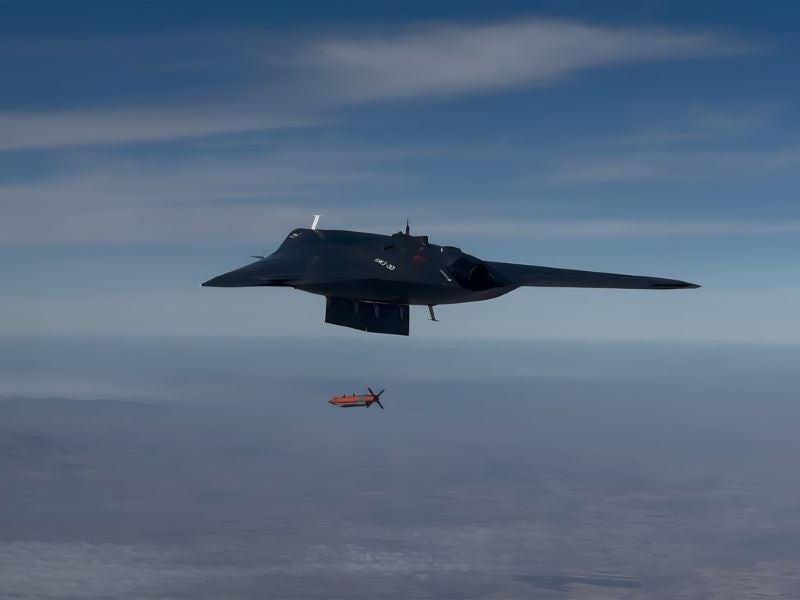
ANKA III can carry weapons on several stations, including up to 650kg in each of its two internal bays, 650kg on each inner wing pylon and 100kg on each outer wing pylon.
The platform can be configured to employ precision-guided munitions including laser-guided rockets and anti-tank missiles.
For electronic warfare roles, the aircraft can be fitted with signals intelligence payloads that support communications intelligence, electronic intelligence and electronic support measures.
ANKA III can also integrate satellite communications and radio relay equipment.
Additional onboard systems include an automatic identification system, personnel and emergency locator equipment, a remote video terminal and a traffic collision avoidance system.
Propulsion and performance
The UCAV is powered by a turbofan engine and is designed to operate at up to 40,000ft, and can remain airborne for up to ten hours when flying at 30,000ft. At that altitude, it can reach speeds of up to 425 knots, equivalent to Mach 0.7.
ANKA III has a cruising speed of approximately 250 knots, roughly Mach 0.42.
ANKA III testing details
Under an accelerated test schedule, the ANKA III development programme moved into live weapons trials in October 2024. On its 12 sorties, ANKA III engaged a designated target using the TEBER-82 guidance kit and achieved an accurate strike.
In January 2025, the aircraft successfully released the TOLUN munition developed by ASELSAN from an internal weapons bay, a first in Türkiye for a domestically produced and developed aircraft. The event was conducted at 20,000ft and 180 knots, with the munition striking the planned target with millimetre-level precision.
In March 2025, ANKA III launched from Mürted Air Base and arrived at the Acıkır Test Range while a separate ANKA unmanned aircraft provided target designation.
Flying in its tailless delta configuration, the UCAV released ASELSAN’s LGK-82 laser-guided munition from 10km and completed the engagement. During the sortie, it operated at 25,000ft and 200 knots, demonstrating its ability to employ weapons in the 280kg class.
Mission capabilities
The ANKA III can be deployed for various operational roles including precision strikes against ground targets, long-range strategic attack, suppression of enemy air defence systems, aerial interception tasks, and maritime and naval support operations.
The UCAV can perform close air support for ground forces, electronic warfare operations including communications jamming, force protection and escort duties, and Manned-unmanned Teaming. It is also capable of AI-assisted swarm operations.
