

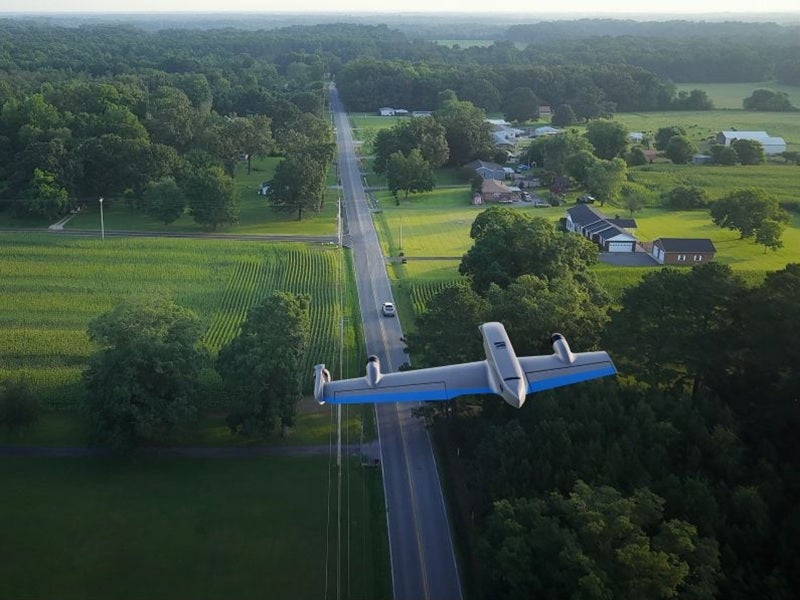
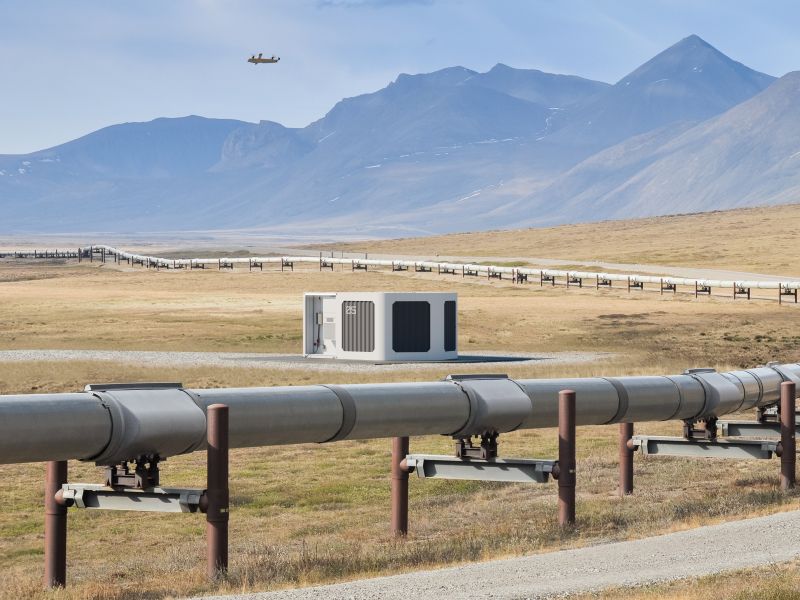
The F10 Lightrunner is an uncrewed, dock-based fixed-wing aircraft developed by Skydio for emergency response, search and rescue, and asset inspection.
The aircraft is intended to launch within seconds, providing commanders with a live aerial view while ground teams remain en route.
Recommended Buyers Guides

Skydio unveiled the platform in September 2026. It is the company’s first fixed-wing aircraft and is scheduled for customer deployment in 2027.
F10 Lightrunner design and features
The F10 Lightrunner measures 57.8in × 33.9in × 7.7in (146.8cm × 86.1cm × 19.6cm) and has an operational weight of 15.43lb (7kg), including batteries. When anchored in its dock, the airframe can withstand winds up to Category 2 hurricane strength.
The platform’s processing architecture combines an NVIDIA Jetson Orin system-on-chip (SoC) with a Qualcomm Snapdragon 865 SoC.
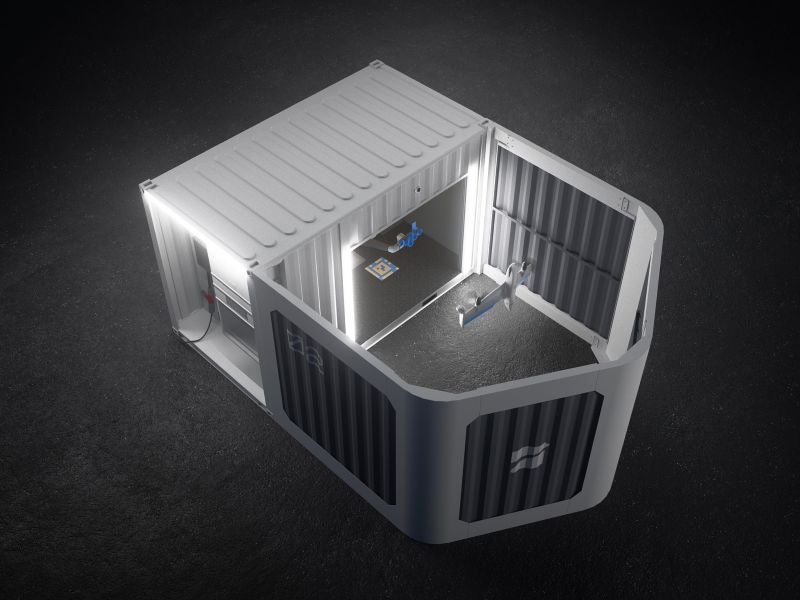
The aircraft uses an autonomous robotic take-off and landing (RTOL) system with a suction-based robotic gripper for deployment and recovery without manual handling. The platform is launched from its MegaDock ground installation, which can hold up to five F10 airframes, supporting concurrent deployments.
The airframe incorporates an offset sensor layout known as SideEye. This configuration positions the sensor array outside the rotors’ rotational plane, reducing the likelihood that the wing structure will obstruct the field of view during manoeuvres.
Performance of the F10 Lightrunner
The F10 Lightrunner has a maximum horizontal speed of 100mph (160.9km/h) at sea level, based on the lower of ground speed and airspeed. It can bank up to 60° during normal navigation and 65° during obstacle-avoidance manoeuvres.
The aircraft can operate in launch and recovery winds of up to 27mph (43.5km/h) and has a maximum service ceiling of 11,000ft (3,352m) density altitude. It has a maximum flight time of 120 minutes.
The platform is certified to the IP55 ingress-protection standard and operates across a temperature range of -20°C to 55°C, measured at the MegaDock station. It includes daytime True 360° obstacle avoidance for autonomous flight operations.
Charging the battery from 10% to 90% takes 45 minutes. The propellers have a service life of 1,000 hours.
F10 Lightrunner sensor package
The F10 Lightrunner aircraft optical payloads comprise a telephoto camera, a narrow camera and a thermal camera.
The telephoto assembly includes a 0.5in 48MP complementary metal-oxide semiconductor (CMOS) sensor and a 35mm (190mm equivalent) focal-length lens with an f/2.8 aperture and provides a 13° diagonal field of view.
The telephoto module uses hybrid phase detection autofocus (PDAF) from 5m to infinity. Its electronic shutter operates from 1/30 to 1/8000 seconds, with an ISO range of 100 to 16,000 and exposure compensation of +/- 3. The module captures video at a 3,840 × 2,880 resolution and still images at 8,000 × 6,000 pixels.
The narrow camera uses a 1/1.7in 64MP CMOS sensor with a 50° diagonal field of view. It has a 10mm (46 mm equivalent) focal-length lens with an f/1.8 aperture. The camera has the same shutter range, exposure compensation, video resolution, and ISO range as the telephoto module, while its hybrid PDAF operates from 1m to infinity. Still-image resolution reaches 9,248 × 6,944 pixels.
The aircraft thermal camera uses a Flir Boson+ uncooled vanadium oxide (VOx) microbolometer. It has a 24° diagonal field of view, an 18mm focal-length lens, and an f/1.0 aperture. The camera focuses from 5m to infinity and has thermal sensitivity of <30mK noise equivalent differential temperature (NEDT), with a 12um pixel pitch.
Thermal telemetry provides spot-meter and area-measurement modes across a temperature range of -40°C to 150°C (-40°C to 350°C low gain). Radiometric accuracy is the larger of +/- 5°C or 5%.
An Adreno 650 graphics processing unit (GPU) and image signal processor (ISP) support onboard thermal image processing. The system exports 640 × 512 video resolution and still images in JPEG and radiometric RJPEG formats, with white hot, black hot, iron red, and rainbow display palettes.
Visual and navigation systems
The F10 Lightrunner has six navigation cameras in binocular configurations across the front, top, and bottom of the aircraft. Each camera uses a 1/1.95in 50MP CMOS sensor sensitive to visible and infrared (IR) light, with an aperture of f/1.8. The forward cameras have a 100° diagonal field of view while the top and bottom cameras provide 200° coverage.
Obstacle detection extends to 328ft 1in/100m in front of the aircraft and 65ft 7.4in/20m above and below.
Launch and recovery systems
The platform supports autonomous launch and landing in high winds, daytime and night-time operations, and flights in moderate rain. It includes Connect Fusion+, which combines multiple cellular connections for command, control, and live-video transmission over longer-range missions.
Skydio’s Pathfinder suite plans point-to-point routes before launch, considering terrain, structures, agency boundaries, geofences, and airspace restrictions. Foresight, part of Skydio Autonomy, uses aircraft-state, environmental, and obstacle data to adjust the flight path during a mission.
The Skydio Airspace Assurance System (SAAS) combines real-time airspace data, an organisation’s policy settings, and onboard perception. It can manoeuvre the aircraft away from nearby crewed aircraft when required.
The F10 Lightrunner has an integrated parachute that can deploy from a minimum altitude of 150ft (45m) above ground level (AGL) at speeds of up to 160.9km/h. Two nitrogen cartridges support automatic deployment following a flight failure. Operators can also deploy the parachute manually through the controller, Ops Center, or Skydio’s Drone as First Responder (DFR) Command.
The parachute is eligible for Part 107 Category 3 during forward flight but does not meet Part 107 Category 3 requirements while the aircraft is hovering.
F10 Lightrunner system security
The F10 Lightrunner uses Connect SL wireless communications with AES-256 encryption, while Connect 5G uses AES-128 encryption.
Connect SL uses the 2,400MHz -2,483.5MHz and 5,150MHz -5,850MHz spectrum bands for launch and recovery operations. WiFi6 supports media offloading while Connect 5G provides command and telemetry connectivity where commercial cellular coverage is available.
The aircraft complies with the National Defense Authorization Act (NDAA) and includes a hardware security module (HSM), installed during manufacturing, as its root of trust.
Secure boot protects system integrity. Updates are AES-256 encrypted, signed, and verified before installation. Internal disk storage is encrypted while SD cards are not encrypted.
