
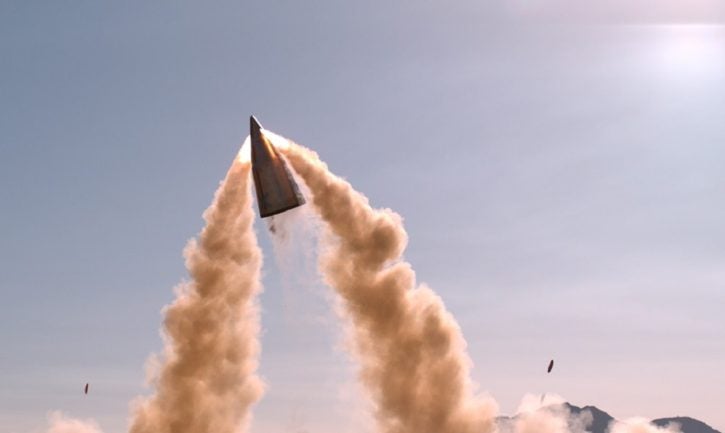
Northrop Grumman Corporation has announced a leap forward in advancing the Sentinel intercontinental ballistic missile (ICBM) programme, following the successful completion of key tests at its strategic missile test and production complex in Promontory, Utah.



The tests, focusing on the forward and aft sections of the Sentinel missile, have provided insights into the missile’s inflight structural dynamics, thereby mitigating risks and enhancing the programme’s overall engineering and manufacturing processes.
According to GlobalData’s “The Global Missiles & Missile Defense Systems Market 2023-2033” report, the third leading supplier in the North American region will be Northrop Grumman Corp., which is set to hold a 19.7% share over 2023–33. The US Air Force’s Ground Based Strategic Deterrent (GBSD) ICBM programme development phase is expected to take eight years, and the entire GBSD programme is anticipated to be worth $60bn over the next two decades.
Sarah Willoughby, vice president and programme manager of Sentinel at Northrop Grumman, underscored the significance of these tests in refining the missile’s design and reducing operational risks. “Our collaboration with the Air Force and our network of suppliers has enabled us to subject crucial elements of the missile’s hardware to rigorous testing,” remarked Willoughby. “The successful outcomes of the shroud fly-off and missile modal tests validate our modelling predictions and validate assumptions, instilling confidence as we progress towards delivering a robust capability to safeguard our nation’s security.”
The US Air Force’s (USAF) Sentinel programmatic agreement aims to replace approximately 400 ageing Minuteman III intercontinental ballistic missiles (ICBMs) across various USAF missile fields.
The programme represents a modernisation initiative to enhance the nation’s ground-based strategic deterrent capabilities, with plans for its longevity through 2075. Spearheaded by Northrop Grumman, the programme’s engineering, manufacturing, and development (EMD) contract encompasses the design and development of technologies crucial for bolstering America’s strategic defence posture.
In addition, Northrop Grumman’s nationwide team has undertaken advancements under the EMD contract, including stage-two and stage-one solid rocket motor static fire tests and hypersonic wind tunnel testing.
This development comes as North Korea continues its testing spree, firing suspected ICBMs. Meanwhile, North Korea is reportedly planning to develop a new ICBM system to bolster its nuclear force in response to perceived threats from the US and other hostile forces. These developments come amid escalating tensions between North and South Korea.



