

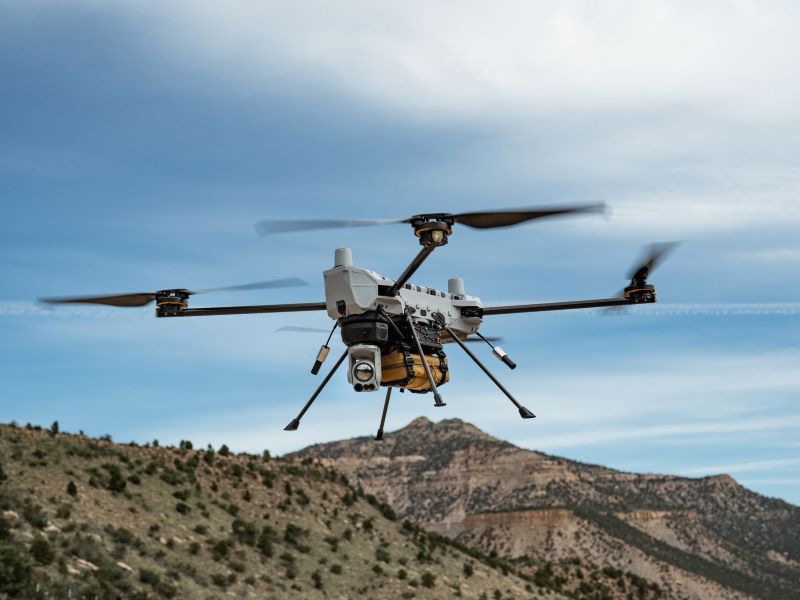
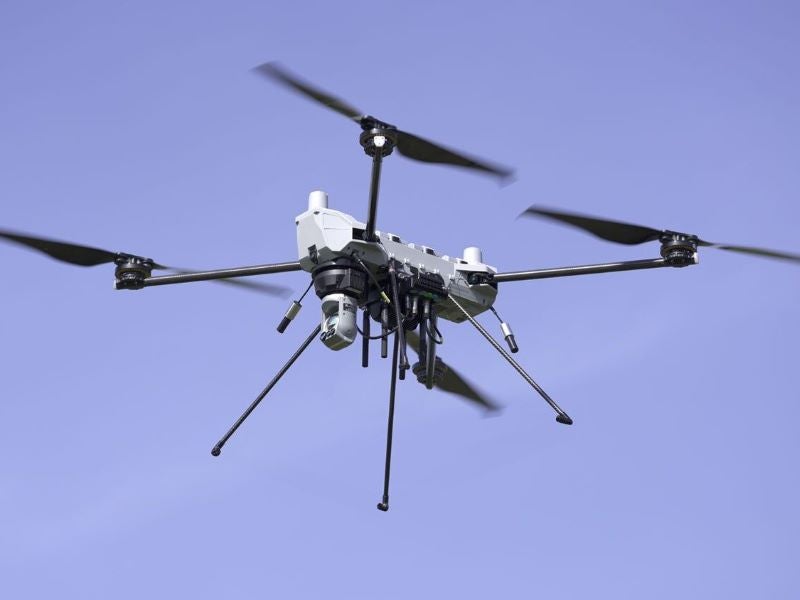
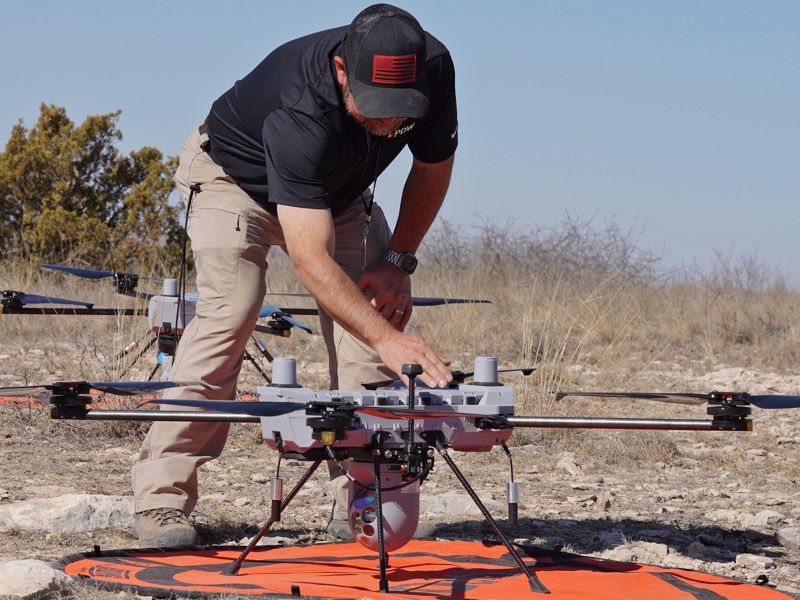
The C100 is a portable, packable, small unmanned aerial system (sUAS) developed by the US-based defence technology company Performance Drone Works (PDW).
The heavy-lift quadcopter is designed for long-range intelligence, surveillance and reconnaissance (ISR) missions, as well as cargo transport, supported by swappable payloads, an open architecture, and autonomous, hands-free functions.
Recommended Buyers Guides

In December 2023, the C100 was approved under the Defense Innovation Unit Blue UAS programme, a US Department of Defense initiative intended to speed up the assessment and adoption of commercial uncrewed aircraft technology.
C100 sUAS design and features
The C100 heavy-lift quadcopter measures 24in × 15in × 8in (0.6m × 0.3m × 0.2m) when folded and 64in × 65in × 11in when deployed.
The system weighs 21.4lb (9.7kg) and supports a maximum payload mass of up to 10lb. It has an acoustic signature of 61 decibels at 5m and is inaudible at 600m.
The ruggedised IP54 airframe folds for carriage in a warfighter’s rucksack. The airframe is designed around universal payload integration and can accommodate electro-optical/infrared (EO/IR), thermal and bespoke payloads, as well as other mission-specific options.
Autonomous capabilities include frontal collision avoidance and Global Navigation Satellite System position hold. For night operations, it offers a zero-light emission mode alongside infrared LEDs and strobe lights.
Incorporating Blue UAS-approved avionics, the platform integrates edge computing with autonomy features intended to reduce operator workload. The compute core is based on Modal Ai’s VOXL 1 Qualcomm 812, with an optional Nvidia Xavier NX.
Configured for different mission sets, the C100 is capable of supporting ISR, cross-domain fires, kinetic operations, electronic warfare (EW) and extended communications.
Performance of C100 heavy-lift quadcopter
The C100 is powered by four long-endurance lithium‑ion batteries, delivering around 211W-hours of energy. Alternative battery configurations are also available, allowing operators to trade off overall weight, payload capability and time aloft.
The system is listed with a 74-minute endurance when carrying an ISR payload with a stated range of more than 10km (6.2 miles), which can increase to 20km with a range extension kit.
The sUAS has a cruise speed of 40.3mph (64.8km/h), with base mode at 22.4mph and safe mode at 4.9mph, and a maximum speed of 40mph.
The maximum operational altitude is 12,000ft mean sea level (MSL) and the operating temperature range is -20˚C – 57˚C (-4˚F – 134.6˚F).
C100 sUAS payload options
The C100 sUAS can carry a wide range of payload including the Trillium HD40-LVV multi-sensor suite, which combines dual visible cameras providing 180x zoom with high definition long-wave infrared and an optional laser pointer.
PVP is a vision-based navigation capability payload, intended to complete objectives autonomously in GPS-denied environments. The StreamCaster payload provides a beyond line-of-sight (BVLOS) communications option for video, voice and data.
Other listed payloads include FireBeast, which locates, classifies and determines the bearing of hostile signals deemed relevant; Stag5 LLD, a modular high-resolution system incorporating a laser target designator (LTD) to improve night-time ISR; and AM, a deployable capability launched from the C100 for extended-range ISR, kinetic and communications missions.
Additional camera payloads include X80, Raptor LP and DragonEye2, each described as EO/IR stabilised solutions for long-range ISR.
Also included is the MRD, which is PDW’s universal payload integration approach, intended to expand payload flexibility across the C100.
Multi-mission payload details
In October 2025, PDW updated its C100 sUAS to support a new range of multi-mission payloads (MMP), which can be integrated into new or existing C100 systems.
The MMP package combines in-house software changes with partner hardware integrations, covering communications relay and mobile ad hoc network (MANET) extension, assured positioning, navigation and timing, and Spectrum Awareness. The payload options include the CACI Mastodon FireBeast, the Silvus StreamCaster MANET communications relay and PDW A-PNT Vision-Based Navigation.
For spectrum awareness, Mastodon FireBeast is a multi-channel transceiver designed for detecting signals and performing direction-finding against adversary signals of interest, supporting situational awareness, threat mitigation and operational adaptability.
MANET connectivity features StreamCaster, a single-radio system that links multiple assets into a self-forming mesh network to support BVLOS relay and extend MANET coverage across a formation, improving range, bandwidth for ISR missions and resilience under contested conditions.
The A-PNT provides a software-agnostic sense-and-compute module paired with a visual-based navigation software solution, enabling the C100 to begin and complete missions using visual cues when GPS is jammed, spoofed or unavailable.
Demonstrations and live-fire tests on C100
In 2025, PDW initiated its Iron Lance campaign in partnership with the Department of War and UK allies, delivering a series of laser designator and launched effects demonstrations in the US and the UK. As a joint organic cross-domain fires effort, Iron Lance used PDW’s C100 sUAS fitted with dedicated laser target designator payloads to support land, air and sea precision strike.
Across four demonstrations, the C100 delivered operational endurance, accurate lasing and integration with US and allied fires platforms. It recorded more than 35 minutes of LTD-equipped flight time in difficult winds and maintained stable performance under operational pressures, with user feedback feeding into iterative updates.
PDW also showcased the C100 quadcopter to the UK Ministry of Defence, fitted with Leonardo DRS’s STAG™ 5 LTD. At a live-fire trial at the 9 Mile Testing Centre in Texas, the C100 was able to track and lase targets for ground-fired APKWS rockets, supporting accurate strikes within the designated impact zone. The sUAS also carried out a longer-range sortie using the NextVision DragonEye2 EO/IR sensor, retaining command link and full-motion video beyond 8.5km, highlighting the system’s range and robustness.
Across the event, the C100 operated with both laser-designator and standard payload configurations, demonstrating its suitability for multiple mission sets and straightforward integration of different payloads.
Orders and deliveries
In October 2025, PDW secured its first US Air Force contract for the C100 sUAS, issued by the 93rd Air Ground Operations Wing, based at Moody Air Force Base in Georgia, which oversees four subordinate units supporting a range of air force tasks across multiple operational areas. The contract award follows PDW’s previous contracts from the US Army for the Medium Range Reconnaissance programme and the Transformation in Contact initiative.
