


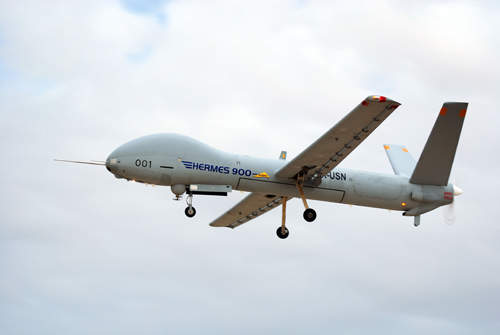
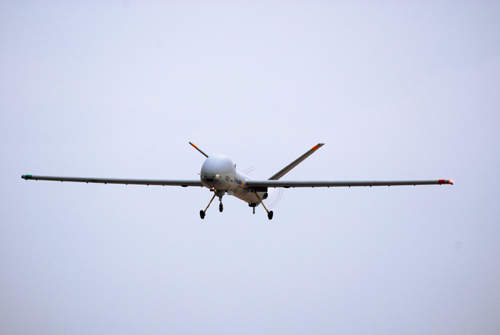
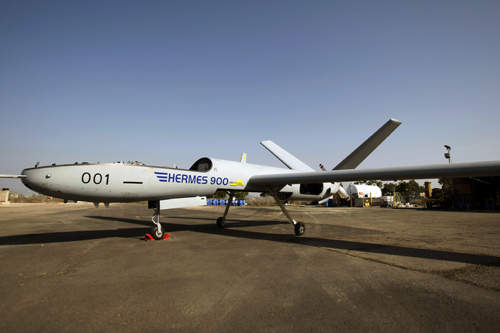
Hermes 900 is a tactical medium-altitude, long-endurance unmanned air vehicle (UAV) system principally designed to allow the Israeli Defence Forces (IDF) to perform intelligence, surveillance, target acquisition and reconnaissance (ISTAR) operations.
Derived from the Hermes 450 UAV, Hermes 900 is primarily used to capture real-time imagery of the battlefield and transmit it to a universal ground control station (UGCS).
Recommended Buyers Guides

The Hermes 900 UAV is manufactured by Elbit Systems. The maiden flight of the UAV was undertaken on 14 December 2009.
Adani Aero Defence Systems, a subsidiary of Indian firm Adani Enterprises, signed a statement of intent with Alpha Design Technologies and Elbit Systems’ ISTAR division in March 2016 to explore opportunities in the UAS space.
It established the Adani Elbit Unmanned Aerial Vehicles Complex in Hyderabad, Telangana, India, in collaboration with Alpha Design Technologies and Elbit Systems. Inaugurated in December 2018, the 50,000ft² (4,645.15m²) state-of-the-art facility was the first Hermes 900 UAV manufacturing facility outside Israel.
Variants of Hermes UAV series
Hermes 1500, Hermes 450, and Hermes 180 are three variants of the Hermes UAV series. Manufactured by Elbit Systems, the Hermes 1500 is a highly reliable twin-engine UAV equipped with a range of payloads.
Hermes 1500 differs from Hermes 900 in maximum take-off weight, endurance, and payload weight. For the Hermes 1500 UAV, these are 1,750kg and 400kg respectively. Development of the Hermes 1500 was halted after problems with exports caused by the missile technology control regime that restricts the sale of some missiles and unmanned aircraft.
The Hermes 450 UAV is the Israeli Defence Force’s primary UAV. The design and features of the Hermes 450 variant, are the same as those of the Hermes 900 UAV. Hermes 450 has completed more than 300,000 flight hours. The variant was selected as the baseline for the UK Watchkeeper.
The Hermes 450B is an all-weather, ruggedised structure UAV. It is an advanced version of the Hermes 450 UAV.
The Hermes 180 UAV is the third variant. It is a small-range UAV used for ISTAR missions. The Hermes 180 variant differs from the Hermes 900 in take-off and payload weights, endurance, maximum speed, and engine. The variant is powered by a 38hp rotary UEL engine.
The maximum take-off and payload weights of the Hermes 180 are 195kg and 32kg respectively, while the maximum speed and endurance are 105km/h and 10 hours.
Design and features of Hermes 900 MALE tactical UAV
The Hermes 900 UAV was designed to provide maximum endurance while increasing flight economy and reducing fuel consumption during flight transition phases. Integral satellite communication terminal operations beyond the line of sight can be carried out by the nose fitted to the aircraft.
The UAV has a length of 8.3m, a wingspan of 15m, and a payload carrying capacity of 350kg. It features a 2.5m-long internal payload bay and external wing hardpoints, supporting customisations to meet the different requirements of the users.
The Hermes 900 UAV is configured for multiple operations, even under adverse weather conditions. Its features include state-of-the-art avionics, retractable landing gear and internal automatic take-off and landing systems (IATOL).
The UAV also has composite structures and built-in growth potential. It is also equipped with modern avionics such as an air traffic control (ATC) radio, radio relay, and an identification friend or foe (IFF) transponder.
Navigation and control of Hermes 900 UAS
The Hermes 900 UAV can be controlled manually from the ground control station or through autonomous mode. It is fully equipped with an automatic launch and recovery (ALR) system, which helps in automatic safe landing during communication failure with the GCS.
Sensors and communications
The Hermes 900 UAV has electro optical (EO) and infra-red (IR) sensors, thermal surveillance equipment, laser designator and electronic intelligence sensors (ELINT and COMINT). It uses multiple sensors and satellite communication (SATCOM) for extended-range data capture and transfer.
The EO sensor converts light rays into electronic signals for capturing images, real-time data and videos. The laser designator is used by Hermes 900 UAV for targeting enemy battlefields.
Thermal surveillance equipment is used to capture high-resolution images at night, even in environments with clouds, rain, smoke, fog, and smog.
The Hermes 900 UAV is equipped with synthetic aperture radar (SAR), a ground moving target indicator (GMTI), electronic warfare (EW), signal intelligence (SIGINT) and communication intelligence (COMINT).
Engine and performance of Hermes 900
The Hermes 900 UAV is powered by a single Rotax 914 turbo aircraft engine. Manufactured by Austria’s leading aircraft engine supplier, BRP-Rotax, the engine can produce 74.6kW of output power.
The Hermes 900 UAV can fly at a maximum altitude of 33,000ft. The maximum and cruise speeds of the aircraft are 222km/h and 103km/h respectively. The maximum endurance of the UAV is about 40 hours, and the maximum take-off weight of the UAV is 1,180kg.
The advanced UAV system offers fully automated take-off and landing even under adverse weather conditions. Flying at an altitude of 33,000ft, Hermes 900 provides operators with real-time information on battlefields by performing surveillance and target acquisition over a large area.
Universal ground control station
Processing, retrieving, and storing real-time data provided by the Hermes 900 UAV are undertaken by the UGCS. The UGCS, manufactured by Elbit Systems, can control two UAVs at a time.
A single operator can control the air vehicle and its payload. The air vehicle and UGCS can communicate through secure, redundant line-of-sight data-link or beyond line-of-sight satellite communications, enabling state-of-art mission managing, automated taxiing, independent flight and automatic take-off and landing systems common to all Hermes UAVs.
The UGCS system includes a ground data terminal, a remote video terminal and a flight line tester/loader.
Commercial-off-the-shelf (COTS) technology is used for converting sensor data such as live and stored images, imagery and spatial information including EO, SAR, moving target indicator (MTI) maps, SIGINT, and electronic support measures (ESM) into actionable intelligence.
Hermes 900 MALE UAV orders and deliveries
In May 2010, Elbit Systems was awarded a $50m contract by the IDF to build and supply Hermes 900 systems by 2013. The contract also included the supply of additional Hermes 450 UAVs. In January 2011, Elbit Systems announced plans to conduct maiden flight of the second prototype.
A Latin American country awarded a contract to Elbit Systems in June 2011 to supply Hermes 900 UASs. The contract was the first Hermes 900 export order for Elbit Systems. It included ground control stations, DcoMPASS payload systems, and radar systems.
The company was awarded another contract worth $70m from an unidentified Latin American country for the supply of Hermes 900 systems and an intelligence gathering system.
Elbit Systems received two contracts worth $20m from Latin American customers for the upgrade of their Hermes 900 UAVs to the latest configuration, in April 2020. The contractual scope included the integration of satellite communication systems and automatic take-off and landing systems in the existing fleet of Hermes 900 UAS. The upgrade was aimed at increasing the operational range of the UAVs to more than 1,000km and enabling autonomous take-off and landing capabilities.
Iceland started using the Hermes 900 UAS as a patrol service over its maritime areas for enhancing surveillance over its exclusive economic zone (EEZ) in June 2019.
The maritime patrol service was provided under a contract between European Maritime Safety Agency (EMSA) and Portuguese company CEiiA for long-endurance and long-range remotely piloted aircraft service (RPAS). Elbit was subcontracted by CEiiA to provide the UAV for the patrol duty.
The Hermes 900 Maritime Patrol UAS, which is designed for littoral and blue water operations, enhances the maritime situational awareness of the users. It is equipped with a maritime radar, an electro-optic/infrared (EO/IR) payload, an automatic identification system (AIS) receiver, and satellite communication, and an emergency position-indicating radio beacon (EPIRB) receiver to provide the ability to continuously monitor large areas of seas and coastlines.
Elbit Systems received a contract worth $300m with an unidentified Asian country to supply the Hermes 900 UAVs in March 2021.
The company’s Brazilian subsidiary, AEL Sistemas, received a follow-on contract for the delivery of additional Hermes 900 UASs along with spare parts for the Brazilian Air Force in January 2022.
