

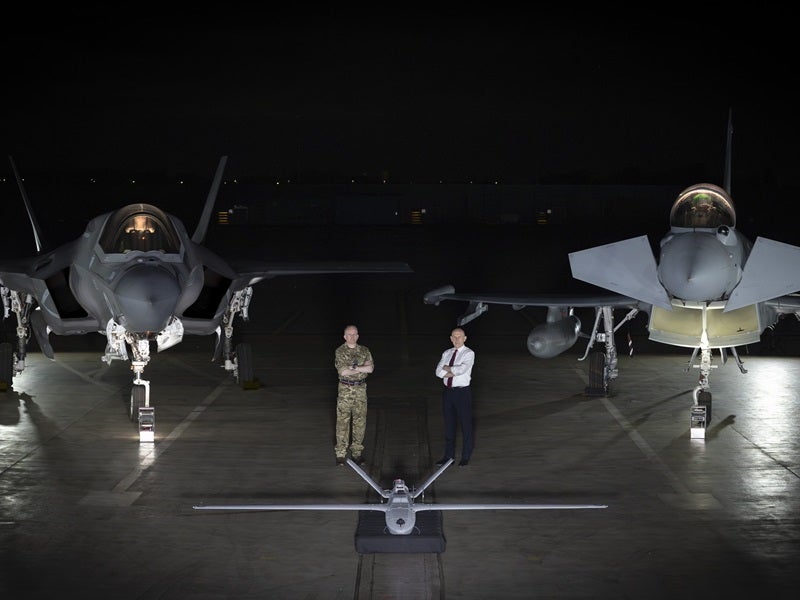
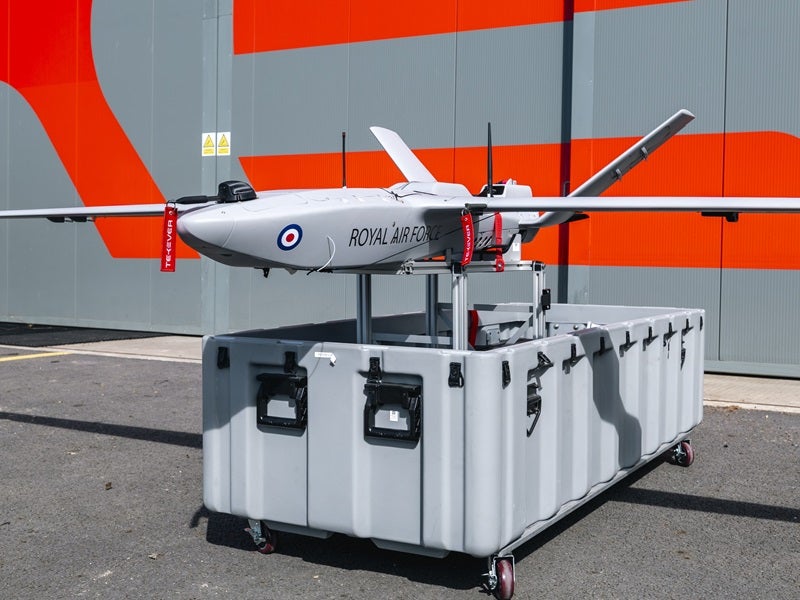
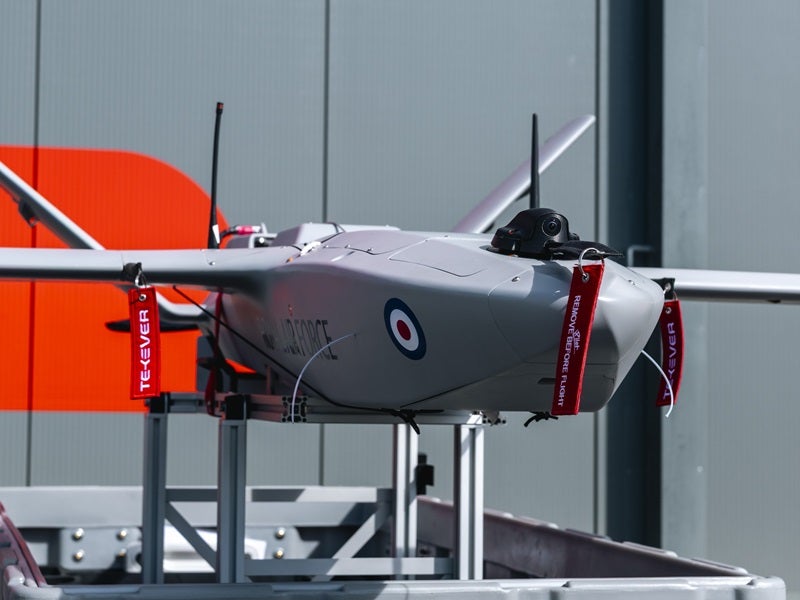
StormShroud is the first in a family of unmanned aerial systems (UAS) due to be deployed by the Royal Air Force (RAF) under its Autonomous Collaborative Platforms (ACP) Strategy.
The UAS provides radar-jamming capability intended to disrupt integrated air defence systems and improve the prospects for nearby crewed aircraft.
Recommended Buyers Guides

Introduced in May 2025, the UAS will be flown by 216 Squadron with support from the RAF Regiment, drawing personnel from the Regular RAF, the Royal Auxiliary Air Force and other parts of the UK Defence forces.
Squadron members will be trained to operate in small teams and function effectively in high-threat environments.
The system was developed in the UK within a year as part of the Urgent Capability Requirement, through a partnership between the RAF’s Rapid Capabilities Office, Defence Equipment & Support’s catalyst team, the Defence Science and Technology Laboratory and UK industry partners.
The development incorporated insights gained from the war in Ukraine as well as experience gained in other operational theatres worldwide.
StormShroud design and features
The StormShroud platform is based on the Tekever AR3 UAS, which has a 3.5m wingspan, with a total length of 1.9m, and can accommodate a 4kg payload.
In vertical take-off and landing (VTOL) configuration, it can remain aloft for up to eight hours, extending to around 16 hours in fixed-wing mode. Its service ceiling is roughly 3,600m above mean sea level (AMSL), and it can maintain communications out to approximately 100km.
Cruise speed is typically 75–90 kilometres per hour (km/h), and the UAS can be launched by VTOL or by catapult.
The system is intended to support F-35B Lightning and Typhoon crews by degrading adversary radar, thereby increasing the survivability and mission effectiveness of crewed aircraft. It will carry Leonardo UK’s BriteStorm electronic attack payload.
BriteStorm electronic attack system
BriteStorm is a stand-in jammer designed to be deployed ahead of high-value crewed platforms, and carried on small uncrewed aircraft or missiles to degrade and deceive enemy integrated air-defence networks.
The payload pairs a Miniature Techniques Generator with configurable transmit-receive modules matched to the carrier platform. Its compact, lightweight and energy-efficient design makes it largely platform-neutral and straightforward to integrate across a range of uncrewed vehicles.
The system uses an open software architecture that lets operators configure the payload to ingest intelligence and sortie data to refine performance, and upload updates in the field to respond to newly observed threats and tactics.
Reflecting recent operational experience, BriteStorm has been designed as an attritable asset that can be rapidly reprogrammed when recovered, with acceptable loss tolerances if it protects higher-value crewed platforms.
RAF ACP strategy
The ACP programme will introduce uncrewed systems into front line service in a phased manner over the coming decade, drawing on the UK’s Defence Drone Strategy to align capability introductions with lessons from recent conflicts.
An initial classification identifies three tiers of ACPs by intended use and survivability. Tier 1 covers disposable systems intended for single or very limited use. Tier 2 describes attritable systems designed to survive missions, although some losses are acceptable. Tier 3 comprises highly survivable systems whose loss would have significant strategic consequences.
The RAF intends to develop and employ these drones in close cooperation with the Royal Navy, the British Army, the wider Ministry of Defence, industry and allied partners to secure cost-effective UK solutions.
By 2030, ACPs are expected to be routinely fielded alongside crewed platforms in national and coalition operations.
