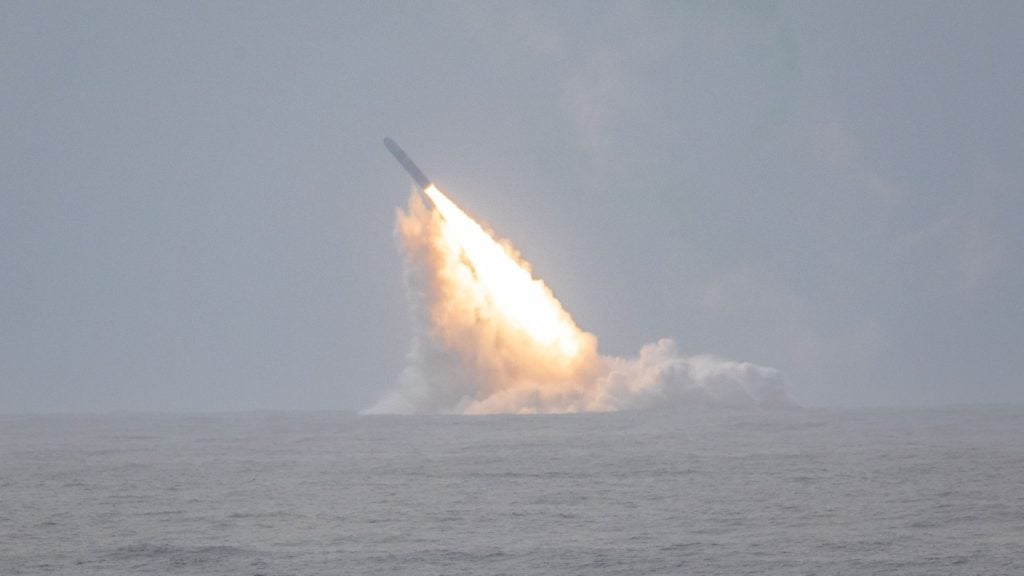
A Trident missile test firing has failed for the second time in a row, sparking questions over the effectiveness of the UK’s nuclear deterrent and readiness of its military forces.
Reports surfaced today (21 February, 2024) that the Trident nuclear missile “plopped” into the Atlantic after being fired from the Royal Navy’s HMS Vanguard submarine during a test on 30 January, 2024, just off Florida’s coast.
The UK’s Ministry of Defence (MoD) said that “an anomaly occurred” but stressed there were “no implications for the reliability of the wider Trident missile systems and stockpile” in a statement sent to Army Technology.
Given the £17m ($21.5m) price tag of each Trident missile, tests are rare – this marks the second failed Trident test by the MoD in eight years, following a previous misfire in 2016.
Others believe the mishap illustrates the “waste of public money being spent on the programme”, says Kate Hudson, General Secretary at the Campaign for Nuclear Disarmament. “Rather than wasting billions of pounds on increasing and upgrading its nuclear warheads, the British government should lead the way in nuclear disarmament.”
A series of unfortunate military events
Scrutiny over the failed nuclear test has also been compounded by a series of embarrassing events for the MoD, according to Fox Walker, defence analyst at GlobalData.
“This mishap comes at a time when some are questioning the UK's military readiness, particularly important given that the defence minister has declared the UK to be in a ‘prewar’ phase”, says Walker. “It comes on top of the malfunction of the HMS Queen Elizabeth, worries about the shrinking size of the British Army, and the UK's failed Trident test in 2016.”
Soldier retention is a major issue in the UK armed forces, which has decreased to its smallest size in centuries – a point made by General Patrick Sanders, head of the British Army, as he called for the government to “mobilise the nation” last month.
Defence Minister Grant Shapps, who was reportedly on-board HMS Vanguard at the time of the Trident misfire, has also faced previous accusations of warmongering for his “pre-war” statements.
“If there had been an issue when the US Navy successfully conducted a similar test in September 2023, I am doubtful it would have garnered as much attention,” Walker tells Army Technology. “Such failures do happen, but it's rather unfortunate for the UK to suffer two failures in a row, especially at a time when some are doubting the military’s ability to deter and defend. Let’s hope Putin and other threats don’t share those doubts.”
Costs “far higher than the $205bn first estimated”
Lockheed Martin has overseen production of the Trident II D5 missiles for both the UK and US militaries since 1989.
In that time, the MoD says it has “successfully completed more than 190 tests”, or “188 successful test launches”, according to Lockheed’s website.
Walker believes that the Trident misfire has faced more scrutiny in the UK than it would have in the US.
“I doubt this would have been such big news if it had happened in the US, where Lockheed manufactures the Trident missile”, Walker says. “The US military has tested the Trident nearly 200 times with a high rate of success. Lockheed Martin is unlikely to be too worried about the long-term outlook of the Trident program, even if today's result did not meet expectations.”
Lockheed Martin did not respond to request for comment.
The latest Trident misfire also throws doubt over a plan backed by UK MPs to spend £40bn on ‘upgrading the nuclear deterrent’.
Intended for the 2030s, this essentially involves replacing the ageing fleet of HMS Vanguard submarines with Dreadnought-class successors.
“The true cost of Trident has been closely guarded, but a House of Commons report from last year put the costs of acquiring the Vanguard fleet at £21bn, while yearly operational costs since 2010 average between £2.5bn and £3.1bn”, Hudson tells Army Technology. “The costs of HMS Vanguard’s mid-life refit jumped from £300m to over £500m and we still have to hear from government what the costs of replacing Trident will be – it will be far higher than the £205bn first estimated.”
HMS Vanguard is authorised to carry 48 Trident II D5 nuclear warheads, which can be fired at targets up to 2,500 kilometres away and at its fastest can travel at more than 20,000kph.
Of the UK’s four Trident submarines, one is always armed and at sea, one is undergoing maintenance, and two are in port or on training manoeuvres at any one time, according to the Royal Navy’s Strategic Defence Review.
Ministers are expected to update MPs about the incident today (21 February, 2024) in the House of Commons. New figures on the cost of the Trident programme are due in the next few weeks.