

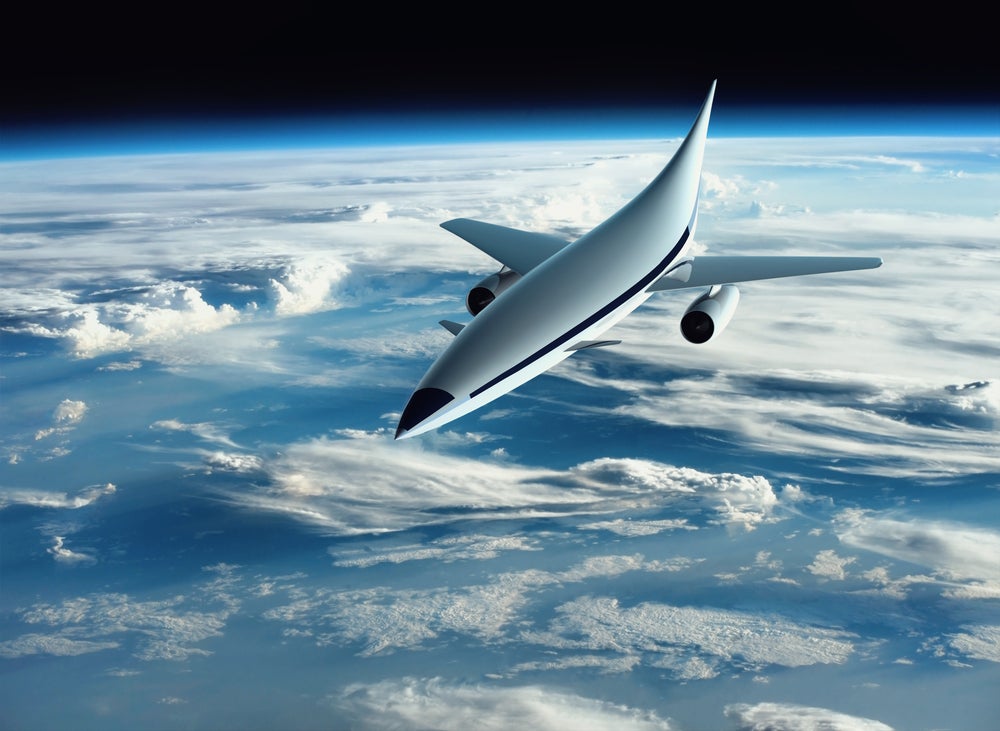
Hypersonic flight, defined as travel at speeds exceeding Mach 5 (five times the speed of sound), remains a frontier largely unexplored by commercial aviation. To date, only a handful of concepts and experimental designs have demonstrated the potential for sustained hypersonic travel, but none have yet proven full commercial viability.
The Concorde aircraft, often cited as the closest precedent, operated at supersonic speeds (Mach 2+), yet faced significant technical challenges, regulatory hurdles and waning public enthusiasm that ultimately curtailed its service. Since then, advances in materials science, propulsion technologies and computational modeling have re-ignited interest in hypersonic passenger travel. Emerging applications beyond passenger transport — such as rapid Earth observation, high-speed cargo delivery, and single-stage-to-orbit (SSTO) vehicles — could drive new commercial opportunities if supported by sufficient investment and regulatory progress.
Go deeper with GlobalData


Access deeper industry intelligence
Experience unmatched clarity with a single platform that combines unique data, AI, and human expertise.
Firstly, commercial hypersonic flight must overcome several technical and scientific challenges. At speeds above Mach 5, aircraft experience extreme thermal and mechanical stresses with surface temperatures that can exceed 1,000°C, particularly at the nose and leading edges. To withstand these conditions, advanced materials such as carbon-carbon composites and ceramic matrix composites are being developed and refined by companies such as GE Aviation and Northrop Grumman, particularly for aerospace and defence applications.
Achieving and maintaining hypersonic speeds also requires advanced propulsion systems. While scramjets (supersonic combustion ramjets) have been demonstrated in experimental programs such as NASA’s X-43 and DARPA’s HAWC, these technologies remain in the defence domain and are not yet optimised for commercial use. Researchers have continued to enhance scramjet performance through innovations such as variable-geometry inlets and pre-cooler heat exchangers, which improve efficiency and airflow management at varying speeds. Additionally, dual-mode engines — capable of transitioning between turbojet and scramjet modes — are being developed by companies such as Hermeus, whose Chimera turbine-based combined cycle engine is a key component of its hypersonic aircraft roadmap.
Aerodynamics presents another major hurdle. Drag increases dramatically at hypersonic speeds, demanding higher fuel loads and more efficient propulsion to sustain velocity. Even marginal improvements in airflow and drag reduction can have substantial performance benefits. To address this, engineers use computational fluid dynamics to simulate high-speed airflow around the airframe. These simulations are becoming faster and more accurate thanks to AI-driven solvers and cloud-based computation platforms. Some researchers are also exploring more speculative technologies such as magnetohydrodynamics — which aims to control airflow using electromagnetic fields — but these remain largely in the experimental stage with no near-term commercial application.
Secondly, commercial hypersonic flight faces significant legal and regulatory challenges. By definition, it involves breaking the sound barrier, which raises concerns over sonic booms and elevated noise levels — both for people on the ground and passengers. Environmental impact is another major issue: hypersonic aircraft are far less fuel-efficient than subsonic jets and produce higher emissions, which stands in contrast to the industry’s growing focus on sustainability and lower emission alternatives, such as electric aviation. Safety and public perception are also major concerns. Emergency procedures at hypersonic speeds and high altitudes are not well established, and any accident could severely damage public trust — potentially halting commercial development entirely. The need for specialised infrastructure — such as cryogenic fuel storage, longer runways, and updated air traffic control systems — further adds cost and complexity. These regulatory, environmental and operational hurdles make commercial adoption more challenging than just achieving the technology itself.

US Tariffs are shifting - will you react or anticipate?
Don’t let policy changes catch you off guard. Stay proactive with real-time data and expert analysis.
By GlobalDataEven if all these issues are solved, is there enough consumer and investor interest in hypersonic flight outside of defence contexts? The cost of developing, operating, and maintaining hypersonic aircraft is extremely high, and in a commercial setting, much of that cost would be passed on to the customer. This implies significantly higher ticket prices, potentially limiting the target demographic to ultra-wealthy travellers. There’s also the issue of perceived value: would high-net-worth individuals consider the time savings (often marginal for most global routes) worth the steep price? The Concorde faced a similar challenge, with declining public interest and unsustainable economics ultimately grounding the fleet. Hypersonic travel would likely be even more expensive and restricted in terms of destinations, further narrowing its appeal.
However, the rise of commercial space tourism offers some hope. Blue Origin and Virgin Galactic have shown that there is a market, albeit niche, for short-duration, high-cost experiences, and demand has been strong enough to justify continued flights. Hypersonic passenger travel may follow a similar path, serving a limited but viable luxury market if marketed as a premium experience.
For rapid global travel, commercial hypersonic flight may face competition from two emerging technologies: reusable rockets and SSTO spaceplanes. SpaceX’s Starship is also being marketed for point-to-point Earth travel, promising sub-90-minute global flights. With full reusability and large capacity, it could offer similar pricing to hypersonic aircraft, while also providing views of space and brief zero-gravity, making it more appealing for premium customers. SSTO spaceplanes were once seen as a promising alternative for rapid travel and orbital cargo delivery. However, the recent bankruptcy of Reaction Engines, a leader in SSTO development, has cast doubt on the near-term viability of the concept. Other startups such as Radian Aerospace remain years from maturity, but SSTOs have the potential to be more appealing to customers than commercial hypersonic flight if their numerous technological hurdles can be overcome.

