

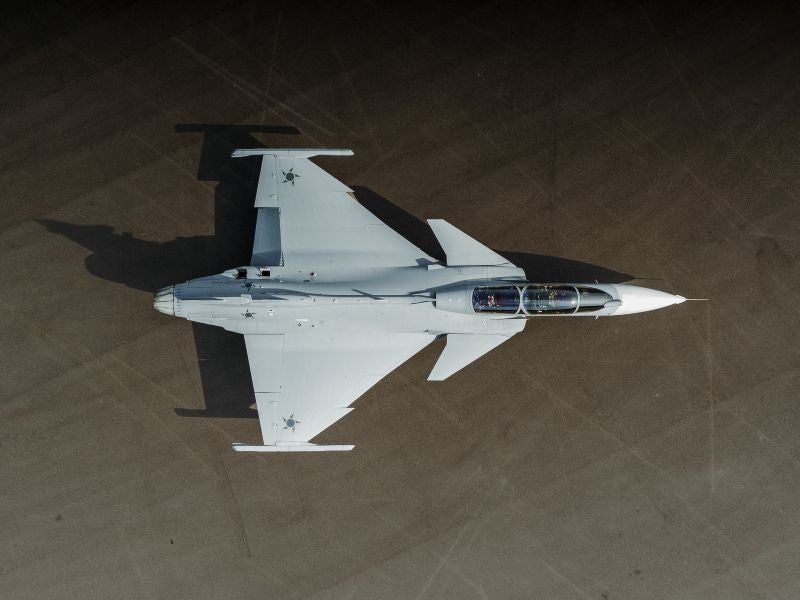
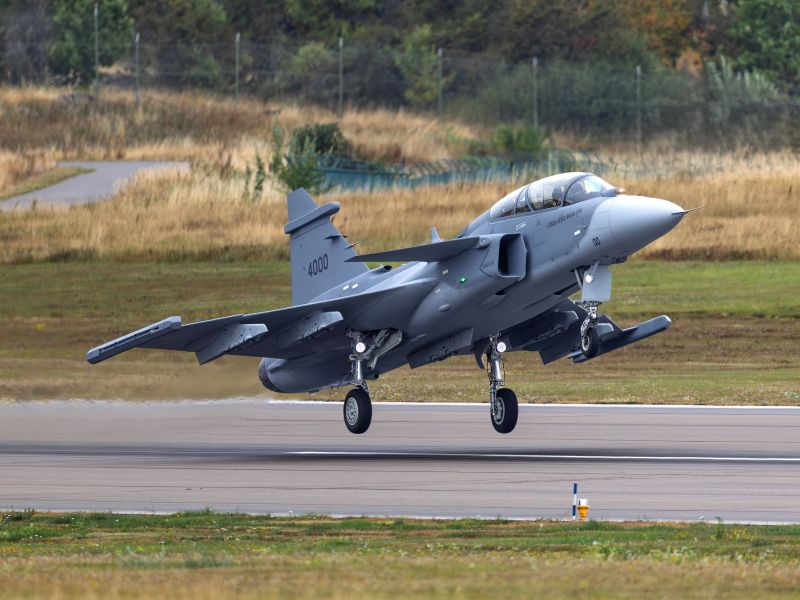
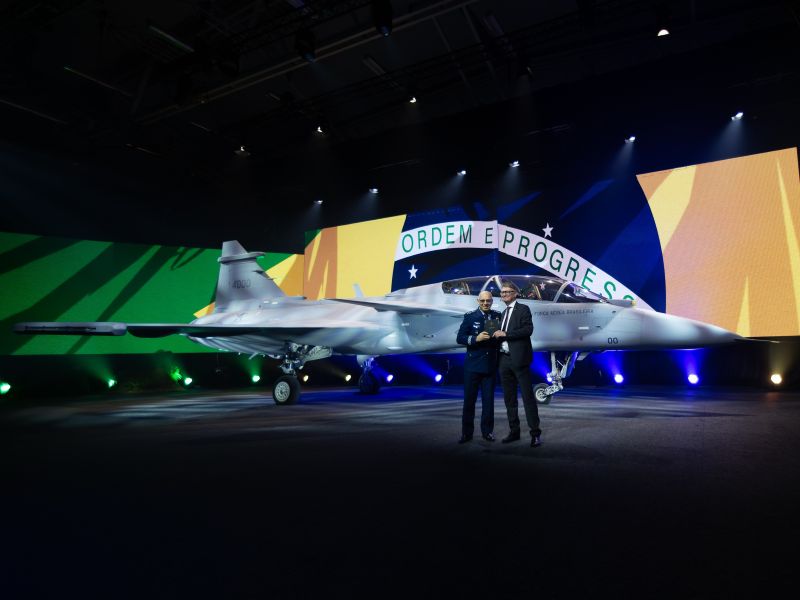
The Gripen F is the two-seat version of the Gripen E series, developed by Swedish defence group Saab in collaboration with the Brazilian Government.
The aircraft combines conversion training with operational combat roles on a single platform.
Recommended Buyers Guides

Brazil, the launch customer, co-developed the variant through industrial collaboration under the Brazilian Gripen Programme. Engineers from Embraer, AEL Sistemas and Akaer contributed to work ranging from structural design to avionics integration.
Saab presented the first Gripen F fighter to the Brazilian Air Force in Linköping, Sweden, in June 2026.
In August 2026, Saab completed the maiden flight of the Gripen F at its Linköping airfield. The sortie assessed the aircraft’s core onboard systems and initial handling characteristics, beginning the flight-test programme for the two-seat variant.
Gripen F development background
Development of the Gripen F aircraft was initiated following a contract awarded by the Brazilian Government in 2014.
Saab began manufacturing the two-seat Gripen F fighter, completing the first metal cut for the aircraft in March 2020. Testing of the aircraft’s tactical and sensor systems commenced in April 2020.
In March 2023, Saab initiated testing of the aircraft’s oxygen and anti-G systems, among other components. The tests were designed to identify potential deficiencies before flight testing and verify that the systems operate reliably and safely under demanding conditions. The aim was to ensure a robust system that provides pilots with breathing air and protection against the effects of high G-forces.
Saab is currently undertaking production acceptance trials, following which the programme will move into flight-envelope expansion. This phase will assess operational parameters including speed, altitude, angle of attack and G-load. Test engineers will also evaluate tactical mission systems and rear cockpit functions associated with the two-seat configuration.
Saab’s Flight Test Centre in Sweden will conduct the campaign. Following completion of the planned tests and acceptance procedures, the Gripen F will be prepared for delivery to the Brazilian Air Force.
Design and features
The Gripen F multi-role fighter has an overall length of 15.9m (52.16ft) and an overall width of 8.6m.
The aircraft uses an open architecture and shares the same cockpit architecture, sensors, avionics and weapon systems as the Gripen E platform. This enables a zero learning curve between training and deployment for the crew. It also reduces the need for separate ground support, maintenance teams and budgets for different aircraft types.
The platform has a combat turnaround time of 15–25 minutes and can conduct air-to-air refuelling.
Gripen F cockpit design
The Gripen F’s two-seat cockpit supports the Observe, Orient, Decide and Act (OODA) decision-making cycle. The rear cockpit is intended to support mission coordination across the wider operating environment, while the front cockpit is focused on the inner OODA loop during air-to-air engagements.
A fully independent second cockpit allows instructors and trainee pilots to undertake missions in an operational fighter aircraft. The configuration is intended to support pilot conversion and preparatory training, while allowing the two crew members to divide tasks during operations in high-threat environments.
Under this arrangement, one pilot manages the immediate engagement while the other coordinates the wider battlespace. In high-threat airspace, the crew can allocate responsibilities between the two cockpits.
Additionally, the Gripen F allows the rear-seat operator to command, monitor and coordinate multiple unmanned systems in real time. It also uses AI support to assist situational awareness, task management and processing large volumes of data, enabling effective human-machine collaboration.
The pilots have access to an active noise reduction (ANR) system that reduces aircrew noise exposure, improves intercom voice intelligibility, and supports pilot focus and decision-making during operations.
The system attenuates low-frequency noise by up to 30dB. It captures ambient sounds and processes them through a digital signal processor to cancel unwanted background noise. Crew members can adjust the level of attenuation based on operational conditions, cockpit noise levels or personal preference.
Propulsion and performance
The Gripen E platform is powered by a GE F414G engine with maximum thrust of 98 kilonewtons.
The aircraft has a maximum take-off weight of 16,500kg (36,376lb).
Gripen F payload design
The Gripen F has ten external hardpoints for weapons carriage. Its architecture supports the integration of weapons already used by air forces operating the Gripen platform.
Mission capabilities
The Gripen F can conduct air superiority and air defence missions including beyond-visual-range engagements using its Active Electronically Scanned Array radar and infrared search-and-track system.
For strike operations, the aircraft can engage ground targets, conduct maritime strikes, undertake electronic warfare and provide close air support. It can also carry out electronic attack and jamming against enemy air defences in contested environments, as well as intelligence, surveillance, and reconnaissance missions using its sensors and data-fusion systems.
The platform can coordinate precise, multi-axis attacks with minimal margin for error and deploy unmanned assets into contested airspace to gather intelligence.
Orders and deliveries
In 2014, Saab signed a contract with the Brazilian Government to develop and produce 36 fighter aircraft, comprising 28 Gripen E and eight Gripen F aircraft. Deliveries began in 2020, and 11 Gripen E aircraft have been handed over to date.
In August 2025, Saab signed a contract with the Swedish Defence Materiel Administration (FMV) for four Gripen E/F fighter aircraft from FMV for the Kingdom of Thailand, comprising three Gripen E and one Gripen F aircraft, as well as associated equipment, support and training.
The order is valued at approximately $554.3bn (Skr5.3bn), with deliveries to take place from 2025 to 2030.
In November 2025, Saab signed a contract with the Colombian Government and received an order valued at $3.5bn (€3.1bn) for 17 Gripen E/F fighter aircraft, with deliveries scheduled to take place between 2026 and 2032.
Contractors involved
Saab contracted Insta, a Finnish defence and security company, to supply its ANR systems for Gripen E and F fighters operated by the Swedish and Brazilian air forces.
