

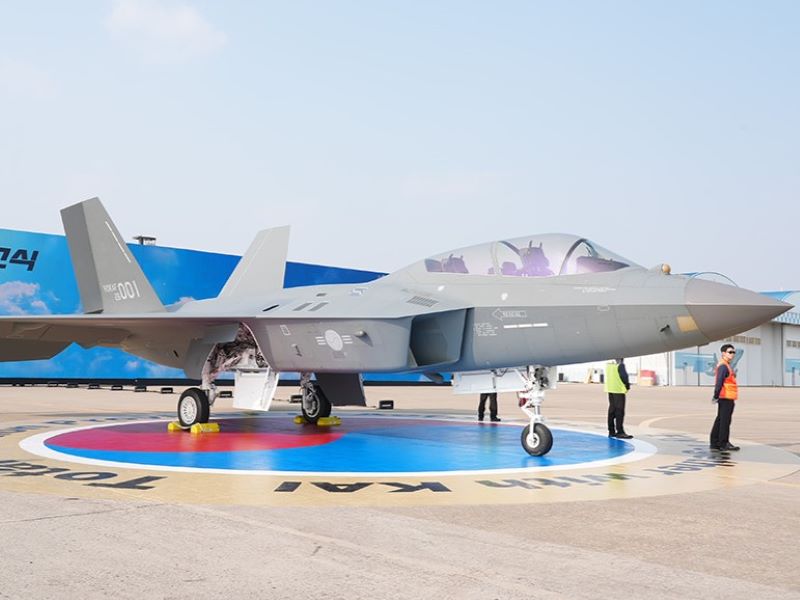
The KF-21 Boramae, previously known as the KF-X (Korean Fighter-eXperimental) programme, is a 4.5th generation multi-role fighter aircraft developed by Korean Aerospace Industries (KAI) for the Republic of Korea Air Force (ROKAF) and Indonesian Air Force.
The aircraft will replace the ROKAF’s ageing fleet of F-4 and F-5 fighters. It completed its maiden flight in July 2022 and achieved supersonic flight in February 2023.
Recommended Buyers Guides

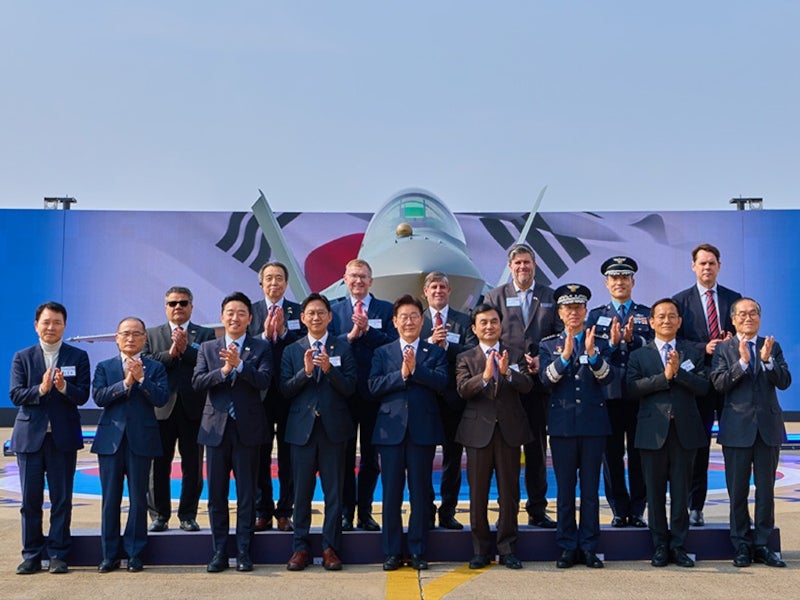
The KF-21 Boramae officially entered its mass production phase in April 2026 with the rollout of the first unit at KAI’s headquarters in Sacheon.
In May 2026, the aircraft obtained Combat Suitability Certification in line with the ROKAF’s operational requirements, confirming it has the required technological maturity and reliability to carry out missions in real battlefield conditions.
Additionally, the Defence Acquisition Programme Administration (DAPA) issued the Type Certification for the aircraft after it satisfied all 745 inspection items across 14 areas of airworthiness certification standards.
KAI plans to produce 120 KF-21 fighter aircraft to serve the ROKAF, with the first production unit set to be delivered in the second half of 2026.
KF-21 Boramae aircraft development
The South Korean Government selected KAI, along with its partner Lockheed Martin, as the preferred bidder to develop an aircraft under the KF-X programme in March 2015.
KAI made a provisional agreement with the Indonesian Government and Indonesia state-owned aerospace company PT Dirgantara Indonesia for the joint development of the KF-X programme in November 2015.
KAI received a contract from DAPA for the development of the fighter aircraft in December 2015.
A final joint development agreement between the Indonesian Government and KAI was reached in January 2016, with Indonesia agreeing to share 20% of the development costs.
The KF-X programme is estimated to involve an investment of more than $7.7bn (Won11.65tn), which is being contributed by the Korean Government (60%) and Indonesian Government (20%), as well as KAI and its partners (20%).
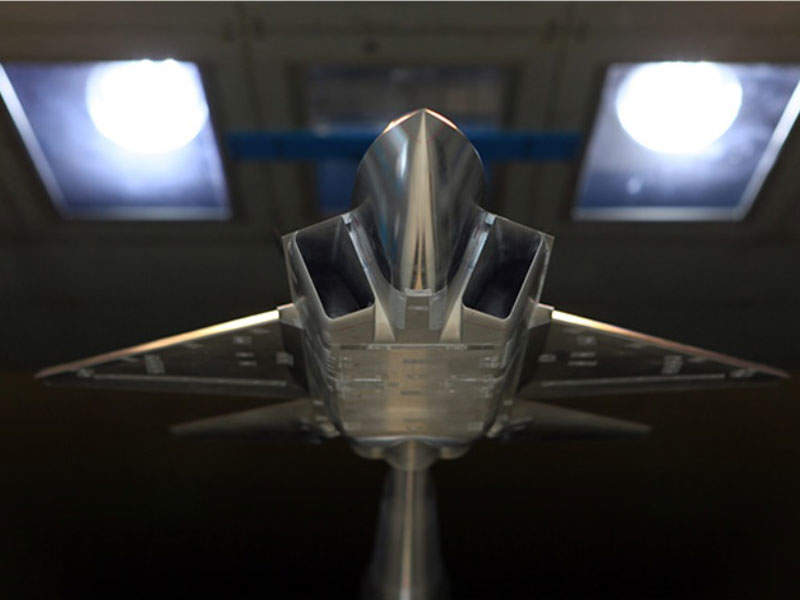
The wind tunnel testing on a 1/13 scaled-down model to develop the shape of the aircraft’s fuselage began at the test laboratory of the Korea Aerospace Research Institute in June 2016. The preliminary and critical design reviews for the aircraft were completed in 2018 and 2019, respectively.
Assembly of the first prototype of the KF-21 Boramae aircraft commenced in 2020 and was rolled out in 2021.
KF-21 Boramae design and features
The KF-21 Boramae measures 55.4ft (16.9m) in length and 15.4ft in height with a wingspan of 36.7ft.
The aircraft has a maximum take-off weight of 56,400lb (25,582.6kg) and can carry up to 17,000lb of payload.
The single-seat aircraft is equipped with advanced avionics and is designed to employ advanced precision weapons. It has ten weapon hardpoints, while its design also prioritises high manoeuvrability and improved survivability.
Cockpit and avionics
The single-seat and tandem-seat cockpit configurations of the KF-21 Boramae fighter feature bird-strike resistant canopy and windshields supplied by Texstars.
The fighter is equipped with an active electronically scanned array radar, an infrared search and track system, an electro-optical (EO) targeting system and a radio frequency jammer. It also features an AI-based computer, enhanced data fusion and satellite communications.
Armament aboard Korea’s next-generation fighter
The first mass-produced unit includes fully operational air-to-air missile capabilities, while air-to-ground strike functions are set to be introduced in later Block upgrades.
The aircraft features an air-to-air missile eject launcher (MEL) for the carriage and launch of air-to-air missiles. The MEL allows the carriage of weapons on store stations within bomb bays, conformal stations and traditional wing pylon stations. It also enables the safe launch of either MBDA’s Meteor or AMRAAM air-to-air missiles.
An EO targeting pod (EOTP) is mounted on the underside of the aircraft to provide functions such as cueing target coordinates, searching for and tracking targets, enabling precision weapon guidance, verifying target identity and confirming mission results against system-designated objectives.
The aircraft also features Harris Corporation’s BRU-47 and BRU-57 release systems. The BRU-57 dual Smart Munition Release System enables the carrying of bombs up to the 2,000lb class and is found on F-16s flying worldwide. It is also capable of carrying the 1,000lb and 500lb JDAM family of munitions.
Additionally, the KF-21’s weapons fit includes the lightweight M61A2 20 mm Gatling cannon paired with a linear, linkless ammunition feed produced by General Dynamics Ordnance and Tactical Systems. Compared with single-barrel alternatives, the M61A2 is designed to deliver up to tenfold higher reliability, with a rate of fire of around 6,000 rounds per minute and a managed shot spread to maximise hits along the target’s flight path.
The air-to-surface armaments include the Korean GPS-guided bomb, GBU-39 small diameter bomb and Korean air-launched cruise missile.
In October 2025, MBDA signed a memorandum of understanding with KAI to integrate the SPEAR air-to-ground missile onto the KF-21 Boramae fighter aircraft.
Engines and performance of KF-21 fighter
The aircraft is powered by two General Electric F414-400K engines equipped with full-authority digital electronic control (FADEC) systems. Each engine can generate a maximum thrust of 22,000lb (98 kilonewtons).
The local production, integration and installation of the engines for the aircraft are being handled by Hanwha Techwin through a technical cooperation agreement with GE Aviation.
KF-21 Boramae offers a maximum ferry range of 1550 nautical miles (2,870.6km) and can achieve Mach 1.8, equivalent to a maximum speed of approximately 1,400mph (2,253km/h). It can also carry an external fuel tank (EFT) with a capacity of 370gal.
Key players involved in the KF-X fighter aircraft development
Héroux-Devtek signed a long-term contract with Hanwha for the design and development phase of the aircraft in August 2016. Under the contract, Héroux-Devtek, in collaboration with Hanwha, is responsible for the development of the landing gear for the aircraft. Hanwha is also supplying the EOTP for the aircraft.
Lockheed Martin provided its technical data and reports, as well as core manpower, to KAI to support the aircraft development.
GE Aviation was selected as the preferred supplier by DAPA for the supply of F414 engines, as well as spare engines, to the aircraft in May 2016.
KAI placed a contract with Triumph Group for the supply of airframe-mounted accessory drives for the fighter aircraft in March 2017.
Oxley was selected by KAI to deliver an external LED lighting system, including landing, taxiing, refuelling and formation lights, as well as wing tip lights and an intelligent lighting controller for the aircraft, in August 2017.
KAI selected Harris to supply the BRU-47 and BRU-57 release systems for the multi-role fighter in November 2017.
MBDA is supplying the Meteor air-to-air missiles and the SPEAR air-ground missiles. Cobham was contracted to provide an MEL.
