
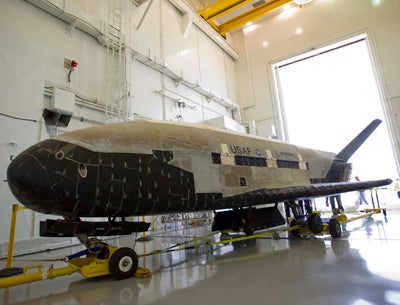
The second Boeing-built X-37B Orbital Test Vehicle (OTV) for the US Air Force (USAF) has successfully completed de-orbit and landing at Vandenberg Air Force Base, US.
Go deeper with GlobalData


Discover B2B Marketing That Performs
Combine business intelligence and editorial excellence to reach engaged professionals across 36 leading media platforms.
Launched from Cape Canaveral Air Force Station in Florida, US on 5 March 2011, the X-37B concluded a 469-day experimental test mission, which was conducted to test the reusable capabilities of the unmanned vehicle.
Boeing Government Space Systems vice president, Paul Rusnock, said the OTV-1 mission demonstrated how unmanned space vehicles can be sent into orbit and safely recovered.
"With OTV-2, we tested the vehicle design even further by extending the 220-day mission duration of the first vehicle, and testing additional capabilities," said Rusnock.
A combination of an aircraft and a spacecraft, the low-cost responsive OTV was the US first unmanned vehicle to independently return from space and land.

US Tariffs are shifting - will you react or anticipate?
Don’t let policy changes catch you off guard. Stay proactive with real-time data and expert analysis.
By GlobalDataThe OTV-1 space shuttle was also the only vehicle that was capable of returning to Earth and being reused.
The second launch of OTV-1 will be conducted by the end of 2012.
Intended to present a reliable and reusable unmanned space test platform for the USAF, the objectives of the X-37B programme include space experimentation, risk reduction, and concept-of-operations development for reusable space vehicle technologies for future space missions.
Image: The second Boeing-built X-37B is 29ft long and weighs 11,000lb. Photo: courtesy of Boeing.



