
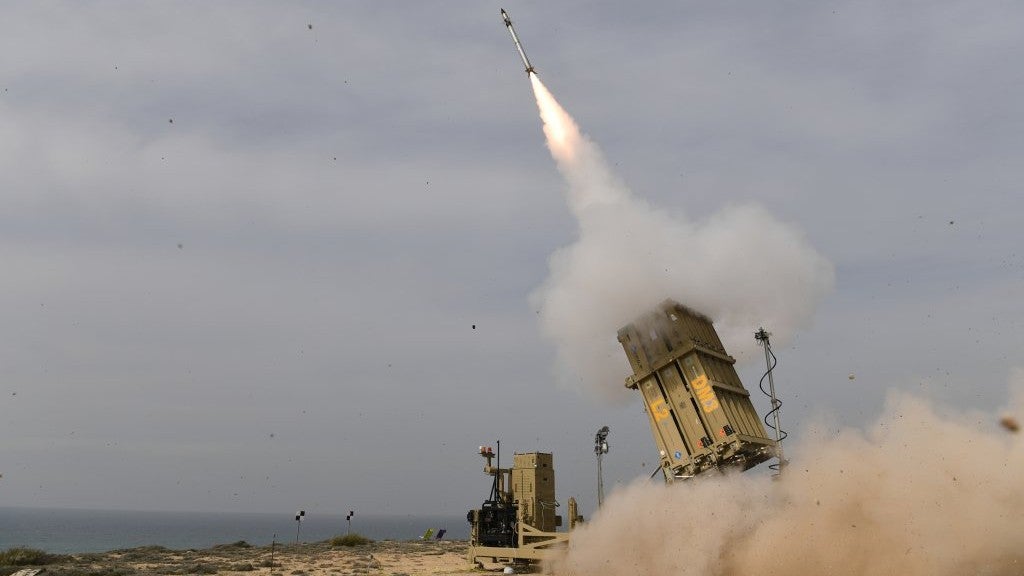
A video circulating on social media which claims to exhibit Israel’s Iron Beam high-energy defence system shooting down Hamas missiles actually uses footage from Arma 3, a military simulation video game.
The video was originally shared on X (formerly Twitter) by an account claiming to be Mossad, the Israeli government’s intelligence agency.
“While it’s flattering that Arma 3 simulates modern war conflicts in such a realistic way, we are certainly not pleased that it can be mistaken for real-life combat footage and used as war propaganda”, Bohemia Interactive, the Czech Republic-based company which developed Arma 3, said in a statement.
The video footage was actually taken from a YouTube video uploaded a few days prior.
Iron Beam vs Iron Dome – what’s the difference?
The overarching difference between Israel’s two defence systems is that Iron Dome is fully operable, whereas Iron Beam – subject to the misinformation – is not.
First deployed by the Israeli Air Force (IAF) in March 2011 following rocket attacks from Gaza and Lebanon, Iron Dome is Israel’s world-renowned air defence missile system. It detects and intercepts incoming threats including artillery, mortar, unmanned aerial vehicles and precise guided missiles.
Iron Dome also boasts a 90% success rate in its decade of usage, although criticism has been levelled at the Israeli Defence Forces’ (IDF) inefficient utilisation of Iron Dome during Hamas’ initial attack on 7 October.
Iron Beam is Israel’s directed-energy weapon air defence system able to destroy fast-moving projectiles with powerful energy beams. In December 2022, Rafael Advanced Defense Systems and Lockheed Martin announced they were jointly developing, testing and manufacturing Iron Beam in the US and Israel.
“We expect [Iron Beam] to become the first operational laser defence system of its kind,” said Rafael CEO Yoav Har-Even.
Whereas interceptors fired by Iron Dome cost $60,000 each, Iron Beam costs “just a few dollars”, meaning “the cost of kill is small”, Uzi Rubin, missile defence expert at the Israeli Ministry of Defence, reportedly told The Telegraph.
Iron Beam also needs no ammunition, and is smaller and lighter, making it easier to conceal. However, it cannot operate in wet conditions, as water particles in the atmosphere absorb the laser’s energy, and has a slower rate of fire, requiring around five seconds to transmit sufficient energy to destroy its target.
US aid package targets Iron Dome
Rumours have circulated that Iron Beam is scheduled for deployment in 2025, although the Israeli Ministry of Defence suggested it intends to fast-track development.
Internationally, efforts are focused on bolstering Israel’s existing Iron Dome system.
On 20 October, the US Department of State unveiled a new bundle aid package covering the various proxy wars it is financially engaged in.
This includes $61.4bn in renewed aid for Ukraine, $9.15bn in humanitarian aid, $7.4bn for Taiwan and the Indo-Pacific region, and $14.3bn for Israel.
Of this Israeli aid, $10.6bn will support air-and-missile defence, with $1.2bn specifically allocated for research, development, test and evaluation funding for Iron Dome, according to a letter to Congress from the Office of Management and Budget.
Our signals coverage is powered by GlobalData’s Thematic Engine, which tags millions of data items across six alternative datasets — patents, jobs, deals, company filings, social media mentions and news — to themes, sectors and companies. These signals enhance our predictive capabilities, helping us to identify the most disruptive threats across each of the sectors we cover and the companies best placed to succeed.