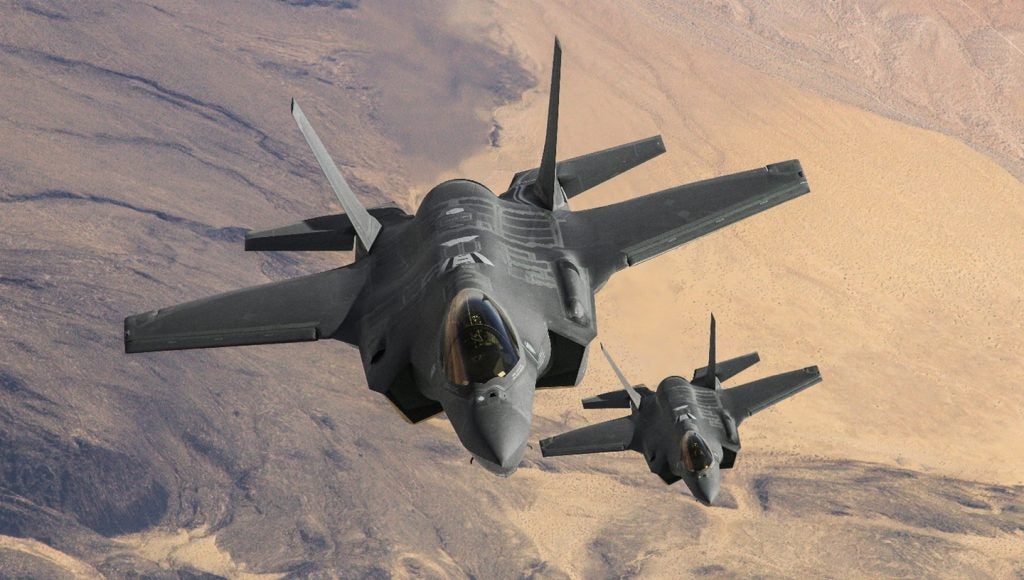
The UK Minister for Defence Procurement and Industry, Maria Eagle, confirmed that the Royal Air Force (RAF) will lean on its allies for the air-to-air refuelling of its future F-35A jets in a parliamentary written response on 4 July 2025.
During the Nato Summit in the Hague last month, the government announced the planned acquisition of 12 F-35A conventional take-off and landing aircraft in its next tranche of F-35 aircraft, instead of the planned short take-off and vertical landing B variant.
The Ministry of Defence (MoD) emphasised that the forthcoming A variant offers a nuclear role that the RAF have not had since 1998.
“We have longstanding reciprocal arrangements to use allies air-to-air refuelling support when required, just as our Voyagers also support refuelling of other allies’ jets,” Eagle relayed.
However, recently, two people gained access to the UK’s largest airbase, RAF Brize Norton, in Oxfordshire, and damaged two Voyager tankers with paint and crowbars in condemnation of the role of the base in assisting Israeli operations in and over the Gaza Strip.
In earlier years, however, Voyager has provided air-to-air refuelling (AAR) on a global scale during exercise Mobility Guardian 23. In 2023, the aircraft deployed to Eilson airbase in Alaska, and from there proceeded to refuel an A400M Atlas on route to Guam, a US Pacific Ocean territory.
The F-35A platform is only compatible with a boom system, whereas Voyager uses the probe-and-drogue system exclusively.
Currently, there are 37 F-35B aircraft jointly operated by the RAF and Royal Navy. The fleet is based at RAF Marham in Norfolk. While the F-35A cannot be refuelled by Voyager, the tanker is compatible with F-35B.

Meanwhile, European countries are increasingly opting for the Multi-Role Transport Tanker (MRTT) which are generally capable of providing both refuelling systems. Belgium, Czech Republic, France, Germany, Luxembourg, the Netherlands, Norway, Spain and the UK – whose Voyager fleet is an alternative type of MRTT – operate them.
Without AAR support, F-35As have a transit distance of 1,200 nautical miles (or 2,200 kilometres) while the F-35B can only reach 900 nautical miles according to an RAF comparison.
Notably, both ranges fall well short of the 4,812km distance between Marham and RAF Akrotiri in Cyprus.
This Mediterranean airbase is a crucial platform from which the service can conduct stand-off strikes in the Near East. While there the 903 Expeditionary Wing, comprising Typhoon aircraft, is based at Akrotiri it would not be possible to deploy F-35As to the base without allied tankers along the way.
Fears Typhoon may leave service
With an order for F-35As, no new orders for the Eurofighter Typhoon, and a lack of government transparency about its procurement plans, this combination of factors have given rise to fears that the UK may phase out its legacy Typhoon fleet.
GlobalData intelligence indicates that there are 137 Eurofighter aircraft in service at present.
The influential British union, Unite, have repeatedly expressed concern that UK jobs will take a hit should the F-35A replace the Typhoon entirely. Unite contest MoD figures of the UK contribution to the F-35 Joint Strike Fighter, which they claim is around 3% rather than the 15% touted by government officials.

While the MoD have not confirmed this supposed transition, the department remains tight-lipped about its procurement plans until the Defence Investment Plan is published in the autumn. This comes after a ten-month wait, when such details were anticipated in the Strategic Defence Review which was released at the beginning of June.
Moreover, Unite have lately revealed that the Typhoon production line at Warton, Lancashire has “ground to a halt”, with BAE Systems dispersing the workforce across various company factories and RAF bases around the country since there are no further domestic or export orders for the Typhoon.
While Unite’s general secretary, Sharon Graham, predicts “the ending of the Typhoon final assembly production at Warton”, Airforce Technology contacted BAE Systems for their perspective on the ostensible transition to the American multirole fighter.
“We’re experienced at responding to the changing demands of the Typhoon programme to ensure we retain our specialist skills,” a spokesperson said.
“The strong level of interest, commitment and investment in the aircraft from current and potential customers gives us confidence that Typhoon production in the UK will take us into the next decade – we’re working hard to secure these orders…”