
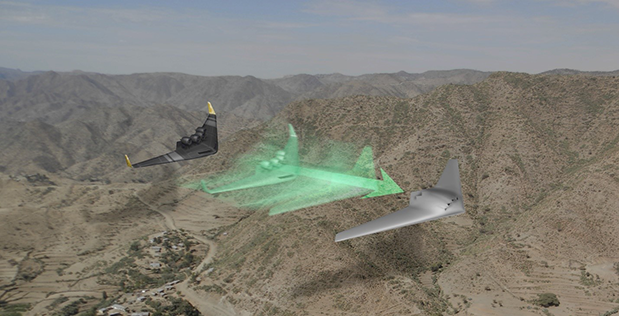
The US Defence Advanced Research Projects Agency (DARPA) announced on 24 June 2024, that the Series Hybrid Electric Propulsion AiRcraft Demonstration (Shepard) programme aircraft received its official designation, XRQ-73.
The concept behind the development of Shepard is the leveraging of hybrid electric systems alongside components from the AFRL/IARPA Great Horned Owl (GHO) project, “to quickly mature a new missionised long endurance aircraft design that can be fielded quickly," according to Steve Komadina, SHEPARD program manager.
The GHO project sought to advance the role of UAS in Intelligence, Surveillance and Reconnaissance (ISR) missions by eliminating or reducing the UAS’ acoustic signature while retaining a long-range endurance. To that end the GHO propulsion system quietly generated electrical power from liquid hydrocarbon fuel, either gasoline or diesel, and then used the stored electrical energy to deliver a purely electrically driven quiet flight.
An official designation typically marks an aircraft as having reached a state of development and testing where it is considered ready for operational use, or at least advanced stages of evaluation. However, designation also plays a part in role identification, and in this case, marks the Shepard as an X-plane, an experimental prototype not intended for operations service but instead for use in experimentation and testing purposes, to validate new concepts and technologies.
Historic examples of 'X-' aircraft include the X-1, famously piloted by Lieutenant Chuck Yeager to be the first aircraft to break the sound barrier in level flight, the X-15, a rocket powered aircraft that reached the edge of space, and the X-29, which was built with forward swept wings to test aerodynamics concepts.
"The Shepard program is maturing a specific propulsion architecture and power class as an exemplar of potential benefits for the Department of Defense,” continued Komadina.
The focus on a speedy development schedule is prominent within communications surrounding the Shepard programme, with a central commitment at origin to “quickly mature a new mission-focused aircraft design that can be fielded with the objective of first flight in 20 months,” according to a description from Komadina for DARPA. First flight is expected by the end of 2024,
The result is a larger scale vehicle than the GHO X-Plane (XRQ-72), with the XRQ-73 weighing in as a 1,250 pounds Group 3 Uncrewed Aerial System (UAS).