
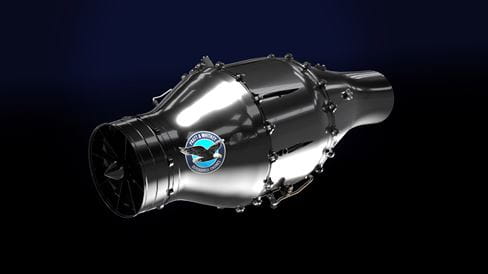
Pratt & Whitney, an RTX business, is in the process of creating a novel family of engines with scalability ranging from 500 to 1,800 pounds of thrust.
These engines will have the ability to power both munitions and collaborative combat aircraft (CCA), according to a company statement issued on 22 September 2025.
Go deeper with GlobalData


Discover B2B Marketing That Performs
Combine business intelligence and editorial excellence to reach engaged professionals across 36 leading media platforms.
Pratt & Whitney’s prototyping arm, Gatorworks, is responsible for the development of the engines.
Created in 2018, Gatorworks focuses on the “rapid and agile development” of reliable lower cost military engines.
“The scalability of the architecture, the commonality across models, and the use of additive manufacturing will allow us to significantly reduce development and production timelines as we look at existing and future applications with customers,” Pratt & Whitney’s military engines business president Jill Albertelli said.
Pratt & Whitney is set to conduct a second series of tests on the new family of engines early in 2026.
These tests are aimed at validating crucial design elements.
Upon completion, this engine family will be available to domestic and international customers of Pratt & Whitney.
The development of new engines follows the company’s opening of an 845,000ft² military engine manufacturing facility in Oklahoma City in October 2024.
This expansion enables Pratt & Whitney to cater to the increasing demands for F135, F117, TF33, F100, and F119 engines from both US-based and global defence users.
In March 2025, Pratt & Whitney also completed a series of tests on its innovative rotating detonation engine (RDE).
These tests were undertaken in partnership with the RTX Technology Research Center (RTRC).



