

- Nato now puts UK 2025 defence spend at 2.31% of GDP (down from 2.4%)
- UK is below Nato averages and behind many allies, despite pledges of 2.6% by 2027 and 3.5% by 2035
- Analysts say voters may not care much, but capability is squeezed by cuts and nuclear costs
A report published by Nato has revised its previous forecasts for UK defence spending in 2025 to 2.31% of its GDP, in the latest credibility crisis to hit the UK Government amid persistent cuts, defence spending delays, and intransigence over the Iran-Middle East war.
This new figure is a downwards revision from Nato, which was reported by the UK Parliament in 2025 to indicate an expectation that the UK would spend 2.4% of its GDP on defence in 2025.

Discover B2B Marketing That Performs
Combine business intelligence and editorial excellence to reach engaged professionals across 36 leading media platforms.
This is a lower figure than was seen in 2020, when Nato registered a UK defence GDP spend of 2.33%.
In February 2025 the UK Government committed to increasing defence spending to 2.6% of GDP by 2027, performing an accounting trick to include the Single Intelligence Account, which pays for the budgets of the country’s Mi5, Mi6, and GCHQ intelligence agencies.
Since then, the UK Government has said that defence spending would rise to 3.5% of GDP by 2035.
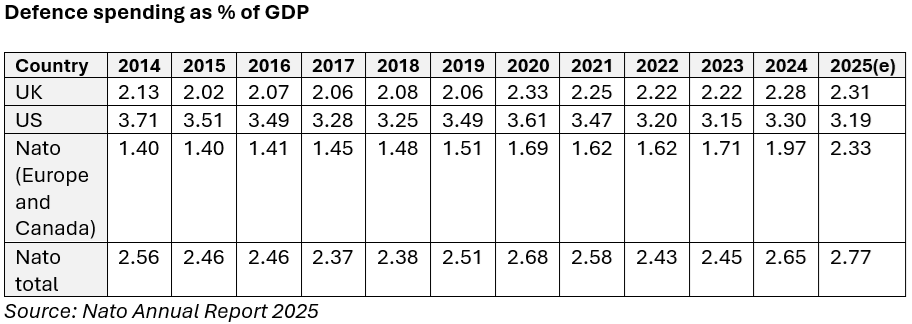
At 2.31%, UK defence spending is below the 2.77% average across the alliance, and even lower than the Europe and Canada average, if the United States’ giant budget is discounted, of 2.33% of GDP.
The UK’s own methods for calculating defence spending broadly follow Nato guidelines, to include costs such as pensions, R&D, infrastructure, civil servant costs, and military aid.
It is likely, if analysing defence expenditure centred on delivery of a warfighting capability that the UK’s military budget as a proportion of GDP is in the 1.5 – 1.7% range.
UK defence spending: as bad as it looks?
However, while a political headache in the macro sense, Nato’s downward revision is unlikely to impact perceptions among the UK populace, according to Fox Walker, defence analyst at intelligence firm GlobalData.
“At this time, increasing defence spending as a share of GDP is not a priority for the majority of voters who feel that the deteriorating global security landscape does not yet greatly impact their day-to-day lives,” suggested Walker.
Continuing, Walker said that while reaching 2.6% of GDP on defence may still be feasible by 2027, future increases towards the 3.5% goal will require challenging the “status quo” of giving more money to older demographics, including pensioners, and protecting the so-called Triple Lock, intended to secure pension increases.
“The public is therefore more likely to continue focusing on immigration figures and entitlements such as the Winter Fuel Payment than to become concerned that defence spending has been revised down as a share of GDP,” Walker stated.
How does the UK compare?
Analysing the data from the Nato report further, and the UK is lagging behind 13 Nato members who were spending more of their GDP on defence in 2025, including the Baltic states of Estonia (3.42%), Latvia (3.74%), and Lithuania (4%).
The data also shows that emergent Nato powers such as Poland (4.3%) and Türkiye (2.33%) could well position themselves as militarily more significant to the Alliance than the UK, given their ability to project conventional deterrent.
Germany has also seen a dramatic increase in defence spending when viewed through the GDP lens, increasing from 1.16% in 2014 to 2.39 in 2025, bypassing the traditional European powers of the UK and France.
Indeed, with anything up to 25% of the UK defence spending committed to maintain a nuclear deterrent that may or may not be actually functional, the UK’s ability to project conventional force is drastically reduced, with cuts across its Armed Forces, and in particular, the land and naval domains.
The UK has been criticised in recent years, particularly by the United States, for being unable to maintain its Nato commitments such as the sustained deployment of warfighting division, while its naval collapse means it is dependent on allies to fulfil its obligations.
At the 2025 Nato Summit, Allies made a commitment to investing 5% of GDP annually on core defence requirements and defence- and security-related spending by 2035. Included in this, is a concession to permit 1.5% of GDP to be spent on projects related to critical national infrastructure and civil resilience.


