
Maxwell Innovations, a small unmanned aerial systems (sUAS) and subsystems developer, has won the Innovation, Research & Development, and Product Launches awards in the 2025 Airforce Technology Excellence Awards, in recognition of its coherent strategy that connects frontline needs to design, production, and deployment.
The company earned the recognition for a coherent strategy that connects frontline needs to design, production, and deployment. It won the Innovation award for its groundbreaking approach to airborne electronic warfare, addressing critical gaps in modern conflict environments. It received the Research & Development award for establishing a sovereign, vertically integrated UAV ecosystem that accelerates design and production cycles. The Product Launches award recognizes Maxwell for introducing a new generation of modular, mission-adaptable UAV platforms tailored to the demands of today’s contested airspace.
Go deeper with GlobalData


Discover B2B Marketing That Performs
Combine business intelligence and editorial excellence to reach engaged professionals across 36 leading media platforms.
“These awards highlight the strength of our engineering culture and our commitment to building a fully sovereign unmanned systems ecosystem. At Maxwell, we focus on rapid iteration, modular architectures, and AI-driven autonomy — and it’s rewarding to see these efforts recognized on an international stage”, said Ahmet Fehmi Özcan, CTO, Maxwell Innovations Aerospace Industries.
“Barracuda’s airborne EW capabilities, the modular Manta Ray family, and our scalable MX platforms reflect our mission: to give our partners adaptable, mission-ready systems for contested environments. In the coming year, several of these technologies will move from development to real-world operations, further strengthening the capabilities of the forces we support. I’m proud of our team and excited for what comes next”, Ahmet added.

Innovation: Airborne electronic warfare that addresses a tactical gap
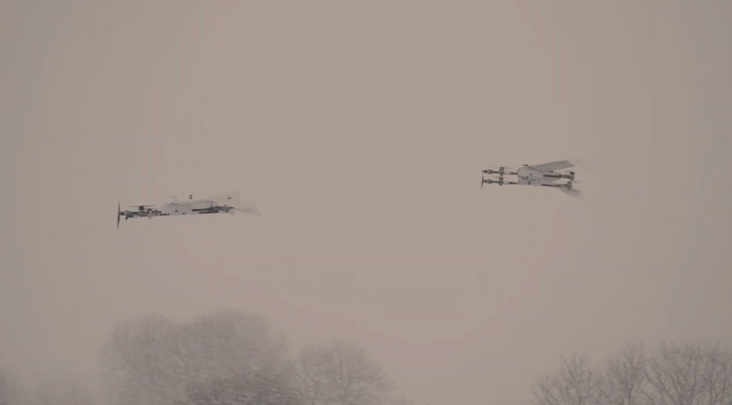
Maxwell’s Barracuda UAV redefines how electronic warfare is delivered in the field. Traditional ground-based jammers often lose effectiveness in complex environments such as mountains, forests, or dense urban areas due to terrain obstacles and limited line of sight. Barracuda overcomes these challenges by taking EW capabilities airborne. As a modular electronic vertical take-off and landing (eVTOL) platform, it provides persistent coverage from above, following maneuvering forces or protecting static assets as needed.
Barracuda is designed to perform three critical functions in a single sortie: suppress hostile radio frequency (RF) links, deliver intelligence, surveillance and reconnaissance (ISR) with electrooptic (EO) / infrared (IR) confirmation, and deploy hard-kill first-person view (FPV) drones when jamming alone is not enough. Its field-reconfigurable architecture allows crews to switch roles at the edge in under 30 minutes—changing wings, propulsion units, or payloads to adapt to different mission profiles. For example, during mountain border patrols, one Barracuda can scan for hostile frequencies while another, configured for jamming, suppresses those bands. A third variant can launch FPV interceptors against identified threats.
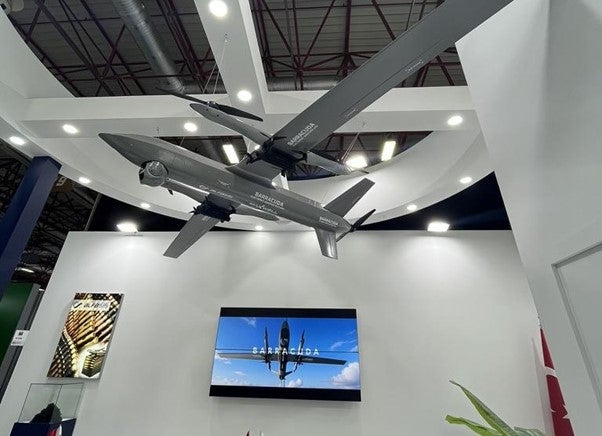
Photo: Maxwell Barracuda VTOL UAV for EW with hard-kill capabilities launched at IDEF 2025 with EW solution partner Alfasis.
The airframe’s biomimetic design and low radar cross section enhance survivability and allow operations closer to contested zones. Onboard artificial intelligence (AI) delivers real-time electronic warfare (EW) mapping and coordinates jamming and ISR while preserving friendly communications. Health and usage monitoring systems enable predictive adjustments during missions. In urban or valley scenarios, Barracuda’s elevated 360-degree coverage closes blind spots and enables rapid deployment of FPV interceptors. At sea, it can be launched from ship decks to protect convoys by jamming control frequencies and deploying interceptors as needed.
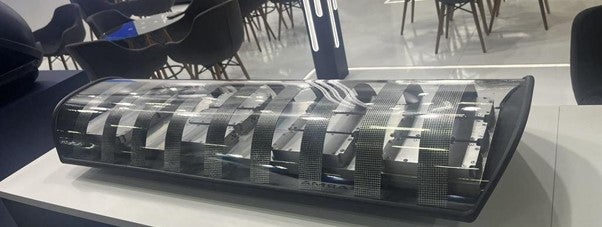
The integration strategy behind Barracuda is also notable. Maxwell supplies the modular eVTOL airframe and flight control architecture, while Alfasis provides compact, high-efficiency EW payloads optimized for airborne use. This partnership results in a scalable airborne asset that brings electronic suppression and kinetic overwatch to environments where traditional countermeasures have struggled. Barracuda directly addresses operational gaps identified in recent conflicts by providing flexible, reconfigurable EW capabilities suited for modern warfare.
Research and development: Building a sovereign UAV ecosystem at scale
Maxwell’s R&D and production campus is more than just a facility—it is a vertically integrated ecosystem designed to accelerate development cycles and ensure supply chain security. By bringing together design, rapid prototyping, environmental testing, and flight validation under one roof, Maxwell streamlines the path from concept to deployment.
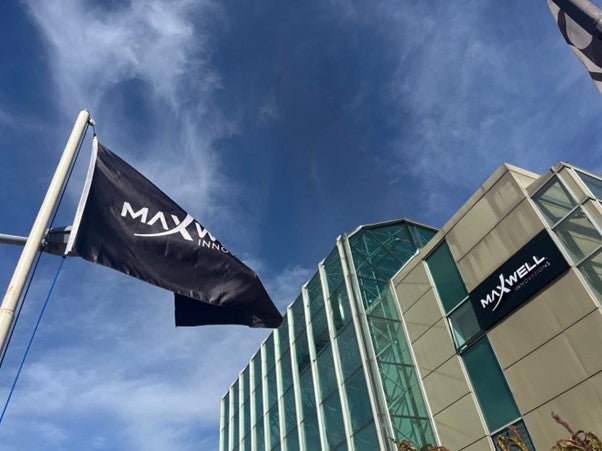
The campus features specialized labs for additive manufacturing, composites and polymers, precision machining, propulsion systems, avionics, AI/autonomy, payload integration, ground and environmental testing, reverse engineering, and flight training. This setup allows software and hardware teams to collaborate closely, solving integration challenges quickly and efficiently.
Sovereignty is central to Maxwell’s approach. All subsystems are developed in-house using non-Chinese components, aligning with NATO and allied export requirements while reducing supply chain risks. The EO and Payload Systems Lab supports advanced ISR packages; the Ground and Environmental Testing Lab handles stress testing; and the Reverse Engineering Lab addresses obsolescence by enabling local redesigns when needed. The Flight Testing and Training Field ensures operational validation and supports client training programs.
Maxwell aims for a production capacity of up to 1,000 small-class and 50 mid-size UAVs per month by 2026—figures that reflect the realities of high-intensity conflict where rapid replenishment is essential. The campus also serves as a hub for workforce development and regional industrial growth. By consolidating all stages of UAV development and production, Maxwell positions itself as a source of continuous innovation in next-generation airpower.
Product launches: Mission-centric, modular combat platforms for EW-contested battles
Maxwell’s 2025 UAV lineup is designed for adaptability in contested airspace. All platforms share standardized payloads, batteries, and interfaces, which simplifies logistics and enables rapid reconfiguration in the field. This mission-centric approach supports manned-unmanned teaming, mass deployment strategies, and urban operations where flexibility is crucial.
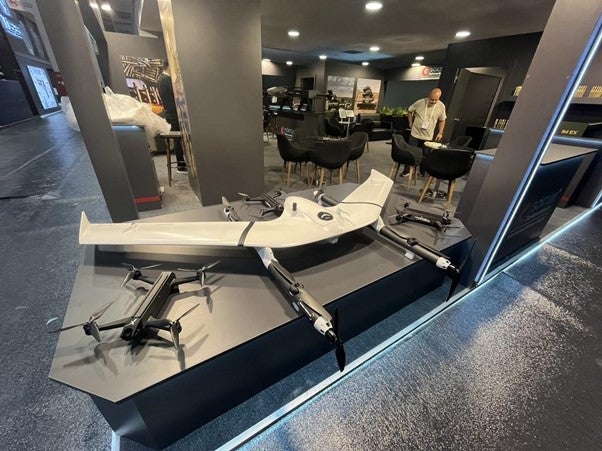
The Manta Ray family illustrates this adaptability: it includes ISR VTOL variants for mass deployment, long-endurance fixed-wing models for wide-area surveillance, and short-wing kamikaze versions suited for swarm tactics. The MX FPV Tactical Loitering System is built for industrial-scale production with standardized mounts for munitions and sensors—making it easy to reload and deploy at scale with minimal pilot training.
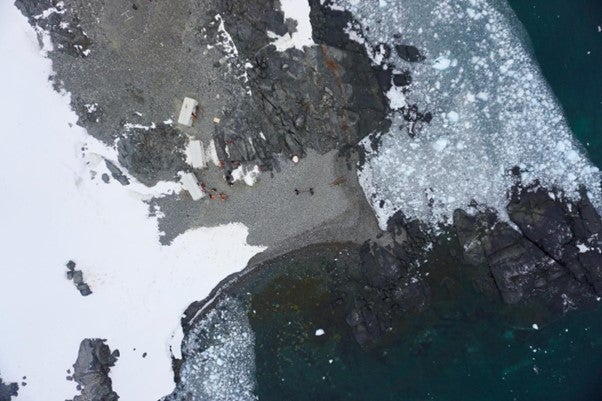
The MX8 Mark III heavy octocopter builds on an airframe tested in Antarctic conditions. It is now optimized for high-altitude logistics, ISR missions, and medium-payload tasks with rugged construction and swappable payloads. The MX‑Tethered ISR Node provides persistent surveillance at up to 100 meters altitude with uninterrupted power—ideal for base security or convoy overwatch in jammed or denied environments.
Barracuda also features prominently in the product lineup as an autonomous jammer platform with onboard FPV interceptors—a self-contained anti-drone unit for spectrum denial missions. Across the range, all systems use non-Chinese subsystems developed in-house to ensure compliance with export controls and operational sovereignty. Smart payloads such as MWIR sensors, Lidar units, and smart geotaggers further enhance flexibility without complicating logistics.
By focusing on standardization and modularity, Maxwell shifts the emphasis from platform-centric procurement to mission-centric employment. Operators can configure UAVs for ISR, jamming, strike missions, or persistent observation using shared ground control infrastructure and common components. This approach addresses the need for adaptability, scale, and trusted supply in modern air operations.
“This recognition is a testament to our team’s relentless pursuit of progress. Winning three Airforce Technology Excellence Awards signals how far Maxwell has come — and how fast we are moving”, said Orkut Aktaş, CEO, Maxwell Innovations Aerospace Industries. “What we’ve shown so far is only a glimpse of what’s next: within the next year, several of these awarded technologies will transition from the lab to active field operations, strengthening the capabilities of our partners and shaping the future of autonomous air systems”, added Orkut.
Company Profile
Maxwell Innovations, founded in 2014 by a team of visionary engineers from Istanbul Technical University, is at the forefront of aerospace technology innovation. Their mission is to design and engineer cutting-edge aerospace systems that can thrive in the most challenging environments, with a relentless focus on reliability, safety, and efficiency. Inspired by the Skunk Works ethos, they specialize in rapid prototyping and top-secret projects, consistently setting new industry standards. Their portfolio includes the groundbreaking payload and subsystems like Health and Usage Monitoring System (HUMS), advanced VTOL platforms like the Manta Ray and Jackal and 5-seater Skysled eVTOL system, and a highly efficient electric and Hybrid Propulsion Units.
Contact Details
Orkut Aktaş – Founder/CEO
E-mail: orkut.aktas@maxwell-innovations.com
Fehmi Özcan – Co Founder/CTO
E-mail: fehmi.ozcan@maxwell-innovations.com
Links
Website: http://www.maxwell-innovations.com/


