

B61-12 is a variant of the B61 family of air-launched nuclear gravity bombs, which have been operational with the US military since 1968. The variant is intended to improve the nuclear capabilities of the US Air Force and allied nations.
The bomb can be air-launched by the aircraft platforms such as B-2A, F-15E, F-16C/D, F-16 MLU, PA-200, F-35, and B-21.
Recommended Buyers Guides

The B61-12 variant development is part of the B61-12 Life Extension Programme (LEP), which is a joint effort between the US Air Force and the National Nuclear Security Administration (NNSA).
Sandia and the wider nuclear security enterprise finished assembling the final B61-12 nuclear gravity bomb production unit in December 2024, marking the completion of the programme.
The programme has now moved into stockpile sustainment and continues manufacturing spare parts and carrying out closeout activities through fiscal year 2026.
B61-12 nuclear bomb development and flight testing
The goal of the B61-12 LEP is to overhaul and replace the ageing non-nuclear components, such as fuses and batteries, of the existing B61 bomb variants, notably B61-3, B61-4, B61-7, and B61-10.
The programme was initiated to extend the B61 bomb’s service life by 20 years while increasing safety, security and reliability.
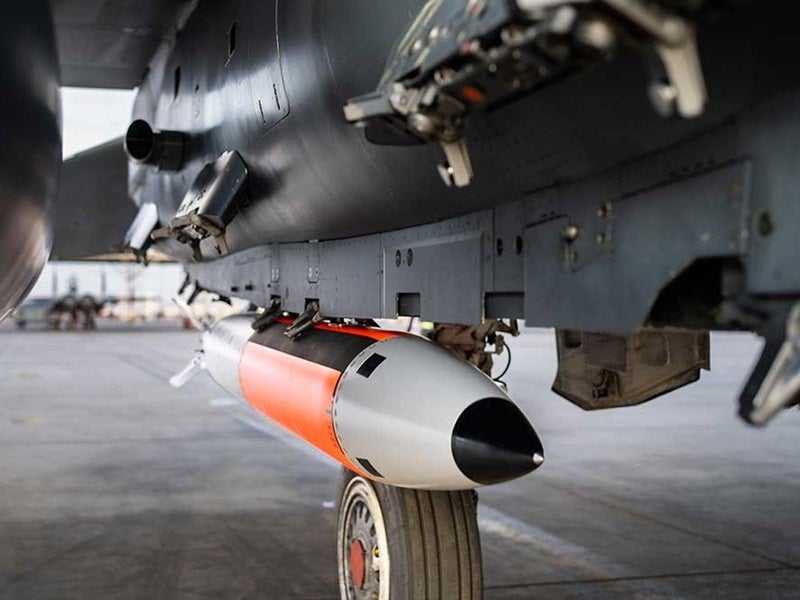
The development engineering of the B61-12 LEP began in February 2012. The first development flight test of the bomb was conducted by an F-15E Strike Eagle multi-role fighter in July 2015, and the baseline design review was completed in January 2016.
The weapon entered its production engineering phase in June 2016, and its first system qualification test flight was conducted from the US Air Force’s F-16C Fighting Falcon aircraft in March 2017.
Two non-nuclear system qualification flight tests of the bomb were completed in July 2018. The B61-12 non-nuclear test bomb assembly was released by a B-2A Spirit Bomber during the tests.
The B61-12 nuclear bomb completed its successful flight tests with the US Air Force’s F-15E in June 2020. It was dropped from above 25,000ft and was in the air for approximately 55 seconds before hitting the target.
In November 2021, Sandia National Laboratories, a US Department of Energy (DOE) science and engineering laboratory, completed production of the first fully refurbished warhead for the B61-12.
Working with the DOE’s NNSA, Sandia completed a series of successful stockpile flight trials at Tonopah Test Range in Nevada, with aircraft support provided by Hill Air Force Base in Utah in 2025.
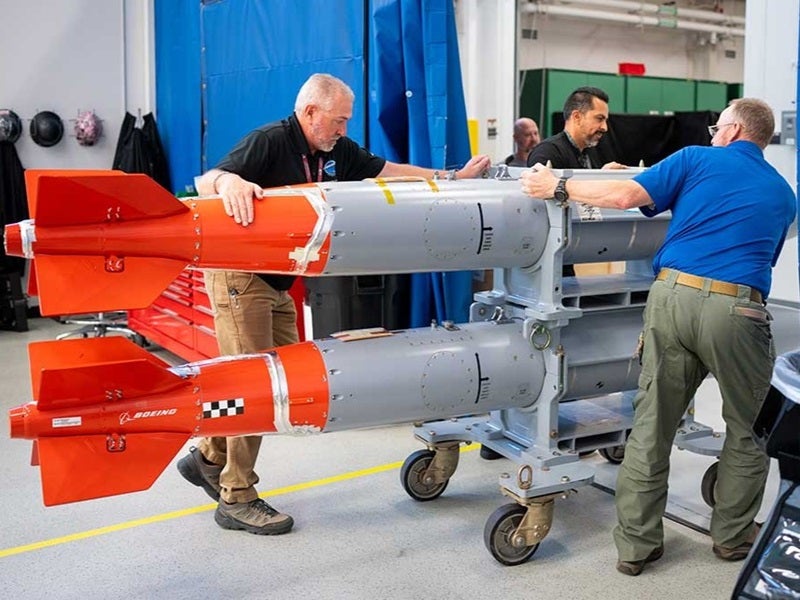
The trials saw inert B61‑12 units carried and released by an F‑35, representing an important milestone in assessing the weapon’s operational characteristics.
As part of the LEP, Sandia refurbished, replaced or repurposed approximately 50 components and subsystems that comprise the B61‑12.
B61-12 nuclear bomb design and features
The B61-12 nuclear weapon has a length of 12ft and weighs approximately 825lb. It can be fired at the target in either ballistic gravity or guided drop modes.
The weapon is based on the B61-4 warhead and boasts two main assemblies: the bomb assembly and tail kit guidance assembly. The bomb assembly comprises reused, refurbished, and the latest nuclear and non-nuclear components.
The tail kit guidance assembly combines guided freefall capability with the existing ballistic (unguided) delivery capability of the B61 bomb.
Equipped with four manoeuvrable fins, the tail section offers high levels of accuracy and limited stand-off capability over the previous variants.
Warhead and guidance of the B61-12
The B61-12 air-launched tactical bomb carries a low-yield nuclear warhead to destroy military targets with minimum collateral damage. Located in the bomb’s middle section, the warhead has four yield options, including 0.3 kilotonnes (kt), 1.5kt, 10kt, and 50kt.
The bomb uses an inertial navigation system (INS) to achieve high kill probability while improving the survivability of the launch platform. The weapon is expected to have an accuracy of approximately 30m.
Key players involved with B61-12 LEP development
Los Alamos National Laboratory and Sandia are responsible for providing design and engineering for the bomb. Los Alamos produced detonators and other classified components while Sandia produced custom electronics, including neutron generators, for the bomb.
The tail kit assembly for the B61-12 bomb was developed by Boeing under a $178m contract with the Air Force Nuclear Weapons Center (AFNWC), which is responsible for technical integration and system qualification of the tail kit assembly.
Kansas City National Security Campus oversees the manufacturing of 39 non-nuclear component assemblies covering firing, safing, and use control components.
The reproduction of components made of uranium and other materials was performed by the Y-12 National Security Campus. The Pantex Plant was responsible for producing high explosives, requalifying the B61 pit, and performing final assembly of the bomb.
The testing, evaluation and replenishment of the gas transfer system was performed at the Savannah River Site.
Details of B61-13 gravity bomb
B61‑13 is the latest addition to the B61 family of nuclear weapons, announced in October 2023.
It is part of seven current warhead modernisation programmes being carried out by the NNSA to maintain the reliability and effectiveness of the nuclear stockpile.
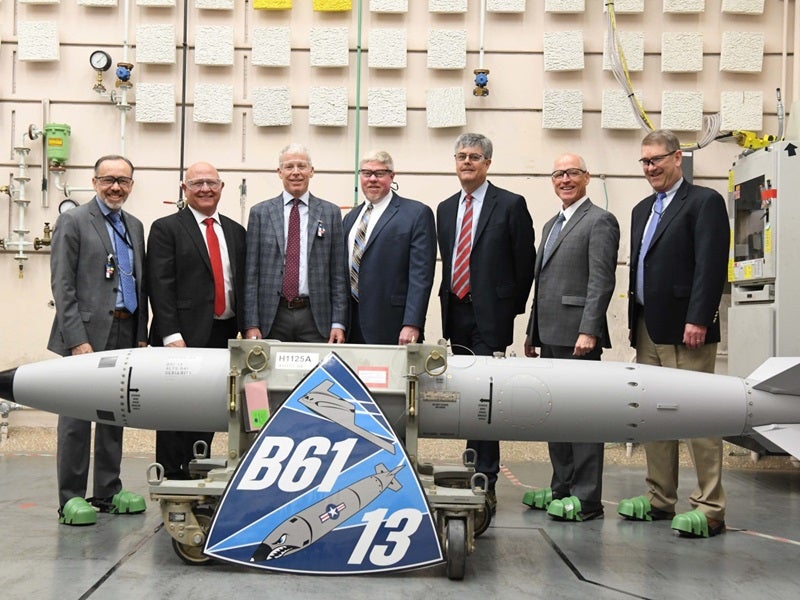
In May 2025, the NNSA completed production of the inaugural B61‑13 gravity bomb at the Pantex Plant.
The B61‑13 represents one of the fastest developed and deployed additions to the B61 family since the Cold War.
The modification drew on established production practices developed for the B61-12. It retains the B61-12’s modern safety, security and accuracy enhancements while offering a yield profile tailored to defeat specific hardened and large-area military targets.
The B61-13 provides a higher yield than the B61-12 while maintaining the latter’s modern safety, security and accuracy features.
Its introduction does not raise the total number of weapons in the US stockpile. The planned B61-13 production was offset by a corresponding reduction in B61-12 units, keeping the combined build aligned with original projections.
