
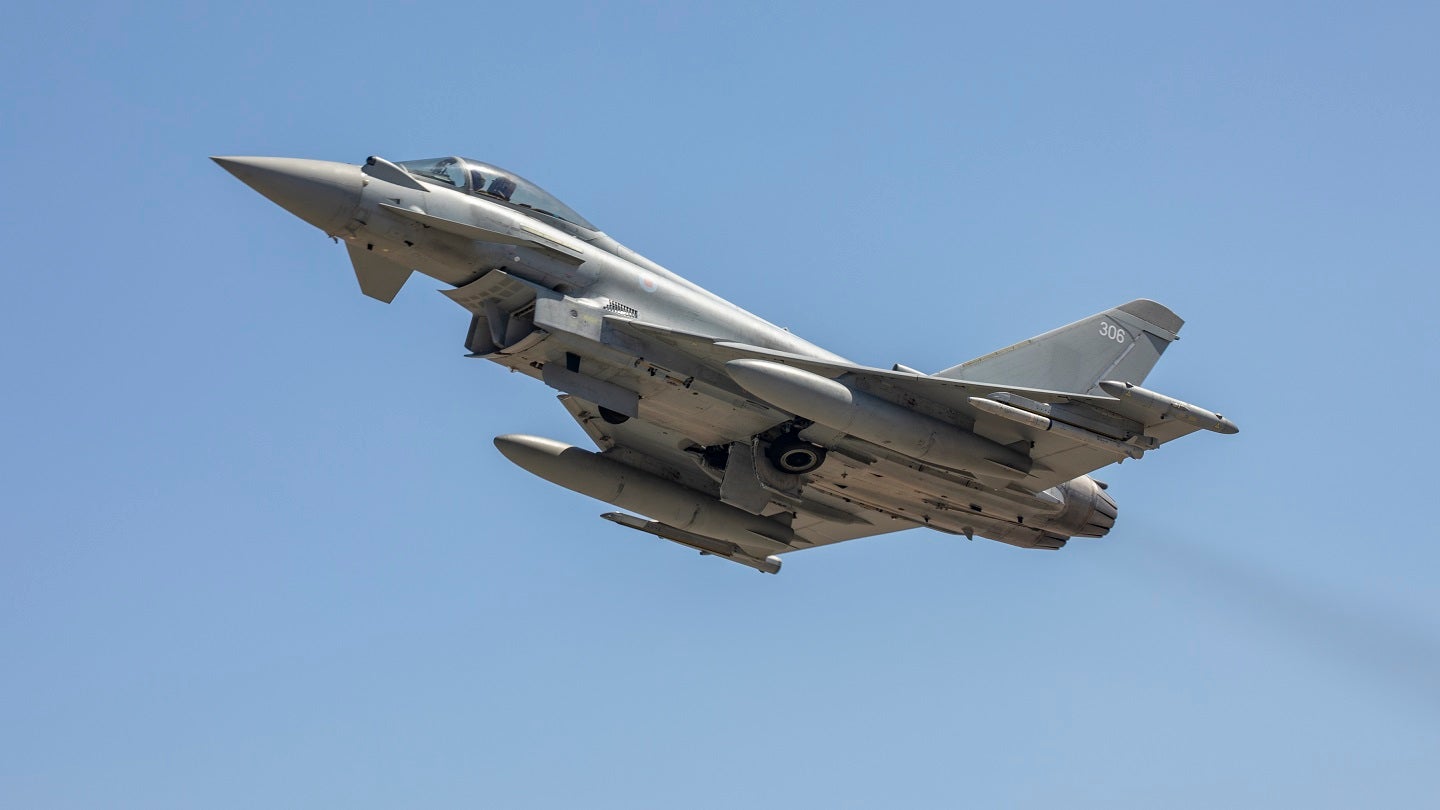
- RAF Typhoons deployed to defend Saudi airspace from Houthi strikes
- The UK also deployed previously refuelling aircraft and air defence systems
- The mission follows attacks on Saudi oil infrastructure and Riyadh airport
UK Royal Air Force (RAF) Eurofighter Typhoon FGR4 multirole fighters are being deployed to Saudi Arabia to help the Gulf state defend its airspace against “escalating Houthi attacks in the region”, according to the UK Government.
Detailed in a 20 October release, the UK Government stated that the RAF Typhoons would fly “defensive counter air missions” over Saudi Arabian cities and critical national infrastructure.

Discover B2B Marketing That Performs
Combine business intelligence and editorial excellence to reach engaged professionals across 36 leading media platforms.
The fighter, while capable of performing ground attacks, would not conduct kinetic operations against Houthi targets, the UK Government added.
In addition, the RAF will also deploy an A400M Atlas transport aircraft to “support the movement of defence materiel within Saudi Arabia”, along with UK military advisors to support Saudi staff officers.
“RAF Typhoons will fly defensive air missions to help protect Saudi airspace from drones and missiles,” said UK Defence Secretary Wes Streeting.
The UK already has Voyager air-to-air refuelling aircraft stationed in the Gulf region that support Saudi Arabian air strikes against Houthi targets in Yemen.
Earlier in 2026 the UK deployed a battery of Sky Sabre air defence systems to King Fahd Air Base in Saudi Arabia to protect the site during the peak of the US-Iran crisis. The battery is operated by the British Army’s 16th Regiment Royal Artillery, part of the 7th Air Defence Group.
Escalating attacks by Houthi forces in Yemen, aided by Iran, have targeted Saudi Arabia’s infrastructure in 2026, with recent strikes against Riyadh airport and the country’s oil fields causing considerable damage.
Combined with the closure of the Strait of Hormuz resulting from the US-Iran war and Iranian strikes on Qatar, Oman, the UAE, Bahrain, Kuwait, and Saudi Arabia, the Gulf region has seen considerable instability through 2026, causing a global spike in fuel costs.
Pre-war disposition of UK personnel in Middle East
According to the UK Governments Annual Location Statistics published in July this year, the UK Armed Forces had 5,570 personnel stationed overseas as at 1 April 2025, a slight decrease from the same period in 2024, and down by around 17,000 from April 2012.
For bases in the Middle East, or locations with a focus on the region, UK sites in Cyprus accounted for 2,160 personnel, around 40 at Diego Garcia, and about 320 at various sites in the Middle East and North Africa.
Of those in the Middle East and North Africa, around 10 were based in Bahrain in 2024, a year-on-year reduction from the previous two years, while the number for 2025 was withheld. Given the UK’s winding up of its maritime patrol mission in the Middle East prior to the US-Iran war, the requirement for base operations staff in Bahrain will be minimal.
Elsewhere, around 40 personnel were based in Kuwait, 70 in Oman, 10 in Qatar, 100 in Saudi Arabia, and 20 in the UAE.
All these figures represent the numbers prior to the US-Iran war or the latest UK deployment to Saudi Arabia.


