

See GlobalData’s recently published report on drones in aerospace and defence for more information.
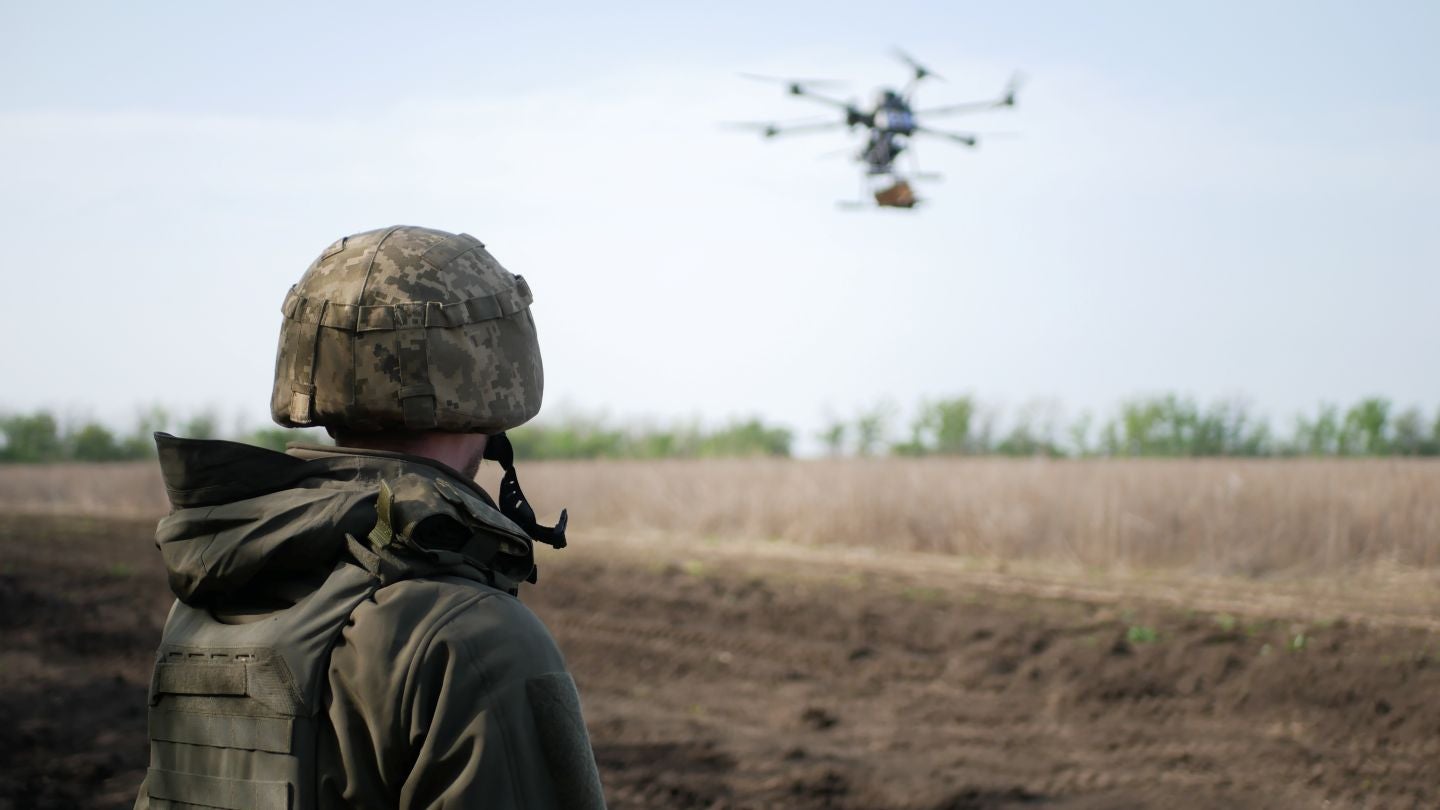
One of the most alarming statistics from the frontline of Russia’s war against Ukraine is the exponential deployment of uncrewed aerial systems (UAS). In 2023, Ukraine launched an estimated 10,000 drones per month; in 2025, this number rose to 10,000 launches per day, marking a 3,000% increase. This change to the character of high-intensity land warfare is fueling a global race to develop robust UAS supply chains.
Go deeper with GlobalData


Access deeper industry intelligence
Experience unmatched clarity with a single platform that combines unique data, AI, and human expertise.
For years, analysts speculated that the United States did not have any ongoing contracts for the mass production of drones because of the rampant innovation within the small drones market. Indeed, of the many drone variants in Russia’s war in Ukraine, even the most elite can be rendered redundant within a few weeks because of counter-drone technology enhancements. Given recent US military interventions in Iran and Venezuela—and discussion of military action elsewhere—the United States seeks to demonstrate its capabilities in key areas of emerging military technologies.
Now, the Pentagon has launched its ‘Drone Dominance Program’ to prove to its allies and adversaries alike that its supply chains are capable of producing drones at scale. The US Department of Defense (DoD) will receive 300,000 one-way unmanned systems in the coming years, with expectations of more than 200,000 delivered by the end of 2027. The Drone Dominance program is designed to equip soldiers with low-cost, disposable drones for use in combat missions, following lessons learned from Russia’s war against Ukraine. By producing so many units, the DoD aims to lower the per-unit cost of each drone and drive competition between drone production companies, who will be eager to deliver a larger contract.
The American procurement process is historically regarded as slow and often overly focused on high-cost, sophisticated systems. The Drone Dominance Program represents a turn toward a balanced procurement strategy that favours ‘precise mass,’ as the Pentagon seeks to eliminate the choice between procuring a large number of unsophisticated systems or developing a smaller but more accurate arsenal. The large defence budget of the United States allows it to spend billions of dollars on novel, cheap devices while still maintaining an impressive range of high-tech ‘boutique’ and ‘exquisite’ platforms, such as the bunker buster bombs used against Iran’s nuclear facilities.
The growth presented in the above global military UAV forecast, 2025–35 is not driven exclusively by the United States, Russia, and Ukraine, however. Of course, countries across the globe continue to make investments in large UAV platforms, such as HALE and MALE drones. But some other relatively large armed forces are actively procuring thousands of drones for their own stocks and the Ukrainian military. For example, the United Kingdom will send 100,000 drones to Ukraine in 2025, which represents a 10x increase from their 10,000 drones delivered in 2024. At this time, any military threat remains distant enough that the UK can distribute its stockpiles to Ukraine while balancing the production of new variants which may subsequently be produced at scale. Poland, by contrast, feels the need to maintain a meaningful arsenal due to its proximity to Russia and Belarus. The Polish military is procuring 10,000 Warmate loitering munitions to support its deterrence efforts, even as it donates billions in funding and support to Ukraine.
Despite these recent developments, it is important to put these figures into perspective. America’s 300,000 sUAS from the Drone Dominance Program represent a month’s supply of drones in Ukraine. While the 100,000 drones from the United Kingdom to Ukraine are surely appreciated, this represents a ten-day supply, and this pales in comparison to the 4-5 million drones produced by Ukraine in 2025. Poland’s 10,000 Warmate loitering munitions represent a mere day’s supply. Of course, the quality, purpose, and circumstances of a drone’s use determine its utility—so a Polish Warmate may prove a better fit than the mass-produced prototypes often used on the battlefield in Ukraine. The much-discussed fibre-optic drones used in the war reportedly do not hit their target as much as 80% of the time.
Finally, drones produced for non-military purposes can be converted into defence systems, so the scale for the military UAV market has considerable room to expand. In July 2025, the Center for Strategic and International Studies (CSIS) released a report that claimed nearly half of Ukraine’s annual defence procurement spending is made up of commercial technology. Drones, once used for construction, surveillance, and other civilian activities, are being bought directly by unit commanders to be repurposed for military applications.

