

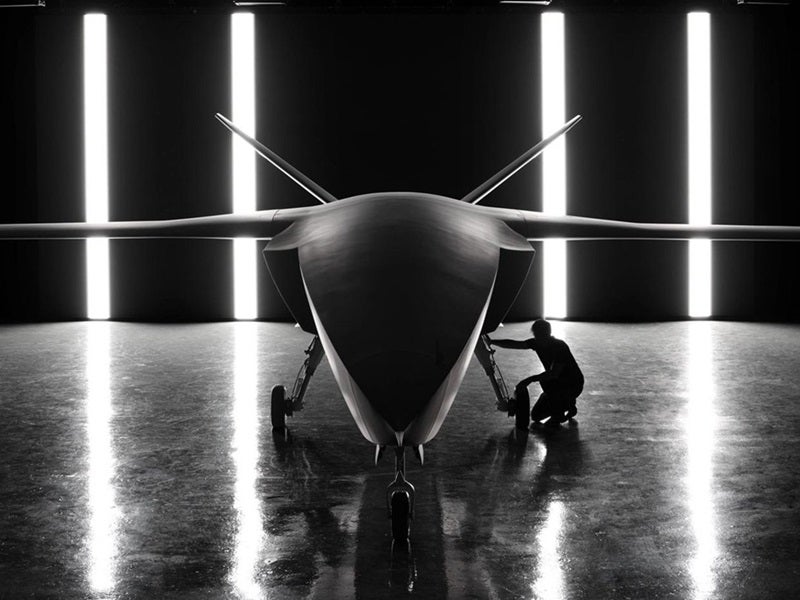
The CA‑1 Europa is an autonomous, uncrewed combat aerial vehicle (UCAV) being developed by Helsing, a European defence technology company.
Designed as a multi‑role drone optimised for high subsonic performance, the UCAV has been conceived for intelligent mass deployment.
Recommended Buyers Guides

Helsing is developing the CA‑1 Europa in partnership with organisations across the European aerospace sector, prioritising scalability and a resilient European supply and logistics chain.
Development and flight testing are being conducted at Helsing’s subsidiary Grob Aircraft.
A full‑scale design study of the aircraft was unveiled at Grob Aircraft in September 2025. A production variant of the jet is expected to enter service within the next four years.
The aircraft is expected to carry out a wide range of missions for the UK and offer combat air capabilities to the UK Royal Air Force (RAF).
CA‑1 Europa design and features
The CA‑1 Europa measures approximately 11m in length with a wingspan of 10m and a maximum take‑off weight of around four tonnes.
The platform includes an internal weapons bay. Its highly scalable airframe is designed for mass production and pairs with capable but cost‑efficient payloads.
The aircraft’s modular architecture allows rapid capability upgrades and the integration of countermeasures to address emerging threats. It can operate autonomously as an individual unit or as part of a coordinated swarm.
The system runs an advanced software operating environment to support flexible integration of sensors, self‑protection systems, effectors and applications that provide enhanced situational awareness and mission management.
Helsing will also supply a command‑and‑control system to assist operators with mission planning, oversight and surveillance during complex autonomous operations.
The CA‑1 development programme incorporates three advanced artificial intelligence systems intended to close capability gaps in contested airspace, including Centaur, Cirra and Symphony for Mission Operations, which coordinates functions across distributed assets, enabling rapid mission insight generation and expedited capability updates.
Centaur AI for autonomous combat
Centaur embeds AI pilots into the cockpits of current and future fighter platforms, improving precision, speed and adaptability.
Using scaled reinforcement learning, the solution is claimed to deliver human‑equivalent performance in air combat, enhancing decision‑making and tactical execution.
Employed alongside Helsing’s mission systems, the Centaur stack enables the delivery of precise effects across diverse mission profiles.
Cirra for electronic warfare
Cirra employs deep learning to classify emitters and infer the intent of previously unseen air‑defence systems.
Rather than relying solely on signature matching against known radars, Cirra models the behavioural patterns of emitters, improving combat readiness and survivability for aircraft operating in high‑threat environments.
Its algorithms run onboard to provide real‑time threat analysis and intent recognition for unknown emitters, supported by a dedicated compute stack that processes incoming signals and assists the pilot throughout the mission.
The modular processing pipeline can be integrated, in whole or in part, with a range of electronic warfare (EW) suites.
The Cirra Ground Station collects and analyses EW data offline, closing the tactical loop through automation. Its data management stack focuses on security and integrity while using modern storage technologies to scale across large numbers of EW assets and missions.
By leveraging historical sortie data, the Ground Station creates a continuous improvement cycle. Cirra’s analytics help refine mission libraries, while automation validates evolving radar capabilities against historical, real and synthetic mission datasets.
CA-1 Europa mission capabilities
The CA‑1 Europa is intended for fully autonomous operation in contested and denied environments and is suitable for a range of missions, including deep precision strikes.
The platform is designed to be deployed in large numbers for sustained, high‑tempo operations.
Optimised for cost‑effective, high‑end force projection, it supports dispersed logistics and can operate from improvised sites with minimal infrastructure.
