

The Collaborative Combat Aircraft (CCA) programme proposed by the US Air Force (USAF) is a multi-pronged initiative to test, develop and implement new autonomous and manned-unmanned aircraft teaming concepts.
Deploying collaborative, mission-focused CCAs at a large scale is seen as a cost-effective and pragmatic solution to possess a formidable airpower capacity in response to proliferating hostile stealth fighters.
Recommended White Papers
Recommended Buyers Guides

In 2024, the USAF issued early development awards to five companies to design and build the aircraft, namely Anduril, Boeing, General Atomics Aeronautical Systems (GA-ASI), Lockheed Martin and Northrop Grumman.
Later that year, the USAF selected Anduril and GA-ASI to produce Increment 1 production-representative test articles, with more than 100 aircraft envisaged across the first five years of the programme. The service is aiming to deliver an operational CCA capability before the end of the decade.
Preliminary activity on Increment 2 is currently under way, with plans to engage with more than 20 companies, including some that were not chosen for Increment 1.
Several Increment 2 contract awards are expected in the early part of fiscal year 2026 (FY26), with overseas suppliers also in contention.
The first batch of CCAs is expected to enter the USAF’s inventory in the late 2020s, with the early operational capability goals under the programme expected to be achieved by 2030.
The USAF is also exploring international partnerships, including potential foreign military sales, under the CCA programme. The partnerships are further expected to bring affordable mass at scale while enabling horizontal integration and interoperability between the partners.
CCA programme details
The CCA programme is intended to rapidly deploy large numbers of autonomous unmanned aircraft, officially designated as CCAs, to team with the fifth or sixth-generation manned fighter aircraft.
It is part of the USAF’s wider Next Generation Air Dominance (NGAD) programme that envisions a system-of-systems approach with next-generation fighter aircraft, weapons, sensors, networking and battle management systems to maintain air superiority in the coming decades.
The CCAs can harness cutting-edge disruptive technologies such as autonomy, machine learning and AI to maximise the safety and performance of current and future fighter fleets for agile combat employment.
In March 2023, the USAF Secretary revealed plans to pair at least 1,000 uncrewed CCAs with advanced manned fighters in the near future.
The plan is tentatively based on the assumption of teaming two CCAs with each of the 200 NGAD platforms and 300 F-35s.
In FY25, $678m in mandatory research, development, test and evaluation (RDT&E) funding was allocated for the CCA programme, which the USAF carried forward within its FY26 budget submission.
In its FY26 request, the USAF sought $126.4m in discretionary funding for CCA, comprising $111.4m for RDT&E and $15m for procurement. When the mandatory element is included alongside the discretionary request, the USAF set out a combined FY26 total of $804.4m for the programme.
CCA programme Increment 1 details
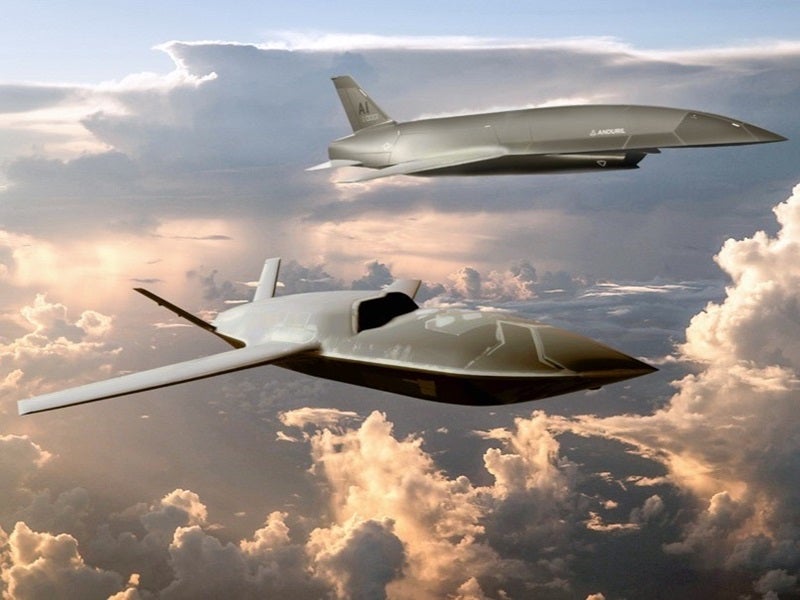
In 2023, Anduril acquired Blue Force Technologies, the developer of the Fury large uncrewed aircraft system. The company said it was investing in Fury to turn it into a high-performance, multi-mission aircraft suitable for the CCA role.
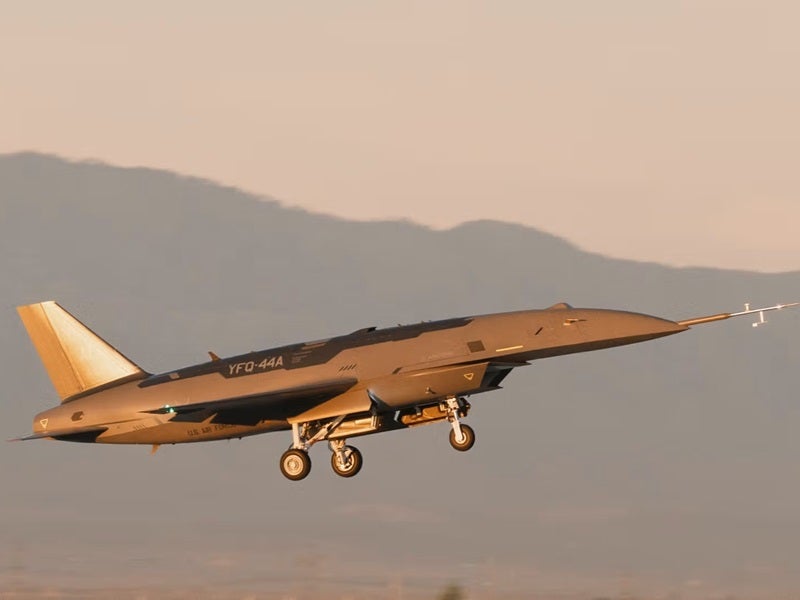
The platform is being paired with Anduril’s Lattice open-systems software to support human-machine teaming. In March 2025, the USAF assigned the prototype the designation YFQ-44A, and in October, the semi-autonomous aircraft completed its maiden flight.
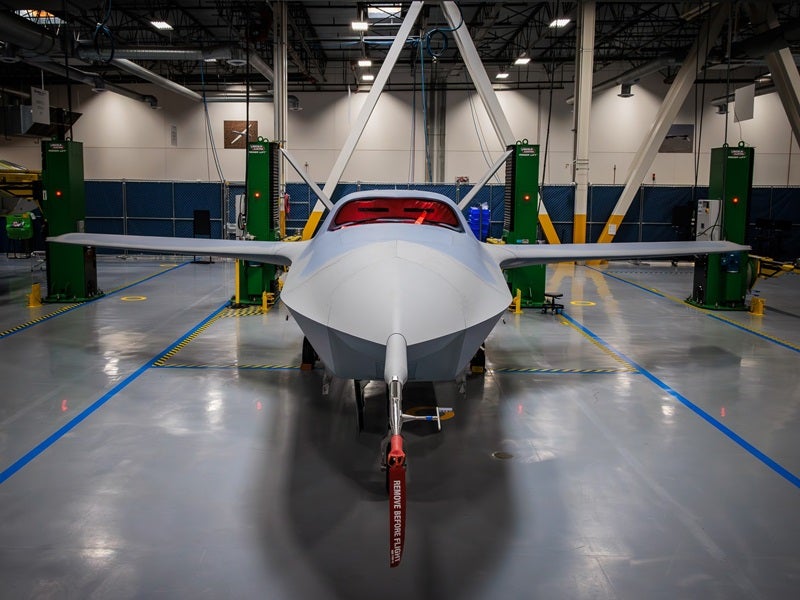
GA-ASI’s CCA bid was derived from its experimental XQ-67A platform, prioritising endurance rather than outright speed or manoeuvrability, with production of its first CCA having started in 2024.
The USAF designated the GA-ASI prototype as the YFQ-42A in March 2025, and the first pre-production YFQ-42A completed its maiden flight in August 2025.
The two aircraft are now in developmental trials in California and are also taking part in operational evaluations with an Experimental Operations Unit at Nellis Air Force Base, Nevada.
Separately, the USAF announced in May 2025 that Beale Air Force Base, California, is the preferred site for a CCA Aircraft Readiness Unit intended to support rapid deployment.
CCA design and operational capabilities
The proposed CCAs will comprise a new breed of significantly less expensive and highly autonomous, mission-focused, unmanned collaborative combat aircraft to fly along with fifth-generation and newer human-crewed fighter jets.
Equipped with a mission-customisable mix of sensors, weapons and other tactical systems, the CCAs will be different in form and function.
They will utilise cutting-edge AI-driven autonomous software to enable seamless and effective collaboration and augment the performance of manned combat aircraft by providing comprehensive situational awareness, greater lethality and improved survivability in highly contested environments.
CCAs will be interoperable with different types of USAF aircraft and designed to operate either as a manned aircraft teammate, an individual autonomous platform or as part of a swarm of collaborative drones without direct human supervision.
They can perform different missions – ranging from carrying weapons, flying ahead of other aircraft to provide intelligence, surveillance and reconnaissance, and relaying valuable early warning and evade detection – to electronic warfare and striking targets either on their own or with the rest of the force.
Fielding multiple collaborative aircraft can ensure comprehensive battlespace surveillance and agile combat employment from different altitudes at different angles, making mission planning more dynamic and flexible.
CCA development details
CCA is the USAF’s official designation for the popularly known loyal wingman uncrewed aircraft systems that are intended to accompany crewed fighter aircraft with similar flight characteristics and execute orders assigned to them by pilots.
The CCA development will leverage some of the existing crewed-uncrewed teaming efforts, including the Defense Advanced Research Projects Agency’s Air Combat Evolution (ACE) programme, the AFRL Skyborg programme and Boeing Australia’s MQ-28A Ghost Bat (Airpower Teaming System) project.
The ACE programme seeks to foster air combat autonomy performance by demonstrating AI-powered human-machine collaboration in aircraft dogfighting.
The objective of the Skyborg programme was to create an open autonomous aircraft teaming architecture and develop a modular and universal core autonomy control software, allowing the low-cost production and deployment of multiple collaborative drone variants alongside crewed fighter jets.
The CCA development will be based on the Skyborg autonomy core system.
Potential contenders for the CCA programme
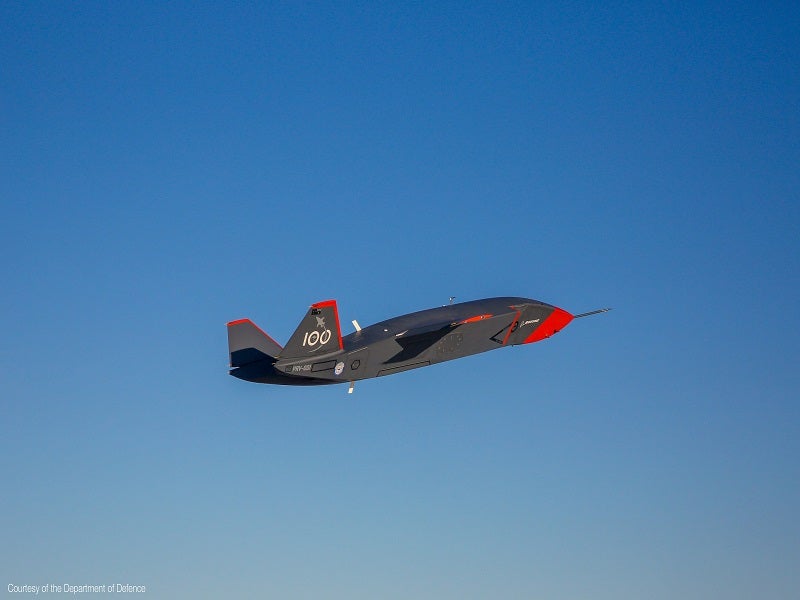
Boeing’s MQ-28A Ghost Bat, which achieved its first flight in February 2021 and was developed as part of the Royal Australian Air Force’s Airpower Teaming System programme, is one of the possible contenders for the CCA programme.
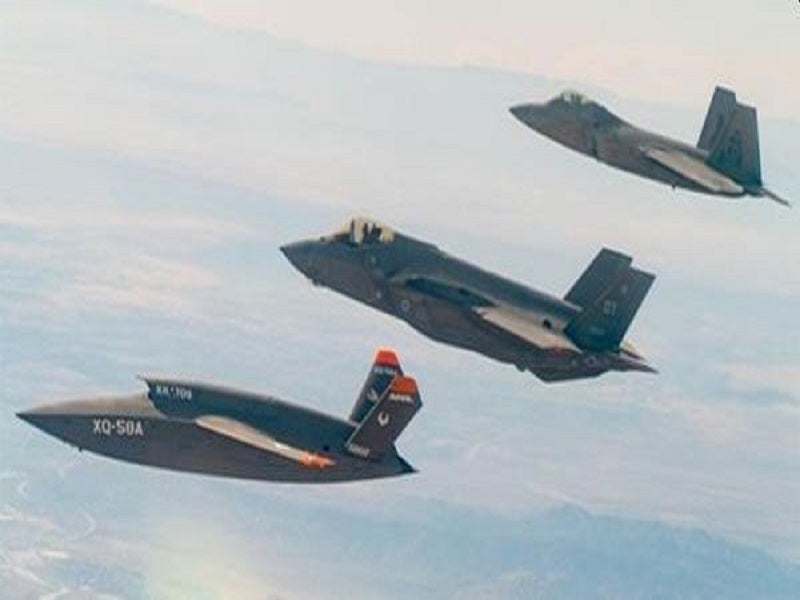
Kratos has developed a family of high-performance, CCA-type uncrewed teaming aircraft, including the Kratos Air Wolf Drone, UTAP-22 Makos and Kratos XQ-58A, each optimised for different mission capabilities.
Similarly, following the MQ-20 Avenger’s successful demonstration of autonomous capabilities, GA-ASI introduced the Gambit autonomous collaborative platform in March 2022.
The company’s Gambit family of unmanned collaborative combat aircraft includes the Gambit 1-ISR, the Gambit 2-Air-to-Air, the Gambit 3-High-Fidelity Trainer and the Gambit 4-Combat Recon.
