

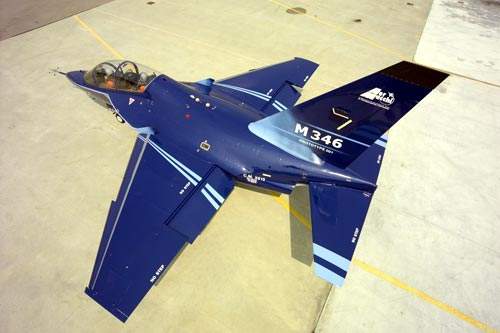
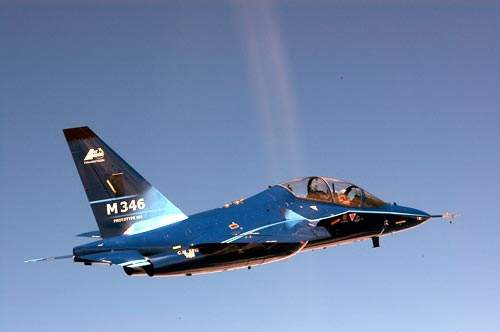
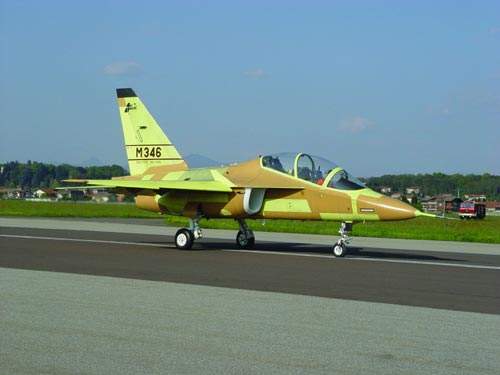
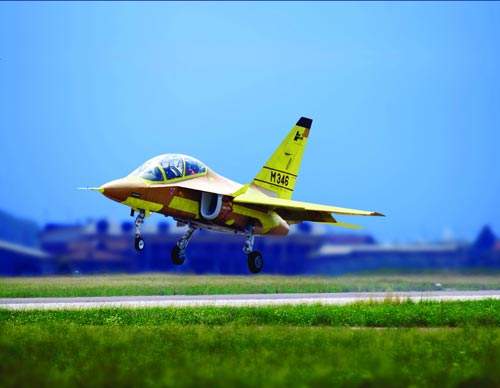
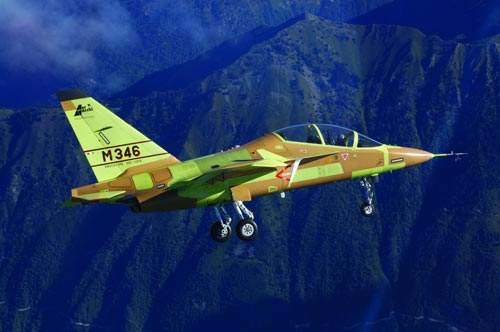
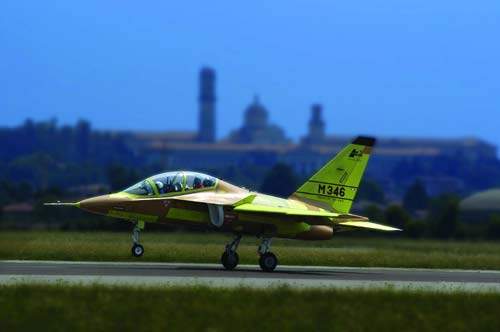
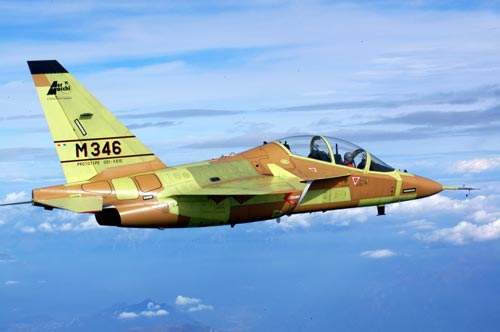
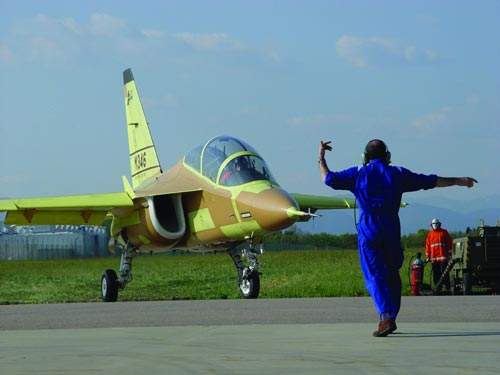

The M-346 Master is an advanced and lead-in fifth-generation fighter trainer developed by Alenia Aermacchi (Italy), a Finmeccanica company. The aircraft is a development of the YAK/AEM-130, a joint programme with Yakolev Design Bureau and Sokol Manufacturing Plant of Russia. In July 2000, Alenia Aermacchi announced that it would cancel the joint project and develop the aircraft alone, as the M-346.
The M-346 provides combat pilot training for front-line fighters with high angle-of-attack capability. The aerodynamic design of the M-346 uses a vortex lift to provide manoeuvrability and controllability at a very high angle-of-attack using a fly-by-wire control system.
Recommended White Papers

Recommended Buyers Guides

The YAK/AEM-130 has flown in prototype form since 1996. As the Yak-130, the aircraft was selected in March 2002 as the Russian AF’s next-generation combat trainer.
M-346 Master fighter trainer development
The M-346 prototype completed its first flight in July 2004. The second prototype made its maiden flight in May 2005. The first low-rate initial production (LRIP) aircraft made its maiden flight in July 2008. The M-346, equipped with advanced helmet-mounted display systems, completed its maiden flight in May 2010.
The Italian Air Force (ITAF), the launch customer, received the first batch of 15 M-346 Master aircraft. Alenia Aermacchi signed a €220m ($330m) contract with ITAF in June 2009 to supply six M-346 jets. The first two of the six M-346 aircraft were unveiled in December 2010.
ITAF designated the M-346 as T-346A, which made its maiden flight in March 2011. The General Directorate for Aeronautical Armaments of the Ministry of Defence issued the military certification for the M-346 jet on 22 June 2011.
The first T-346A aircraft was accepted by ITAF in November 2011, while the second was delivered in February 2012. The contract also involves a five-year maintenance and logistics support. The M-346 was successful in its first air-to-air refuelling tests and several techniques performed by ITAF and the company pilots.
M-346 Master training aircraft orders and deliveries
In April 2009, Alenia Aermacchi received the design organisation military approval (DOMA) certificate for the M-346 Master allowing autonomous and direct management of the homologation process, including continuation of its airworthiness. DOMA also enables Alenia Aermacchi to streamline M-346 interface with the DGAA (Direzione Generale Armamenti Aeronauticiefficient) and improve the aircraft’s internal design and development processes. .
In January 2005, the Greek Ministry of Defence signed a memorandum of understanding (MoU) to become a partner in the programme and, in January 2006, Alenia Aermacchi signed an industrial cooperation agreement with Hellenic Aerospace Industry (HAI), under which HAI is responsible for the production and assembly of certain parts, including the rear fuselage.
In May 2006, Alenia Aermacchi announced an agreement with Boeing to jointly market the M-346.
In July 2007, the M-346 flew to the UAE for hot weather tests and operational evaluation by the UAE Air Force.
In February 2009, the UAE announced that it would acquire 48 M-346 advanced lead-in fighter trainer aircraft. Alenia Aermacchi was intended to form a joint venture with Mubadala Development in the UAE for establishing the M-346 final assembly line.
ST Aerospace signed a €170m contract with Alenia Aermacchi on 24 June 2011 for providing logistics support to 12 M-346 trainers deployed by the Republic of Singapore Air Force (RSAF). The M-346 jets were ordered by the RSAF in September 2010 under the Fighter Wings Course programme. The first aircraft was rolled out in August 2012 and deliveries were completed by March 2014.
Alenia Aermacchi also provides spare parts, repair and overhaul services, render engineering, and field support services.
The M-346 trainer was selected by the Israeli Ministry of Defence (MoD) in February 2012, who placed an order with Alenia Aermacchi for 30 M-346 aircraft in July 2012. Deliveries were concluded in July 2016.
The Polish Ministry of Defence placed an order with Alenia Aermacchi in February 2014 for the delivery of eight M-346 Master aircraft. The first two aircraft were delivered in November 2016. Poland ordered an additional four M-346 trainer aircraft along with an option for four more aircraft, in January 2018. Deliveries are expected to conclude by 2022.
In December 2014, the Italian National Armaments Directorate contracted Finmeccanica-Alenia Aermacchi for the delivery of three M-346 advanced trainer aircraft to the Italian Air Force.
The Italian Air Force placed a contract for nine M-346 training jets in March 2016. Deliveries are scheduled to complete by 2018.
M-346 weapons
Armaments are carried on nine external store stations, six of which are underwing, equipped with 1,000lb class ejector release units, and two wingtip stations for air-to-air missiles. The under-fuselage station carries avionics pods or a 300l conformal fuel tank.
The system data presentation and control functions of the stores management system use any one of the multifunction displays in both cockpits. Hands-on throttle and stick (HOTAS) controls are used to select the weapons. Weapon aiming is controlled by the central main processor, aiming data being presented to the pilots through the head-up display (HUD) or the helmet-mounted display (HMD).
The weapons carried include: MK82 500lb and MK83 1,000lb free-fall or retarded bombs; rocket launchers; AIM-9 Sidewinder short-range air-to-air missiles; Raytheon AGM-65 Maverick air-to-ground missiles; MBDA (formerly Alenia) Marte MK-2A anti-ship missiles.
The external hard points can also carry the Vinten VICON-601 reconnaissance pod, laser designator pod, radar warning receiver pod and Elettronica ELT-55 electronic countermeasures pod.
For fighter trainer role, self-protection system functions and simulated tactical scenario threats are presented and monitored on the multifunction displays.
For operational roles, the aircraft is fitted with a radar warning receiver, chaff and flares dispensers, and active electronic countermeasures.
Cockpit
The cockpit is representative of the latest-generation combat aircraft, and each crew position is equipped with raster / stroke type head-up display (HUD), full-colour liquid crystal multifunction displays (three in each cockpit), helmet-mounted display with threat simulation capability, night-vision goggle (NVG) compatible instrumentation and hands-on throttle and stick (HOTAS) controls.
The cockpits can be fitted with MK16 ejection seats from Martin Baker of Uxbridge, UK.
Avionics
The avionics architecture is based on a dual-redundant, MIL-STD-1553B digital data bus with the capacity for additional systems. The communication suite includes a VHF / UHF transceiver and an information friend of foe (IFF) transponder. The navigation suite includes a laser gyro inertial navigation system with an embedded GPS receiver, and tactical air navigation (TACAN) and VHF omnidirectional radio ranging (VOR/IIS/MB).
The flight control system (FCS) is a full authority digital fly-by-wire quadruple-redundant system, which includes four BAE Systems Italia flight control computers.
The FCS provides the aircraft with controllability up to angles-ofattack (AoA) of 35° and higher, g-limitation, stall and spin prevention, and maximum AoA limitation.
It can be adapted to various degrees of automation and autopilot modes with reversionary modes featuring automatic selection in case of damage or failures.
Turbofan engines
Povazke Strojarne L.M. was to be the supplier of the two DV-2S twin-shaft turbofan engines for the YAK / AEM-130. For the M-346, these are replaced with two Honeywell / ITEC F124-GA-200 turbofan engines, produced with Fiat Avio.
There is also a closed-circuit, self-contained, aerobatics lubrication system and dual-channel Full Authority Digital Engine Control (FADEC).
Performance
The M-346 can climb at the rate of 127m/s. The maximum and cruise speed of the aircraft are 1,092km/h and 1,059km/h respectively. Its stall speed is 166km/h. The range and service ceiling of the M-346 are 2,590km and 13,700m respectively. Its take-off run is 320m, while the landing run is 470m. The aircraft weighs around 4,610kg and its maximum take-off weight is 9,000kg.
The Global Military Aircraft Market 2011-2021
This project forms part of our recent analysis and forecasts of the global military aircraft market available from our business information platform Strategic Defence Intelligence. For more information click here or contact us: EMEA: +44 20 7936 6783; Americas: +1 415 439 4914; Asia Pacific: +61 2 9947 9709 or via email.
