

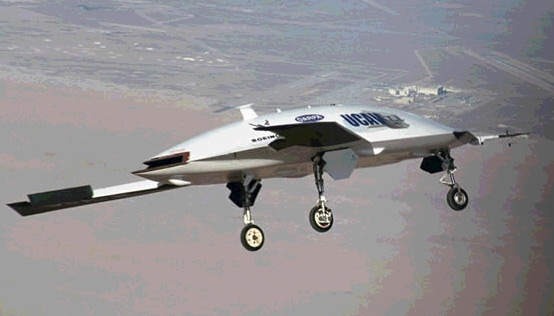
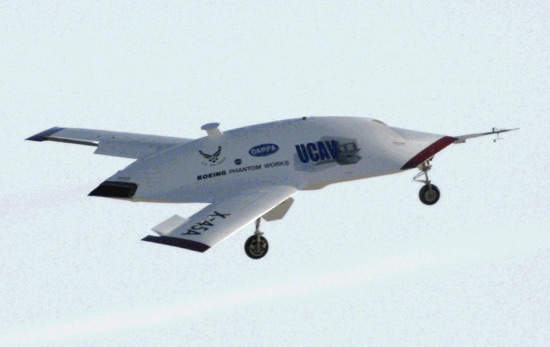
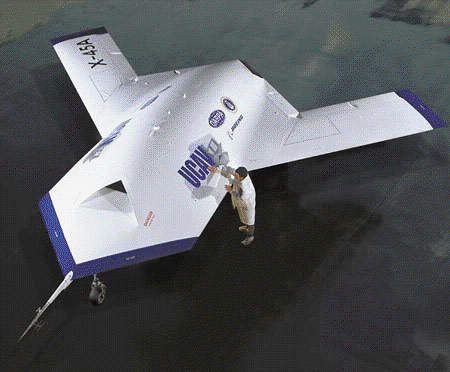
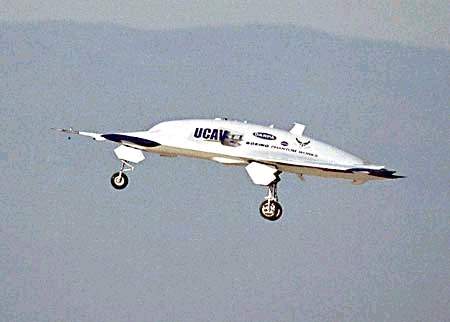

The Boeing joint unmanned combat air system X-45 is an unmanned combat air vehicle being developed for strike missions such as Suppression of Enemy Air Defence (SEAD), electronic warfare and associated operations.
Recommended White Papers

Recommended Buyers Guides

Joint Unmanned Combat Air System (J-UCAS) programme
The Joint Unmanned Combat Air System (J-UCAS) programme began being managed by DARPA, but was handed over to a joint US Navy and Air Force office in October 2005. The two principle systems being developed under the first phase of the programme, the Spiral 0 phase, are the Boeing X-45 and the Northrop Grumman X-47. The J-UCAS program combines the programmes previously conducted under the DARPA, USAF and Boeing X-45 UCAV program and the DARPA, USN and Northrop Grumman X-47 UCAV-N program.
joint unmanned combat air system X-45 is an unmanned combat air vehicle.”
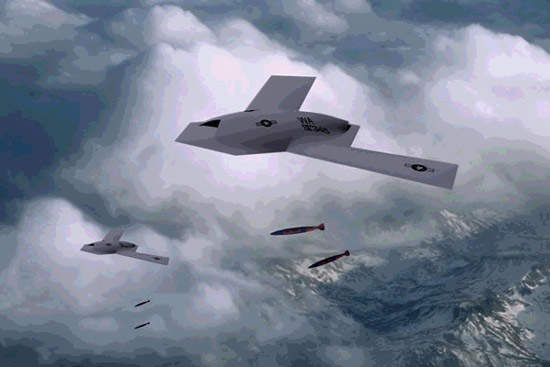
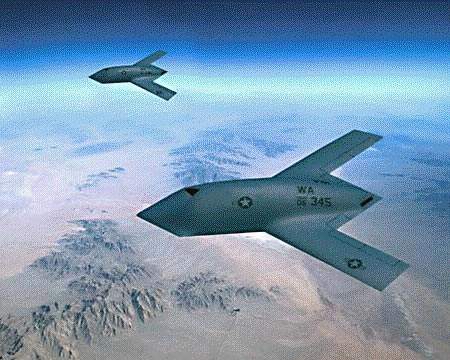
In March 2004, the X-45A completed a ten-day schedule of test flights including dropping a 250lb inert Small Smart Bomb (SSB) at NASA’s Dryden Flight Research Center, Edwards Air Force Base, California. The X-45A air vehicle released the unguided weapon from its internal weapon bay at an altitude of 35,000ft and speed Mach 0.67 (about 442mph). In August 2004, the first test of multi-vehicle operations took place. Two X-45A demonstrators were controlled by a single operator / pilot. X-45A flight tests were successfully concluded in August 2005.
Unmanned Combat Air System Demonstrator (UCAS-D) programme
In April 2007, Boeing submitted a bid to the US Navy for the Unmanned Combat Air System Demonstrator (UCAS-D). Boeing’s bid is based on a version of the X-45C, the X-45N which has been strengthened for carrier landings. In August 2007, Northrop Grumman was selected by US Navy with a version of the X-47B.
X-45A demonstrator UAV
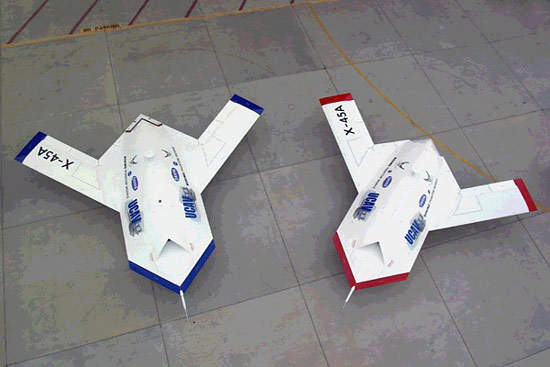
In 1999 Boeing was awarded a demonstration phase contract by DARPA and the USAF. Under the contract, Boeing Phantom Works completed two X-45A demonstrator air vehicles. The roll out ceremony of the first vehicle was in September 2001. The first flight was completed in May 2002.
Boeing Company in Seattle is the principle contractor responsible for the X-45 programme and is also responsible for the provision and implementation of the mission control aspects. Boeing in St Louis is responsible for the development of the air vehicle
A series of block 1 tests on both X-45A vehicles, including timing and positional navigation trials, autonomous taxiing and the integration of ground mission control elements, was completed in February 2003.
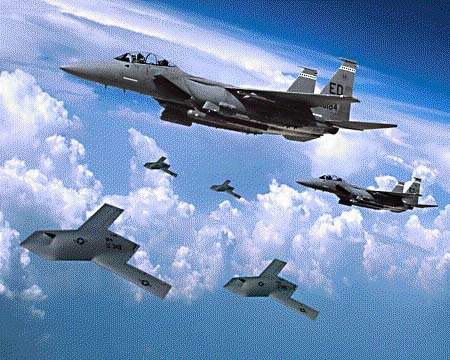
Block 2 testing, which began in March 2003, included integration of the unmanned vehicles with manned aircraft. By March 2004 the block 2 software build was completed and the first flight tests of the block 2 software were successfully completed. Block 3 testing includes mission replanning during flight, station keeping manoeuvres and the simulated deployment and dropping of inert weapons. Block 4 testing completed in August 2005, included the transfer of decision making to the air from the ground-based control station.
X-45A air vehicle
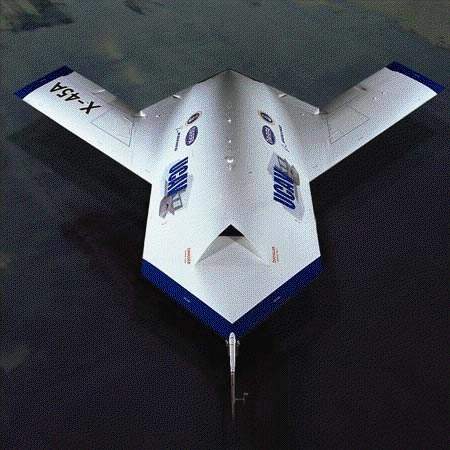
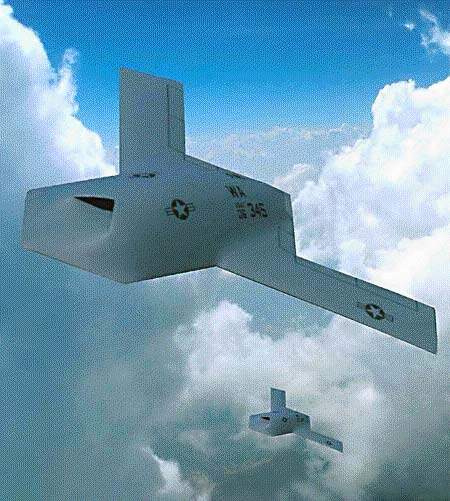
The X-45A air vehicle is of a swept-wing stealthy design and composite construction using foam matrix core and a composite fibre-reinforced epoxy skin, with a wingspan of 10.31m and overall length 8.03m. There is no vertical or canted tail. The low-mounted wing and blended fuselage have a straight leading edge and W planform trailing edge.
The fuselage carries two internally housed weapons bays and an internally mounted Honeywell F124-GA-100 non-afterburning turbofan engine. The engine, rated at 28kN, is equipped with a notched air intake and a two dimensionally yaw-vectoring nozzle exhaust. The fuel load is 1,220kg.
The vehicle carries a payload of 680kg. The air vehicle incorporates underwing hardpoints for carrying auxiliary fuel tanks for increased range or increased time on station or for additional weapon carrying capacity.
The air vehicle is fitted with fully retractable tricycle landing gear for conventional autonomous take-off and landings.
The air vehicle is capable of operating at an altitude of 10,670m (35,000ft) and has a cruise speed of Mach 0.75.
The X-45 is air transportable to forward areas of operation. The wings are detachable from the fuselage so the air vehicle can be stored and transported in a storage container. A single C-17 Globemaster can carry up to six X-45A containerised UCAVS.
X45B and X-45C UAVs
Boeing planned the development and construction of two UCAV prototype air vehicles, X-45B, a larger air vehicle than the X-45A with an integrated avionics system, increased weapon delivery capacity and increased operating range and altitude. A fully operational version of the prototype X-45B was designated A-45, for entry into service with the USAF in 2008 but the X-45B program was superseded by the joint-UCAS programme and the development of the X-45C.
In June 2003 DARPA announced the Joint Unmanned Combat Air Systems (J-UCAS) programme which combined the DARPA / USAF UCAV and the DARPA / USN UCAV-N programmes. In early 2003, DARPA announced the cancellation of the X-45B and the approval for the development of a larger and improved UCAV system, comprising the X-45C air vehicle, mission control, support and simulation systems.
The X-45C has a larger payload performance (2,041kg), persistence and range envelope than the X-45B. The X-45C has a similar fuselage design to that of the X-45B but with a new wing design that gives the X-45C its distinctive arrowhead shaped profile. Boeing began assembly of the first of three X-45C demonstrators in June 2004 and first flight was in 2007, followed by a two-year operational assessment.
Weapons
The air vehicle can carry advanced precision guided munitions, 2,000lb bombs or other munitions and weapons systems.
Sensors
The X-45 air vehicle is equipped with a suite of sensors including an Active Electronically Scanned Array (AESA) Synthetic Aperture Radar (SAR) and an electronic support measures system developed by Raytheon. The Raytheon synthetic aperture radar provides a resolution of 60cm at a target range of 80km.
Control
The sensor suite allows detection, identification and location of fixed and mobile targets in near real time. The battlefield situation and target data is downloaded via secure datalinks to the ground control operator station, to aircraft or to satellite datalinks. The operator station is equipped with artificial intelligence decision aids to assist the operator in the assessment of the battlefield situation and in his decision to authorise UCAV weapons release.
The taxiing, take-off and landing are fully autonomous but a pilot-operator has the option of controlling these manoeuvres. The UCAV ground control station has been designed by NASA. BAE Systems Controls has been contracted to supply the computerised air vehicle management system. The air vehicle is fitted with a Milstar satellite communications link.
