


Recommended White Papers
Recommended Buyers Guides
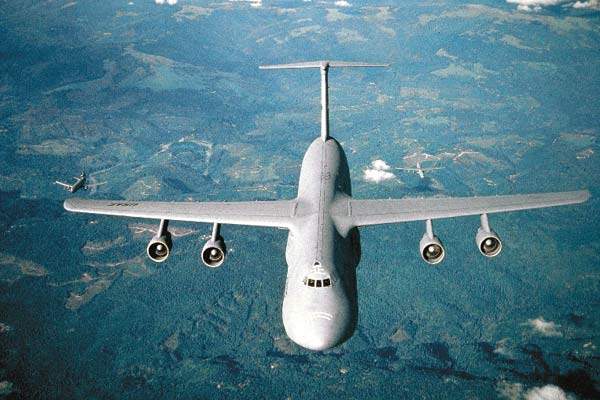
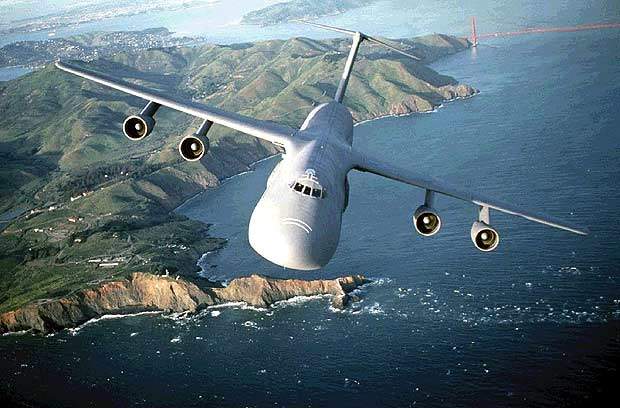
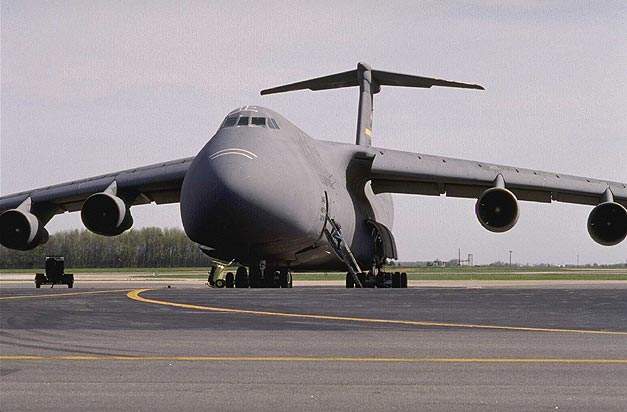
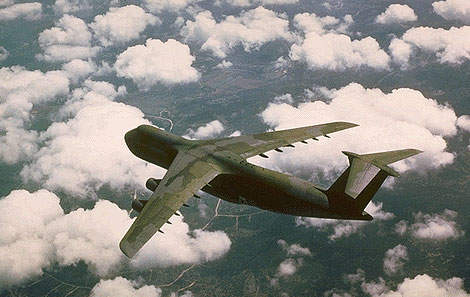
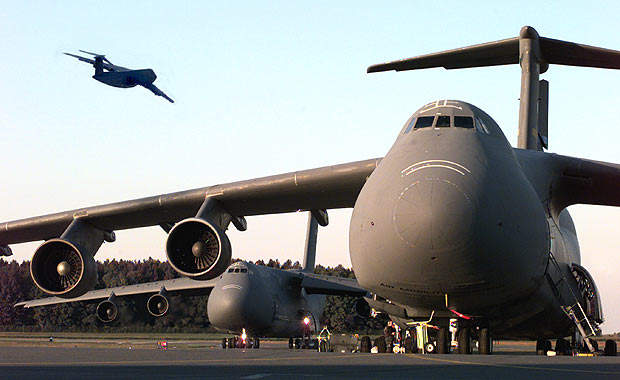
The Lockheed Martin C-5B Galaxy strategic transport aircraft first entered service with the US Air Force in 1986. The USAF has 126 C-5A/B aircraft in service, but is retiring a number of the C-5As.
The C-5B is capable of carrying a maximum payload up to 118,387kg to a range of 5,526km,which can be extended by in-flight refuelling. The heavy logistic transport aircraft is of cantilever high-wing monoplane design with a fail-safe semi-monocoque aluminium alloy fuselage.
C-5M Super Galaxy
The US Air Force initiated a comprehensive upgrade programme to ensure the capability of the C-5 fleet to at least 2040. The first phase of the upgrade is the avionics modernisation programme (AMP). The second phase, the C-5 reliability enhancement and re-engining programme (RERP) is to upgrade the aircraft’s engines and pylons, as well as to improve reliability.
In December 2001, Lockheed Martin Aeronautics Company was awarded a system development and demonstration (SDD) contract for the C-5 RERP, to apply the new systems to four C-5 aircraft by 2009.
First flight of the C-5M, the designation given to aircraft upgraded under RERP and AMP, took place in June 2006. The second of three C-5M test aircraft made its first flight in November 2006 and the third (a modernised C-5A) in March 2007. The first of three test aircraft was delivered to the USAF for operational test and evaluation in December 2008 and the remainder were delivered in February 2009.
the USAF.”
In February 2008, the USAF approved the upgrade under the C-5 RERP for 49 additional aircraft – 47 C-5Bs used for intra-theatre lift and two C-5Cs used for support of the US space programme.
In February 2009, the USAF awarded two contracts worth $324m for the C-5M Super Galaxy programme. The first contract is $299m worth of RERP production for nine aircraft, while the second contract is $25m worth of interim contractor support (ICS) for familiarisation and operational test and evaluation of the Super Galaxy.
In September 2009, the test aircraft flown by a joint USAF and Lockheed Martin flight crew claimed 41 world aeronautical records in a single flight.
C-5 RERP Galaxy upgrade programme
Under the US Air Force C-5 RERP, Lockheed Martin Aeronautics Company selected new engines, General Electric CF6-80-C2, and Goodrich Aerospace pylons for the aircraft.
The CF6-80-C2 engine produces more than 50,000lb of thrust, a 22% increase over the TF39 engines and is Stage III noise compliant. It is also fitted to commercial airliners such as the Boeing 767 and Airbus A310. The new engine with a FADEC III control system received US Federal Aviation Administration certification in September 2004.
Lockheed placed its first C-5 Galaxy aircraft into RERP production line in August 2009, the second in January 2010 and the third in June 2010.
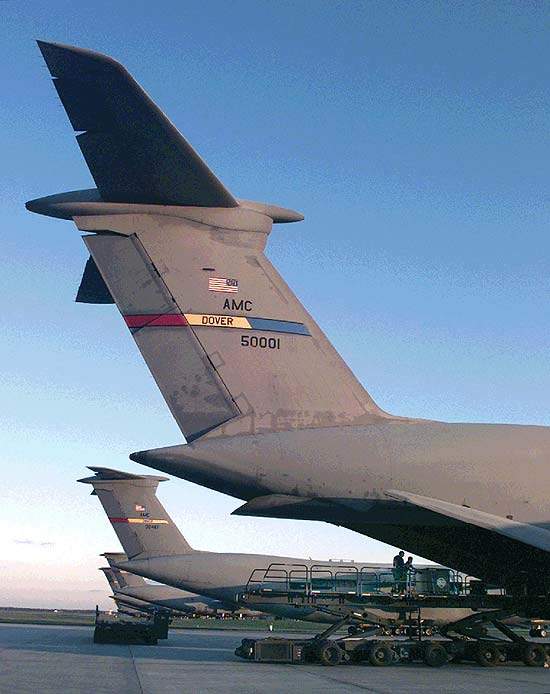
After the completion of the changes, Lockheed Martin and the Air Force carry out operational check flights of the C-5M. The redelivery of the first production of C-5M was in 2010 to Dover Air Force Base.
The Air Force plans for Lockheed Martin include redelivery of 52 modified C-5Ms (49 C-5Bs, two C-5Cs, and one C-5A) by 2017.
C-5 avionics modernisation programme (AMP)
In 1999 Lockheed Martin Aeronautics-Marietta were awarded a contract under the US Air Force AMP. The contract is for the integration of new systems, which include: digital flight control system, seven 6in x 8in flat panel liquid crystal displays, 12-channel embedded global positioning system / inertial navigation system, multimode receivers for the communications suite that add Aero-1 satellite communications and HF datalink, TCAS (traffic alert and collision avoidance system) and enhanced ground proximity warning system.
AMP also provided the avionics necessary to comply with the new international global air traffic management (GATM) requirements.
The first flight of the upgraded aircraft took place in December 2002. A production contract for the first eight kits was issued in April 2003 and for the next 18 in January 2004. The first was delivered in October 2004, and installation had been completed on 42 of the 112 USAF C-5A/B aircraft by September 2008.
In May 2005, the USAF awarded Northrop Grumman a contract to provide a large aircraft infrared countermeasures (LAIRCM) Lite system for a trial installation on a C-5 aircraft.
LAIRCM is based on the AN/AAQ-24(V) NEMESIS and is being fitted to the USAF fleet of C-17 transport aircraft.
C-5 Galaxy cockpit
The aircraft is flown by seven crew members: the pilot and co-pilot, two flight engineers and three loadmasters.
Upper deck
A rest area at the front of the upper deck provides accommodation for 15 people including the relief crew. The rear section of the upper deck can be fitted with seating for 75 troops.
Lower deck
Loading of the aircraft can be carried out by a straight-in loading into the front hold via the visor-type upward hinged nose and loading ramp under the flight deck. There is also a rear loading ramp which forms the underside of the rear fuselage. For ground loading and unloading the side panels of the rear fuselage are hinged for outward opening to provide wider access. The side panels and ramp are supplied by Canadair Limited.
The deck is fitted with aerial delivery systems for paratroop and cargo airdrop via the rear loading ramp door.
The aircraft is capable of transporting a maximum payload of 118,387kg. It is capable of carrying two Abrams main battle tanks, an Abrams tank plus two Bradley armoured fighting vehicles, 10 LAV light armoured vehicles, six Apache attack helicopters or 36 standard pallets type 463L.
The lower deck can accommodate 270 troops. The passenger doors are fitted with Garrett Air Cruisers evacuation slides and four life rafts, each of 25-passenger capacity.
The cabins and decks are air conditioned and pressurised.
Turbofan engines
The C-5B aircraft is powered by four GE TF39GE-1C turbofan engines, each providing 191kN. The aircraft is also equipped with a Hamilton Sundstrand auxiliary power unit.
The aircraft has 12 integral fuel tanks installed between the front and back spars in the wings. The total fuel capacity is 193,624l. There are four refuelling points, with two installed in the forward section of each main landing gear pods.
The in-flight refuelling receive unit is compatible with the KC-135 and KC-10 tankers and is installed in the upper forward section of the fuselage over the flight engineer’s station.
Landing gear
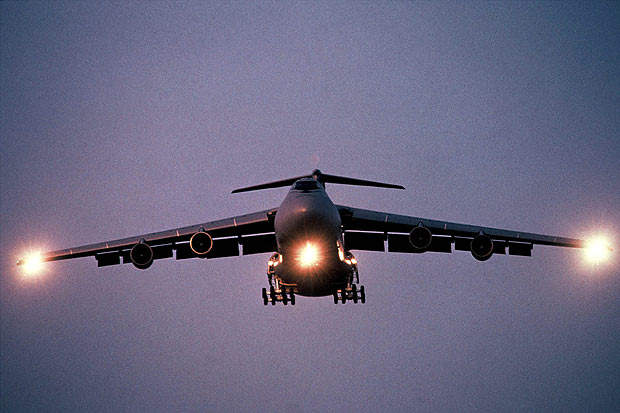
The C-5 is fitted with retractable tricycle-type landing gear. The landing gear is fitted with Bendix oleo-pneumatic dual-chamber shock absorbers, Goodrich wheels, carbon disc brakes and modulated anti-skid units supplied by Hydro-Aire. The Goodrich tyres can be deflated in flight to suit the landing conditions at the destination airfield.
There are four main landing gear units fitted in tandem pairs. Each of the four main units has a six-wheel bogie with two wheels forward and four wheels rear of the shock absorber. The main units are rotated through 90° for inward retraction by a hydraulically-driven gear system.
The four-wheeled nosegear is equipped with robust hydraulically driven ball screw units to retract rearward. The nosegear is steerable through a 120º frontal arc, giving a ground turning radius of 22.10m about the nosewheel and 52.12m about the wingtip.
