

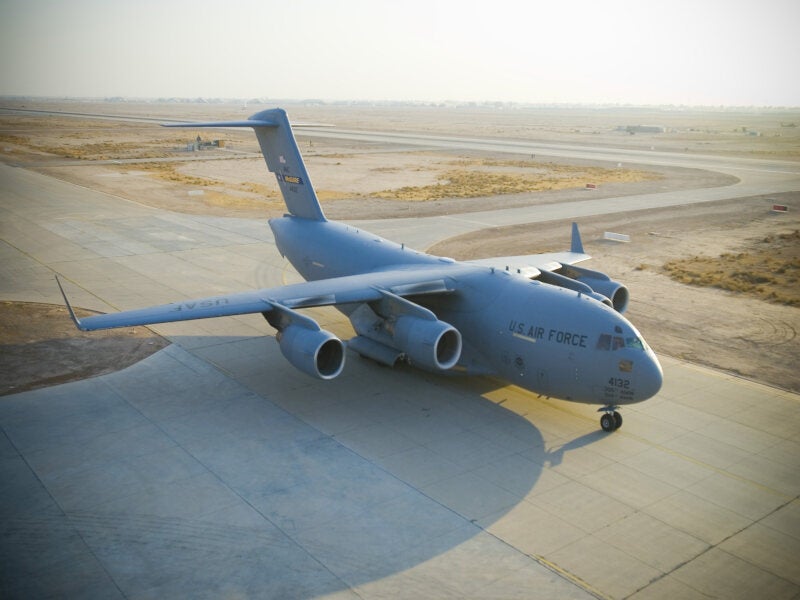
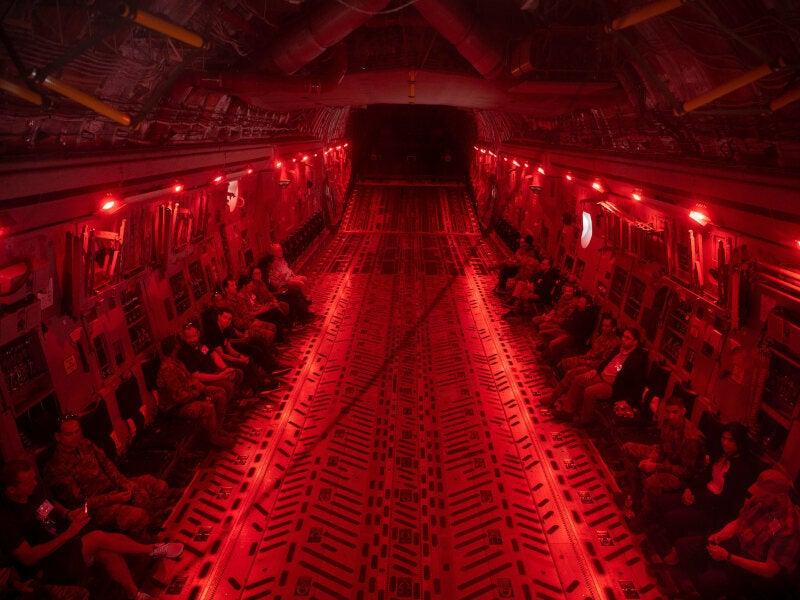

The Boeing C-17 Globemaster III military airlift aircraft is a high-wing, four-engine, T-tailed military transport vehicle capable of carrying payloads up to 77t.
The aircraft has an international range and the ability to land on small airfields with unmatched airlift capability.
Recommended Buyers Guides
The C-17 aircraft was first delivered to the US Air Force (USAF) in 1993 and entered service in January 1995.
Currently, there are 275 aircraft in the global C-17 fleet serving the USAF and allied nations including the UK, Canada, Australia, India and Kuwait, alongside Qatar and the United Arab Emirates (UAE), and the 12-nation Strategic Airlift Capability (SAC).
The final Boeing Globemaster III military aircraft left the company’s production facility in Long Beach, California, US, in November 2015, marking the official end of the aircraft’s production.
Boeing is currently providing maintenance and sustainment support to various countries, ensuring the aircraft remain operational. The work also aligns with the USAF’s objective to keep the C‑17A in service until 2075.
C-17 modernisation and sustainment details
In September 2021, the US Department of Defense awarded an indefinite-delivery/indefinite-quantity (IDIQ) contract worth up to $23.8bn to Boeing for ten years for the sustainment of the C-17 fleet. The contract is part of a performance-based logistics agreement to continue the critical sustainment activities of the fleet.
Under the agreement, Boeing will perform critical sustainment activities including engineering, field support and material management for the global fleet of 275 aircraft.
In May 2023, Boeing was awarded a contract modification, valued at $216m, for the existing IDIQ to deliver spares management support for the C-17 Globemaster landing gear.
A contract modification, worth $1.67bn, for the existing IDIQ was awarded in September 2024, followed by another modification worth $2.45bn awarded in March 2025 for C-17 Globemaster III sustainment.
In September 2025, Boeing was awarded a $282.47m contract for C-17 Globemaster III sustainment covering the supply of landing gear spares. Boeing received a contract modification valued at $166.8m linked to the existing agreement in April 2026. The update increases the contract’s cumulative value from $7.8bn to $8.04bn. Work is set to take place across multiple sites with completion planned for October 2027.
In February 2026, Boeing secured a contract to support the long-term serviceability and operational readiness of the aircraft under the USAF’s C-17 Globemaster III Flight Deck Obsolescence and Technology Refresh (FDOTR) programme, which has a projected total contract value of more than $400m over its lifetime.
Under the award, the company will design, manufacture, integrate and qualify a modernised C‑17A flight deck, progressing through military certification. The effort will replace ageing avionics and other mission-critical systems with updated equipment built around a modular open systems architecture, intended to simplify future upgrades and speed the introduction of new capabilities at lower cost.
Boeing has contracted Curtiss-Wright to deliver mission computer technology and Intellisense Systems to deliver data concentrator units and multifunction displays for the FDOTR programme.
In April 2026, Boeing unveiled an Aircraft Data Reasoner that draws on onboard aircraft data to support maintenance decisions across the worldwide fleet.
The tool is intended to improve visibility of system and component condition so that emerging issues can be detected earlier. This supports efforts to keep aircraft available for tasking and to lower the likelihood of failures during deployments away from home base.
C-17 design and features
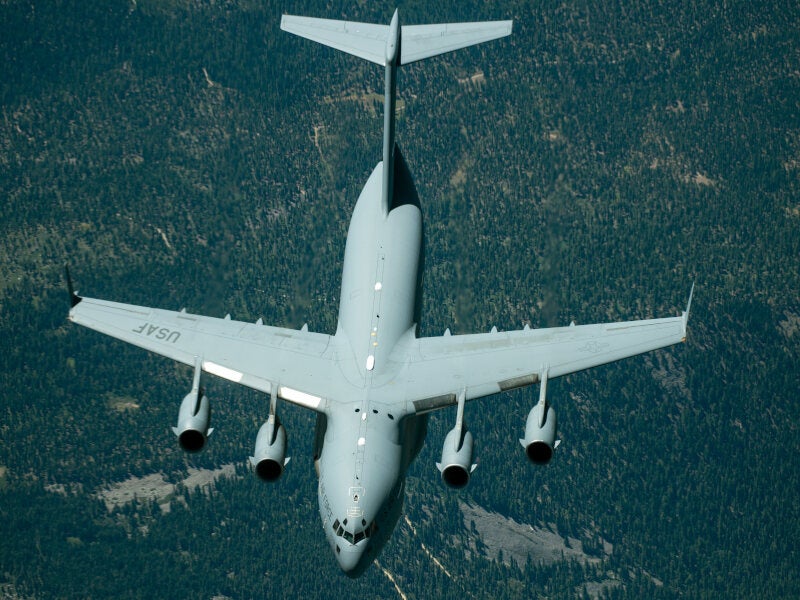
The aircraft is 53m (174ft) long and 16.8m high with a wingspan of 51.75m. A propulsive lift system, which uses engine exhaust to generate lift, allows the C-17 to achieve safe landings on short runways. The C-17 can land a full payload in less than 3,000ft.
The C-17 Globemaster III aircraft can turn in a small radius and complete a 180-degree star turn in 80ft. It can also carry out routine backing. A fully loaded aircraft can back up a 2% gradient slope using the directed flow thrust reversers.
Cockpit of the C-17 Globemaster III
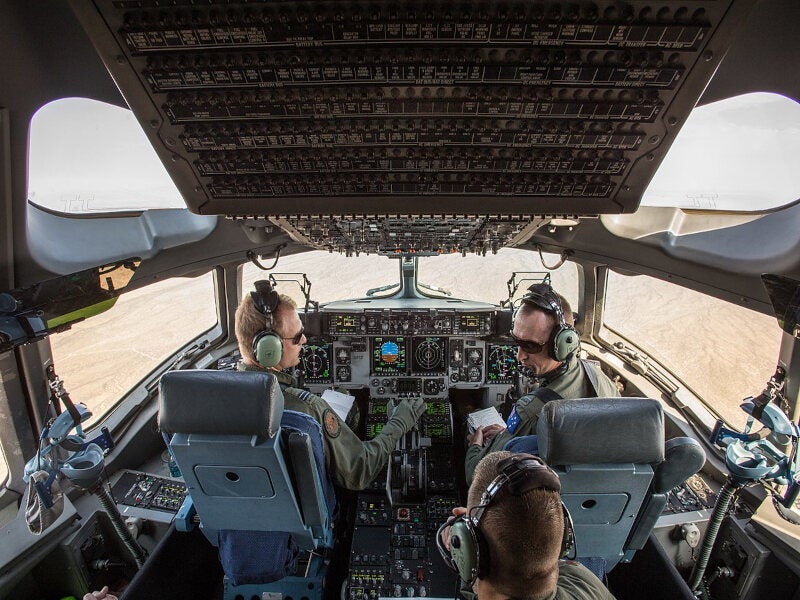
The C-17’s cockpit features a fully integrated electronic cockpit, which has pilot, co-pilot and two observer positions. The digital avionics system has four Honeywell multifunction cathode-ray tube displays, two full-capability head up displays, plus cargo systems.
The quadruple-redundant electronic flight control system also has a mechanically actuated backup system.
There are two Lockheed Martin central processing computers, one Hamilton Sundstrand data management computer, and two Honeywell air data computers.
A programme to upgrade the C-17A avionics includes new mission computers and displays, and new software for the warning and caution system, provided by Northrop Grumman Navigation Systems.
The automatic flight control system is upgraded with BAE Systems’ CsLEOS real-time operating system, which is certified for global air traffic management system requirements.
The aircraft is flown by a three-person crew comprising a pilot, a co-pilot and a loadmaster, which can lower staffing needs, reduce exposure to operational risk and help contain long-term operating costs.
Cargo systems on Boeing’s C-17 Globemaster III
The advanced cargo system allows the operation of all systems on any type of mission.
The design of the cargo compartment allows the C-17 to carry a wide range of vehicles, palleted cargo, paratroopers, airdrop loads and aeromedical evacuees.
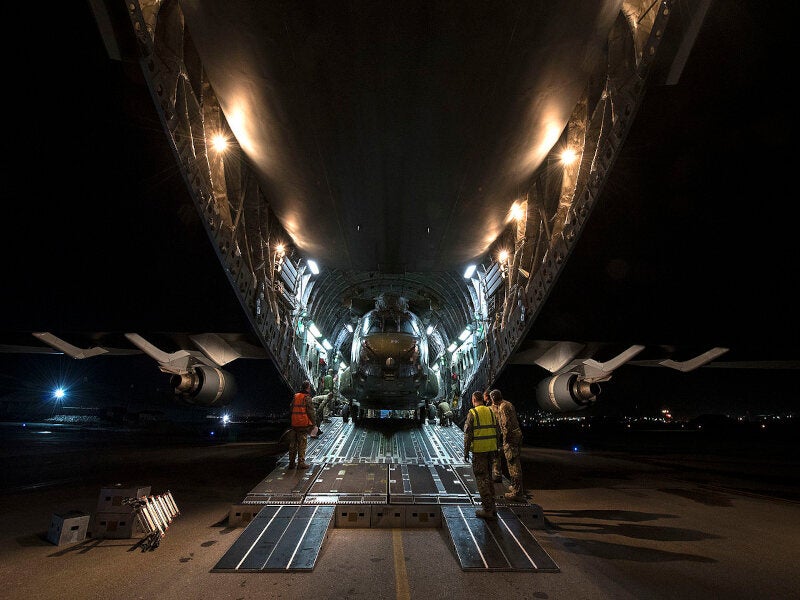
The cargo compartment has a sufficiently large cross-section to transport large wheeled and tracked vehicles, tanks, helicopters (such as the AH-64 Apache), artillery and weapons such as the Patriot missile system.
Three Bradley armoured vehicles comprise one deployment load on the C-17. The US Army M1A1 main battle tank can be carried with other vehicles. The cargo bay can accommodate loads ranging from an Abrams tank, four Bushmaster vehicles and three black hawk helicopters.
The maximum payload capacity is 77,519kg (170,900lb) with 18 pallet positions, including four on the ramp. Airdrop capabilities include a single load of up to 60,000lb, and sequential loads of up to 110,000lb, a container delivery system, airdrop up to 40 containers of 2,350lb each and up to 102 paratroopers.
The transport aircraft is equipped for low-altitude parachute extraction system drops. For Medevac, the C-17 can transport up to 36 litter and 54 ambulatory patients and attendants. C-17s can take off from a 7,600ft airfield and refuel while in flight. It can land on a 3,500ft-long and 90ft-wide airstrip.
When carrying a payload of 74,797kg, the C-17 can fly roughly 2,400 nautical miles (nm) without refuelling when cruising initially at around 8,534m. Its typical cruise speed is roughly 450 knots, or around Mach 0.74.
Capacity
The aircraft has the capacity to carry 134 passengers, 102 paratroopers, six high-dependency medical patients or 36 stretcher patients, one CH-47F Chinook helicopter, 18 463l military pallets and approximately 77t of cargo.
Countermeasure technology of C-17 Globemaster III
The AN/AAR-47 has a suite of surface-mounted thermal sensors around the aircraft, which detect the thermal signature of the missile exhaust plume. Frequency selection and signal processing techniques are used to minimise the false alarm rate.
The system provides a warning to the crew via the cockpit indicator unit of the presence and direction of the missile threat. A signal is automatically sent to the ALE-47 dispenser.
The AN/ALE-47 can carry a mix of expendable countermeasures including jammers. The system interfaces to the C-17 Globemaster III aircraft’s sensors. The aircrew can select the mode of operation of the dispenser for fully automatic, semi-automatic or manual operation.
The cockpit control unit can be used to input mission data, together with the numbers and types of expendable countermeasures systems loaded into the ALE-47. The cockpit controller updates and displays the status of the dispenser and the numbers and types of countermeasures remaining.
ALE-47 can dispense the new-generation active expendable decoys, POET and GEN-X, in addition to the conventional chaff and flare decoys that are compatible with the previous-generation ALE-40 and ALE-39 dispensers.
A total of 56 USAF C-17 aircraft are equipped with the Northrop Grumman large aircraft infra-red countermeasures (LAIRCM) system.
LAIRCM is based on the AN/AAQ-24(V) Nemesis. It entered low-rate initial production in August 2002 and completed its initial operational test and evaluation in July 2004. A total of 25 upgraded aircraft have been delivered. The system entered service in 2007. The four aircraft leased by the UK Royal Air Force are fitted with LAIRCM.
Engine and performance
The aircraft is powered by four Pratt & Whitney PW2040 (military designation-F117-PW-100) turbofan engines with 40,440lb thrust, each integrated into the wings. Engine thrust reversers, which are operable in flight, and speed brakes enable the aircraft to carry out rapid deceleration and descent manoeuvres.
The engine exhaust is directed onto large flaps, which extend into the exhaust stream, allowing the aircraft to fly a steep approach at a relatively low landing speed.
The cruise speed is between Mach 0.74 and 0.77. The range without in-flight refuelling, and with a payload of 160,000lb, is 2,400nm. Aerial refuelling provides an intercontinental non-stop range. It can reach an altitude of 45,000ft and travel a range of 10,390km with paratroopers.
C-17 Globemaster orders and deliveries
The UK ordered its fifth aircraft in August 2006, and by 2012, Boeing delivered its eighth aircraft to the UK RAF.
In February 2009, Boeing won a $2.95bn USAF contract for 15 additional C-17s. Two C-17s were delivered to Stewart Air National Guard Base in July 2011.
Australia selected the C-17 in March 2006 for four aircraft, with deliveries concluding in 2008. Australia signed a Foreign Military Sales (FMS) agreement in April 2011 to procure a fifth C-17, delivered in September 2011. By 2015, an eighth aircraft was delivered.
Canada signed a contract for four aircraft in February 2007. Deliveries began in August 2007 and concluded in April 2008. An additional C-17, ordered in 2014, was delivered in March 2015.
In September 2006, Nato announced its intention to buy an initial three or four C-17 aircraft. The Nato Airlift Management Organisation purchases, owns and manages the aircraft, while the Heavy Airlift Wing conducts operations.
SAC requested an FMS for the first two aircraft in 2008, with deliveries concluding in 2009.
In March 2007, Boeing said C-17 production would end in 2009 once current orders were fulfilled; however, the USAF purchase of 15 additional aircraft was approved in 2008.
Qatar ordered two C-17s in July 2008 with options for two more. Deliveries commenced in August 2009 and concluded in 2012. Qatar placed an order for four more aircraft in June 2015.
The UAE announced in February 2009 that it would acquire four C-17s and ordered a total of six in January 2010. Deliveries started in 2011 and concluded in June 2012. Boeing also received a $18.7m contract in 2017 to provide two years of logistics support and simulator maintenance for the UAE fleet.
India signed a $4.1bn agreement with Boeing in June 2011 for ten C-17s. Boeing delivered the first aircraft in June 2013 and four more by November 2013; the remaining five were delivered in 2014. An 11th aircraft was delivered in August 2019 as the final Boeing-built ‘White Tail’ without a specific customer.
Kuwait received two C-17s in 2014, including related equipment and training support.
C-17 flight testing with a synthetic fuel/JP-8 blend began in October 2007; certification was completed in February 2008.
