

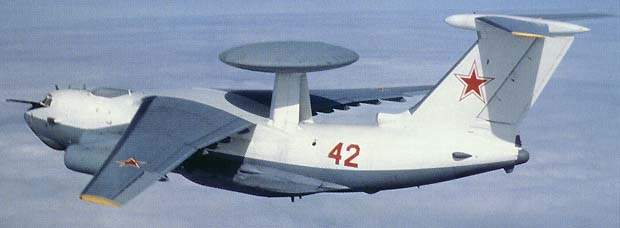
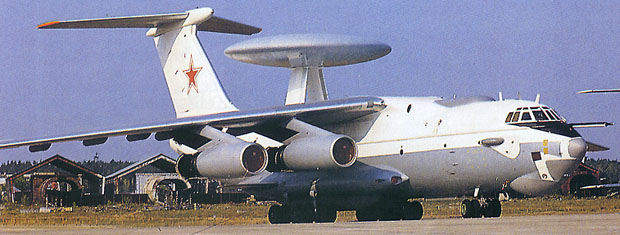
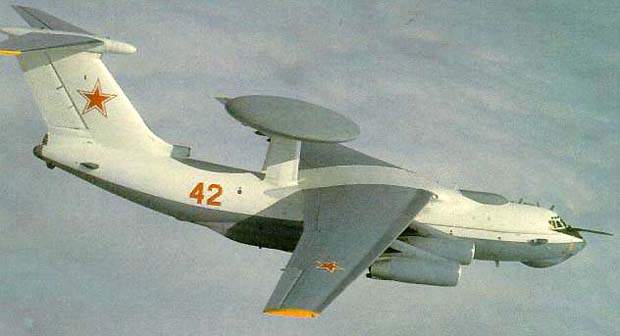
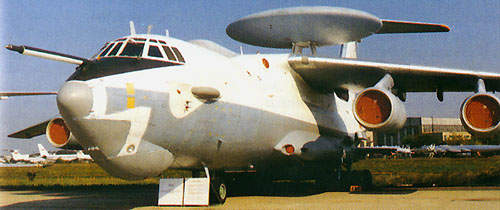
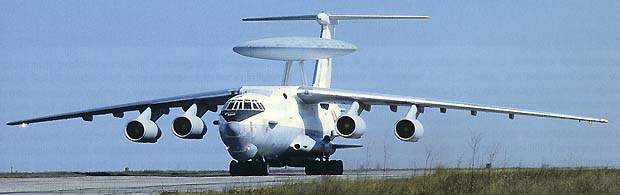
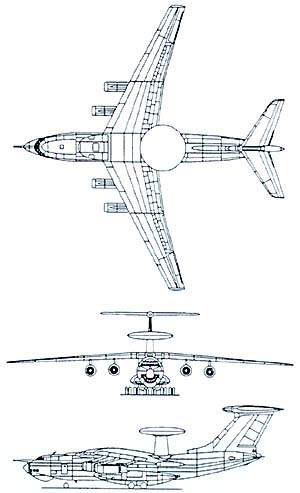

The A-50 airborne early warning and control aircraft (AEW&C) was developed and manufactured by the Beriev Aircraft Research and Engineering Complex Joint Stock Company based at Taganrog in the Rostov Region of Russia. The A-50 aircraft was developed from the llyushin IL-76MD military transport aircraft manufactured by the Ilyushin Aviation Complex Joint Stock Company based in Moscow.
Recommended Buyers Guides

The aircraft is known in the West by the Nato codename Mainstay. Beriev aircraft normally carry the Russian designation Be- followed by the number, however, the A-50 aircraft retained the well-known A-designation which Beriev allocated to the original prototype.
The A-50 aircraft detects and identifies airborne objects, determines their coordinates and flight path data and transfers the information to command posts. The A-50 also acts as a control centre, guiding fighter-interceptors and tactical air force aircraft to combat areas in order to attack ground targets at low altitudes. The role of the A-50 is comparable to that of the US’s E-3 AEW system developed by Boeing.
A-50 Mainstay programme and development
The A-50 entered service with the Russian Air Force in 1984. Currently, 16 aircraft are operational in the Russian Air Force. The upgraded version, the A-50U was first announced in 1995 but did not enter testing until 2008. It then entered service in 2011. The upgraded A-50Us have extended the aircraft’s the service life to 2020.
The modernised A-50 aircraft can now take more fuel on board with the same take-off weight, while increasing the range and mission time performance. A satellite navigation system integrated into flight and navigation complex offers a dramatic increase in the navigational accuracy.
A-50 variants
The A-50 aircraft was followed by four variants: A-50M, A-50U, A-50I and A-50E/I. The A-50M variant is an advanced version of the A-50 aircraft. The outdated analogue equipment of the A-50 have been replaced with digital electronics system to create the A-50M aircraft.
The A-50U is an updated Russian variant, first shown in 1995. It was created by modernising the element base of airborne radiotechnical complex, thereby reducing the total weight.
The A-50I is a variant specifically developed to meet the requirements of the Indian Air Force. It is additionally equipped with Israeli-made Phalcon radar. The variant, A-50E/I is an Israeli Phalcon radar export version.
Orders and deliveries
India selected three A-50EI / IL-76 variants equipped with Phalcon AEW radar systems in 2001. Elta of Israel provided the AEW radar systems. A contract for the sale was signed in March 2004. The AEW aircraft, which was expected to be delivered to the Indian Air Force in 2007-2008, was delayed and the first AEW aircraft was finally delivered on 28 May 2009. The second and third AEW aircraft were delivered in March 2010 and December 2010 respectively.
Israel Aerospace Industries (IAI) purchases the aircraft from Ilyushin and TAPC. In September 2010, India unveiled a decision to buy two additional aircraft from IAI . Apart from India and Israel, the AEW&C radar system developed by IAI and Elta Electronics Industries are in service with Chile and Singapore.
China also ordered four A-50/A-50M/U aircraft from Russia.
Mainstay AEW&C radar system
The A-50U airborne radar warning and guidance system is the Schnel-M produced by Vega. It comprises:
- radar station
- data reduction system
- interrogator-responder and signal transmission system
- digital computer complex
- identification friend or foe (IFF) equipment
- command radio link to guide fighters
- encoding communication system
- radio communication equipment
- telemetry / code equipment
- registering equipment.
The radar and guidance systems have the capacity to track 50 to 60 targets simultaneously and to guide ten to 12 fighter aircraft simultaneously
Countermeasures
The A-50 is fitted with a self-defence system when flying en-route and over patrol zones. The self-defence system ensures protection from guided and unguided weapons of the enemy’s fighters attacking the aircraft from its front and rear hemispheres. The self-defence system includes an electronic countermeasures system.
The aircraft can also be protected from the enemy’s fighter aircraft via guidance of friendly fighters.
The aircraft radio and electronics systems are robust against hostile jamming and provide good combat performance in dense electronic countermeasures environments.
Flight control and navigation
The aircraft is fitted with the NPK-T flight control and navigation system used to ensure air navigation during all flight stages in all-weather day and night and all-year operations performed at all geographical latitudes. The system also provides flight control and navigation data intended for mission specific systems and equipment.
Performance
The A-50 carries out patrol missions at an altitude of 5,000m to 10,000m. The patrol service ceiling is 10km. The maximum flight range of the aircraft is 5,000km and the flight endurance is seven hours 40 minutes. At a range of 2,000km, the A-50 can remain on patrol for up to one hour 25 minutes.
The aircraft is manned by five flight crew and ten mission crew. The maximum take-off weight of the aircraft is 170,000kg. It can travel at a maximum speed of 800km/h.
The Global Military Aircraft Market 2011-2021
This project forms part of our recent analysis and forecasts of the global military aircraft market available from our business information platform Strategic Defence Intelligence. For more information click here or contact us: EMEA: +44 20 7936 6783; Americas: +1 415 439 4914; Asia Pacific: +61 2 9947 9709 or via email.
