

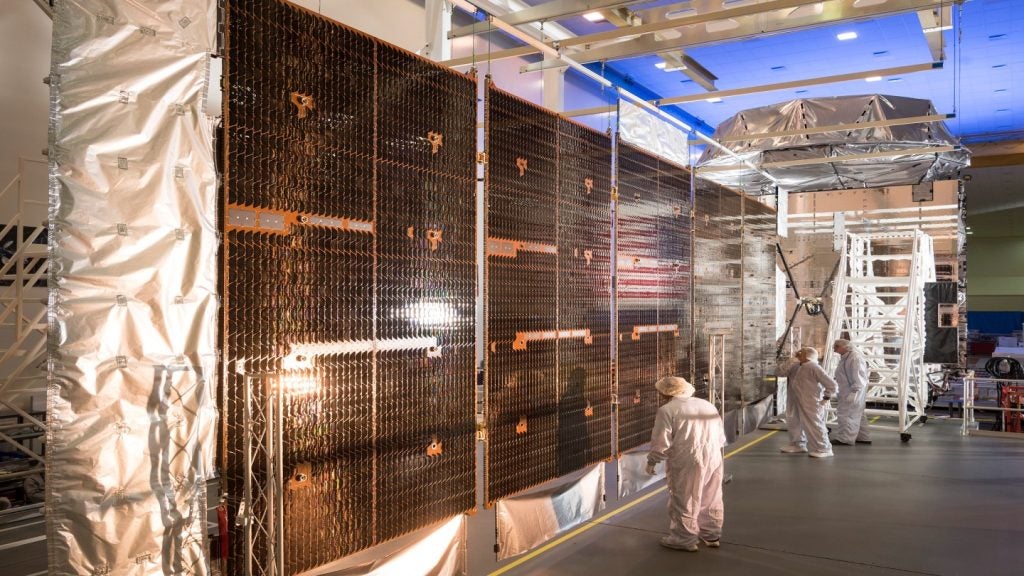
Lockheed Martin has achieved an early design review milestone for its satellite solution for the US Space Force (USSF) Space Systems Command's Mobile User Objective System (MUOS) Service Life Extension (SLE) programme.
This milestone reveals the company's aim to advance the design of future MUOS satellites, which are said to be integral to maintaining high-quality, secure communication for mobile military forces.
The MUOS network currently comprises four active satellites and one spare, which are constructed and maintained by Lockheed Martin.
The SLE initiative aims to bolster current advanced communication systems into the next decade. The plan includes the deployment of an additional pair of MUOS satellites, ensuring that the quartet of these units always remains operational, supplemented by auxiliary satellites to maintain traditional ultra-high frequency (UHF) networks.
Lockheed Martin and Boeing were selected for the Phase I of the MUOS extension programme in 2024, focusing on early design and risk mitigation efforts.
Lockheed Martin MUOS SLE development efforts programme management director Maria Hartin-Swart said: “In less than the initial one-year base period of performance, our team went above and beyond to deliver not only a successful early design review – but one so robust that it passed the rigorous standards of a more advanced design assessment.”
Leveraging its experience from the existing MUOS constellation, Lockheed Martin aims to address mission complexities proactively.
In collaboration with SEAKR Engineering, a specialist in space application electronics, Lockheed has developed a new payload processor for the MUOS satellites.
This electronics box is designed to achieve a balance between processing power, durability, and efficient resource use on the spacecraft.
Featuring the capability for in-space reprogramming, the next-generation MUOS payload processor by Lockheed Martin enhances the adaptability of future satellites.
This flexibility allows the satellites to adjust to evolving mission requirements over their operational lifespan.
The processor has recently completed a demonstration for the customer and has been awarded a Technology Readiness Level-6 designation, indicating its readiness to proceed to the production phase.
The integration of this technology is expected to ensure that future MUOS satellites remain secure and responsive to dynamic threats
Lockheed notes that the MUOS revolutionises secure communications for mobile military forces through a network of satellites and relay ground stations.
The current MUOS constellation employs a Wideband Code Division Multiple Access waveform, functioning similarly to a conventional cellphone network and accommodating multiple users across a spectrum.
Presently, the MUOS system supports more than 67,000 terminal and radio users, providing secure and clear voice, video, and data communication.
It ensures reliable connectivity globally, even in remote areas.
Following the conclusion of Phase I, the USSF will select a contractor for Phase II, which involves the production and deployment of two new MUOS satellites by 2030.