The US Air Force’s (USAF) 418th Flight Test Squadron (FLTS) has ended its ten years of support for NASA with the successful completion of the final Orion parachute system test.
The USAF Squadron has been supporting NASA by providing C-17 Globemaster III military transport aircraft and personnel to assist the space agency with the testing and qualifying of the Orion spacecraft’s parachute system.
Go deeper with GlobalData


Discover B2B Marketing That Performs
Combine business intelligence and editorial excellence to reach engaged professionals across 36 leading media platforms.
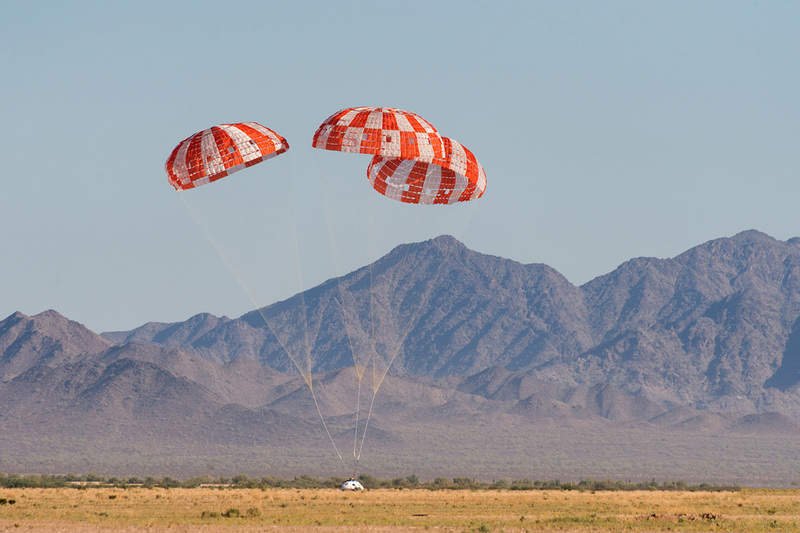
During the final trial conducted over the US Army’s Yuma Proving Ground in Arizona, the 34,000lb Orion parachute test article was pulled out from a cargo bay of a C-17 aircraft in order to test the spacecraft’s Capsule Parachute Assembly System (CPAS).
While returning to Earth, the system of 11 parachutes will enable the space capsule to slow its descent for a landing in the ocean.
USAF’s planning and cooperation with NASA commenced in 2006, but the first airdrop test was carried out in July 2008. Edwards Air Force Base (AFB) has participated in CPAS testing since 2008.
To date, the 418th FLTS has conducted more than 23 airdrops, which primarily involved two test pilots from the squadron, two flight test engineers, two test-qualified loadmasters, two airdrop engineers, two physiological technicians, two aerial photography personnel, and two to three aircraft maintainers.

US Tariffs are shifting - will you react or anticipate?
Don’t let policy changes catch you off guard. Stay proactive with real-time data and expert analysis.
By GlobalData418th FLTS evaluator flight test loadmaster tech sergeant Shane Powell said: “As a loadmaster, we are responsible for being thoroughly familiar with the test plan, safety package, technical order waivers, airdrop malfunction procedures / deviations, and principles of test conduct.
“We are responsible for loading the article on the aircraft and ensuring that it is properly secured. Additionally, we are responsible for rigging the system for extraction, which involves setting up a drogue parachute, two extraction parachutes, and making nine ties using airdrop rigging materials.
“We then complete a thorough Joint Airdrop Inspection with an army rigger. On the day of test, we are responsible for running the system in-flight that enables the airdrop to occur.”
The C-17 test aircraft then flies at an altitude of 25,000ft to 35,000ft, depressurises to open the cargo door and ramp, and then extracts the mock spacecraft test article by using an extraction type airdrop, Powell added.
According to Powell, the test is an integration of NASA, USAF and US Army assets.



