
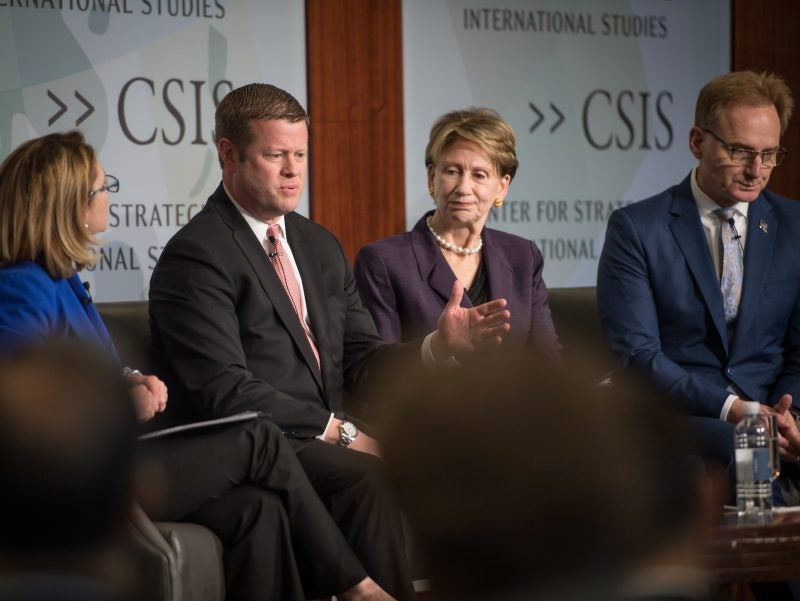
Speaking at the Centre for Strategic and International Studies (CSIS), US Army, Navy and Air Force leaders said that supply chain vulnerabilities could present a problem for the US Armed Forces.
Speaking last Friday, Acting Secretary of the Navy Thomas B. Modly said: “It’s not so much the top-tier suppliers, but it’s the second- and third-tier suppliers that have a lot of vulnerabilities that we’ve discovered.”
Go deeper with GlobalData


Discover B2B Marketing That Performs
Combine business intelligence and editorial excellence to reach engaged professionals across 36 leading media platforms.
He went on to explain that providing adequate information technology security can be an expensive investment for smaller suppliers to make. Modly added that the US military needs to work more closely with contractors to develop a “better way to protect information” in the face of adversaries trying to exploit vulnerabilities in systems to erode the US “competitive advantage”.
Secretary of the Army Ryan D. McCarthy said that gaps in US industrial capability were also creating vulnerabilities, citing the production of semiconductors as an area concern.
Almost all modern systems feature some degree of computational power, meaning future production of systems could potentially possibly be compromised by the semiconductor supply chain.
McCarthy said: “We really don’t make those [semiconductors] in America anymore, and they’re in everything,”

US Tariffs are shifting - will you react or anticipate?
Don’t let policy changes catch you off guard. Stay proactive with real-time data and expert analysis.
By GlobalDataMcCarthy explained that the Department of Defence (DoD) needs to protect its own as well as other markets and assure the DoD knows where components are made and who by.
Secretary of the Air Force Barbara M. Barrett added that the US Air Force is experiencing similar problems with the supply chain to the Navy and Army.
The concerns around supply chain were raised during a Q&A at CSIS on the challenges of developing and deploying hypersonic weapons, which McCarthy said was a growing national security threat to the US.
McCarthy said that the US will need to develop a low-Earth orbit satellite system alongside a joint command and control system to mitigate the threats the weapons pose to the US.
The Secretaries of the US Armed Forces are understood to have regular meeting to discuss the financing and development of US hypersonic capabilities, including sharing test data to streamline developments.
McCarthy said: “How they’re [hypersonic systems] used and employed by the services will be very different because the means are different,” but he added that despite this there should be similarities between the three services approaches to make development cheaper.
Barrett echoed this saying: “If we did it separately, there would be duplications and inefficiencies that we couldn’t afford,”



