
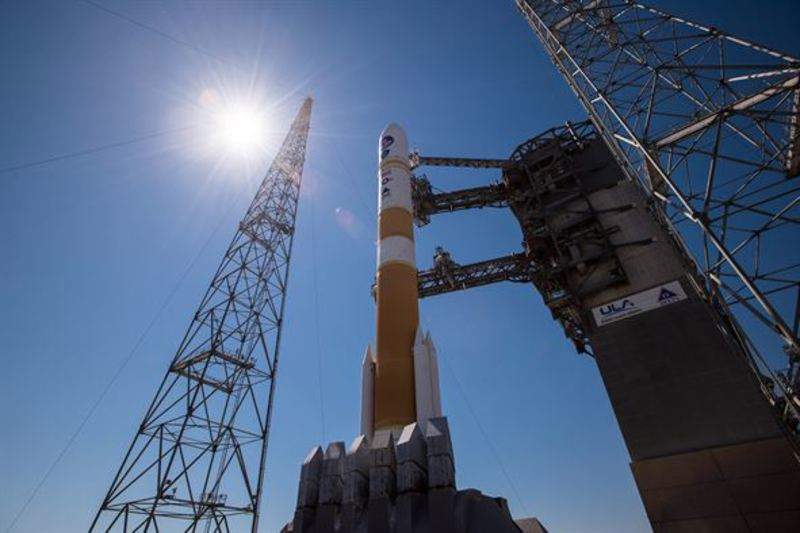

United Launch Alliance's (ULA) Delta IV rocket has successfully delivered the ninth Boeing-built US military communications satellite, Wideband Global Satcom (WGS-9), from Space Launch Complex 37 at Cape Canaveral Air Force Station, Florida.
Supported by the US Air Force's (USAF) 45th Space Wing, the WGS-9 launch is said to boost communications links in the X-band and Ka-band spectra.
Go deeper with GlobalData


Discover B2B Marketing That Performs
Combine business intelligence and editorial excellence to reach engaged professionals across 36 leading media platforms.
Boeing Department of Defense / Civil Satellite Programs executive director Rico Attanasio said: “This unique international collaboration increases military interoperability and expands affordable high-data-rate communications for US and allied partners around the globe.
“WGS-9 is among the most capable military communication satellites on orbit today.”
The communications satellite is expected to increase interoperability among the US, Australia, Canada, Denmark, Luxembourg, the Netherlands and New Zealand.
The WGS-9 is equipped with upgraded digital channelisers that nearly double the available bandwidth of earlier satellites in the series.
It is the third Block II Follow-on satellite with an ability to filter and downlink up to 8.088GHz of bandwidth.
The satellite was funded through an agreement between the US and Canada, Denmark, Luxembourg, Netherlands and New Zealand, Boeing stated.
The WGS satellites form a key part of a new high-capacity satellite communications system that provides enhanced communications capability to troops in the field.
The Delta IV rocket was powered by one common booster core and four solid rocket motors built by Orbital ATK.
To date, ULA has launched more than 115 satellites into orbit that provide critical capabilities for troops in the field, aid meteorologists in tracking severe weather, enable personal device-based GPS navigation and unlock the mysteries of the solar system.
Boeing will launch ten WGS satellites in total, with the last satellite scheduled for launch in 2018.
Image: A ULA Delta IV rocket carrying the USAF's WGS-9 satellite lifts off from Cape Canaveral Air Force Station, Florida, US. Photo: courtesy of United Launch Alliance.


