
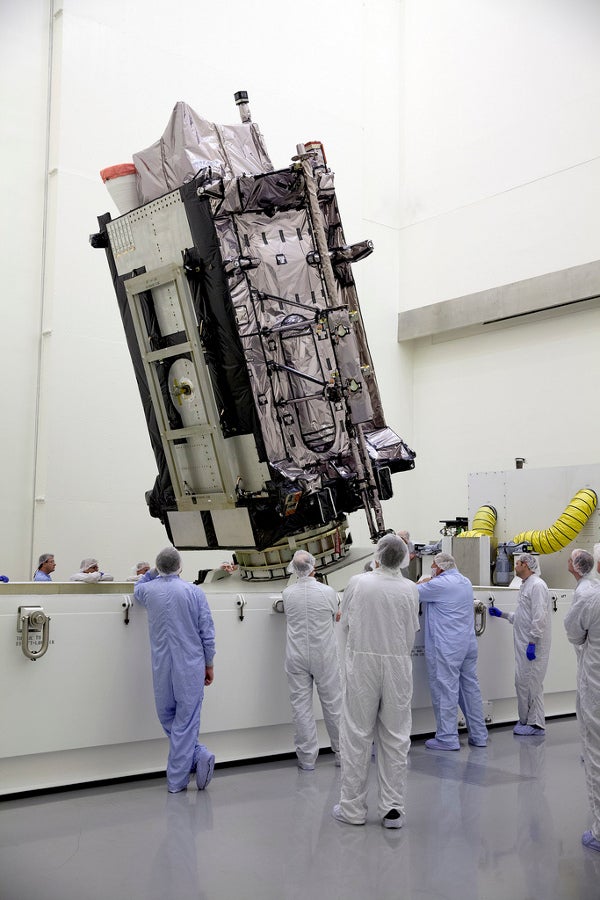
Lockheed Martin’s global positioning system (GPS) III nonflight satellite testbed (GNST) has demonstrated its backward-compatibility with the current GPS satellite constellation in orbit during testing at Cape Canaveral Air Force Station (CCAFS) in Florida, US.
During testing, the full-sized GPS III satellite prototype successfully communicated through cross-links with the US Air Force’s (USAF) flight-like hardware simulators for the GPS IIR, GPS IIR-M, and GPS IIF satellites that comprise the bulk of the existing GPS satellite constellation.
Go deeper with GlobalData


Discover B2B Marketing That Performs
Combine business intelligence and editorial excellence to reach engaged professionals across 36 leading media platforms.
The testing also confirmed the ability of an air force receiver to track navigation signals transmitted by the GNST.
Lockheed Martin GPS III Development director Paul Miller said the tests demonstrate for the first time, communication between GNST’s flight-like hardware, and GPS constellation, as well as a navigation receiver.
”This provides early confidence in the GPS III’s design to bring advanced capabilities to our nation, while also being backward-compatible,” Miller said.
Manufactured under the original GPS III development contract, the GNST is designed to help USAF identify and resolve development issues prior to integration and testing of the first GPS III space vehicle, designated as SV-1.

US Tariffs are shifting - will you react or anticipate?
Don’t let policy changes catch you off guard. Stay proactive with real-time data and expert analysis.
By GlobalDataHaving arrived in CCAFS to evaluate facilities and pre-launch processes prior to the arrival of the first flight satellite in July 2013, the prototype has successfully established remote connectivity and also communicated with the GPS next generation operational control system (OCX) being developed by Raytheon, the following month.
The GPS III is a family of next-generation satellites designed to replace USAF’s existing GPS constellation, which provides location and time information in all weather conditions, while enhancing capability to address the emerging requirements of military, commercial and civilian users worldwide.
Currently under contract for the production of the first four GPS III satellites (SV 1-4), Lockheed has also secured advanced procurement funding for long-lead components for the fifth, sixth, seventh and eighth satellites (SV 5-8).
Delivery of the first flight-ready GPS III satellite to CCAFS is scheduled for 2014, for planned launch in 2015.
Image: The GPS III non-flight satellite testbed arrived at CCAFS in July to test facilities and pre-launch processes in preparation for first GPS III space vehicle launch. Photo: © 2013 Lockheed Martin Corporation.



