
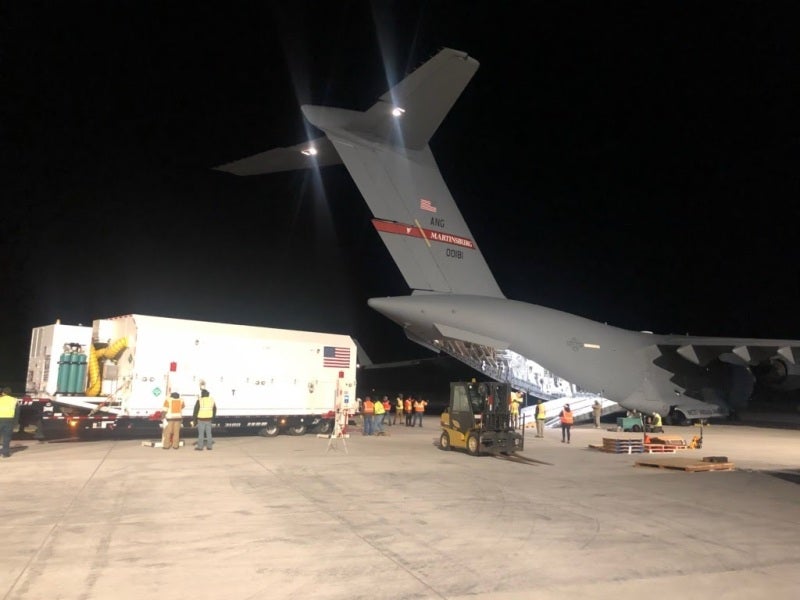
Lockheed Martin has delivered the US Air Force’s (USAF) second global positioning system (GPS) III satellite to Cape Canaveral in Florida, US.
Expected to be launched in July, the new GPS III satellite will bring higher-power, more accurate and harder-to-jam signals to the GPS constellation.

Discover B2B Marketing That Performs
Combine business intelligence and editorial excellence to reach engaged professionals across 36 leading media platforms.
The GPS III space vehicle (GPS III SV02) was transported in a custom container on board a C-17 Globemaster III from Lockheed Martin’s factory facility in Waterton, Colorado, US.
Named ‘Magellan’ in honour of Portuguese explorer Ferdinand Magellan, the satellite was designed and built at the company’s GPS III Processing Facility near Denver, Colorado.
According to Lockheed Martin, GPS III can provide up to eight times improved anti-jamming capabilities when compared to the GPS II satellite design block.
Developed with an entirely new design, GPS III is set to become the first GPS satellite to broadcast the new L1C civil signal, which is expected to improve future connectivity for commercial and civilian users around the world.
The L1C civil signal is compatible with other international global navigation satellite systems such as Galileo.
The USAF intends to modernise the GPS constellation with new technology and capabilities. As part of these efforts, the service launched its first GPS III satellite in December.
GPS III SV01 is known as ‘Vespucci’ and will serve in space for 15 years. The satellite is now receiving and responding to commands from the company’s Denver facility.
Lockheed Martin navigation systems vice-president Johnathon Caldwell said: “After orbit raising and antenna deployments, we switched on GPS III SV01’s powerful signal-generating navigation payload and on 8 January began broadcasting signals.
“Our on-orbit testing continues, but the navigation payload’s capabilities have exceeded expectations and the satellite is operating completely healthy.”
The company is under contract to build ten new GPS III satellites. In September, the company received another award for the 11th and 12th GPS III satellite.
The USAF also selected Lockheed Martin for the GPS III Follow On (GPS IIIF) programme. If a contract is formalised, the $7.2bn project will involve building up to 22 additional GPS IIIF satellites.
Prior to the scheduled launch, GPS III SV02 will undergo final testing and checks.
The satellite is due to be launched on board the United Launch Alliance’s (ULA) Delta IV launch vehicle and will join the operational constellation of 31 GPS satellites.


