

- France has validated a C-UAS package for Rafale fighters, which will launch 68mm rockets at Shahed-type attack drones
- The move captures a trend among allied militaries hoping to intercept attack drones at the earliest opportunity and at the furthest point of engagement
- Besides the 68mm Aculeus laser guided rockets, the Thales package comprises the TALIOS targeting pod, modified to track small and slow-moving objects
France’s armaments directorate (DGA) has validated the integration of a counter-uncrewed aerial system (C-UAS) package that will adapt the Rafale fighter jet for drone hunting in the air.
This adjustment captures an ongoing trend in the global aerospace industry, where military users aim to eliminate UAS threats from as far away as possible. Ukraine’s Ministry of Defence recently described its F-16 fighters as “the most effective platforms” for intercepting aerial threats, while announcing plans to procure training simulators for its pilots several days ago.

Discover B2B Marketing That Performs
Combine business intelligence and editorial excellence to reach engaged professionals across 36 leading media platforms.
But this constitutes a notable expansion in the mission set of conventional fighter aircraft. Once limited to close air support, strikes and aerial superiority, fourth and fifth generation combat aircraft must now provide another protective layer against cheap drones.
Remarkably, the DGA claim that its new C-UAS rocket system was validated after eight months. This is a significant push as Paris must consider the right effects but also its doctrinal shift, namely integrating the appropriate balance of systems across a fighter’s growing number of responsibilities.
What is this new weapon?
It is not a new capability to begin with.
This 68 milimetre (mm) laser-guided rocket system – which the DGA has abbreviated “LADAC”, meaning counter-drone warfare on combat aircraft – is widely featured on the Army’s Eurocopter Tiger attack helicopters in the last 15 years.
While helicopters remain a vital part of the joint force, as the United States demonstrated in Caracas, Russia has still taken many tactical losses across its attack helicopter fleet in Ukraine. This has led some militaries in the West to alter army aviation practices with the insertion of uncrewed collaborative rotorcraft, such as the UK’s Project NYX.
Components on the LADAC system include the Aculeus laser-guided rocket, which measures 1.4 metres in length and wieghs 8.8 kilogrames; these are carried by Telson JF12 launch pods, which can carr up to 12 units; and an the TALIOS electro-optical targeting and reconnaissance pod. Deliveries of the system will begin from July 2026.
Such a system allows the French Air and Space Force to engage targets at a fraction of the cost of traditional air-to-air missiles.
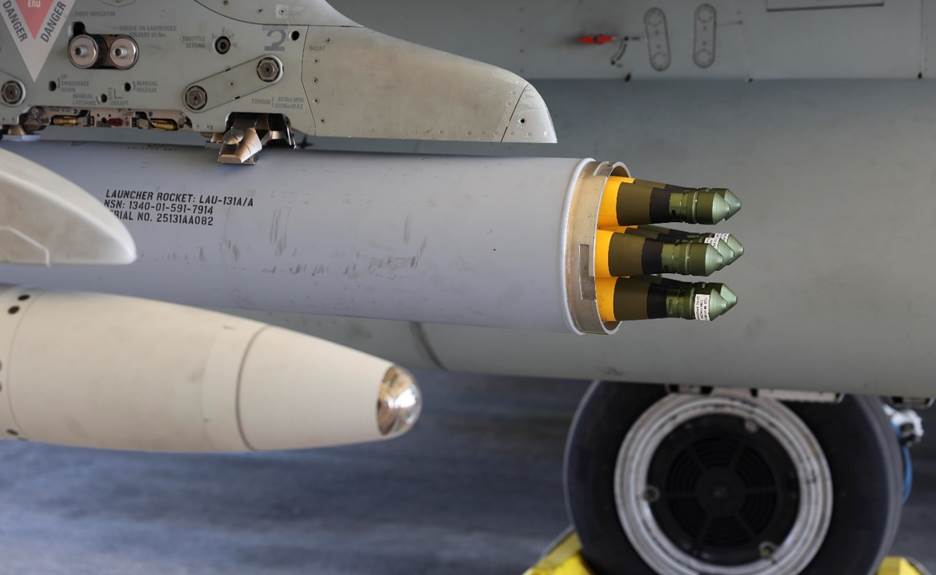
To strengthen aerial superiority in the face of this disruptive aerial threat, Nato militaries are adding C-UAS capabilities to aircraft.
While the French incorporate the Thales weapon system to Rafale, neighbouring allies are integrating the Advanced Precision Kill Weapon System to Eurofighter Typhoons, which uses 70mm Hydra rockets.
Test and findings
Since February 2026, the DGA conducted several tests intended to modify the Rafale’s sensor software and processing logic required for tracking small and slow moving aerial objects, a mode more suitable in enabling a low cost C-UAS package.
Likewise, the AESA radar had to be modified to isolate these objects types in sky.


