

British satellites are increasingly under threat, and thus the UK’s military operations and everyday life from bank transfers to weather forecasts.
The Strategic Defence Review (SDR) prioritised resilience against Russian and Chinese anti-satellite effects. Their global precision weapons, guided by space-based navigation systems, hold UK strategic capabilities at risk, the document reads.

Discover B2B Marketing That Performs
Combine business intelligence and editorial excellence to reach engaged professionals across 36 leading media platforms.
More recently, the head of UK Space Command, Major General Paul Tedman told the BBC last week that Russia is stalking British satellites and that these assets are under threat of jamming on a weekly basis.
Prior to this, at the DSEI 2025 exhibition in mid-September, Tedman accounted for 20 “counterspace systems” in geostationary orbit (GEO), and over 200 in low earth orbit (LEO) – “this is not an emerging threat”, he emphasised, “it is here, now, and active.”
Tedman considered several of China’s space-based weapons systems used over the past year in close-proximity operations from dual-use inspector satellites and integrated kinetic, directed-energy, artifical intelligence, and cyber tools.
There were concerns throughout last year that Russia had been developing a nuclear weapon to take out satellites indiscriminately – including its own.

US Tariffs are shifting - will you react or anticipate?
Don’t let policy changes catch you off guard. Stay proactive with real-time data and expert analysis.
By GlobalDataThe UK is formulating a Defence Investment Plan expected sometime in the autumn. It is a cost assessment of defence and security investment following the publication of the SDR and Defence Industrial Strategy which provided, in an abstract sense at least, a pathway for defence. Yet, Tedman warned, “the cost of inaction is rising.”
Industry observers will be eager to read the government’s priorities in comprehensive financial terms, probably for the first time, for until now companies have pivoted according to pledges and statements the government have conveyed since they came into office in July 2024.
UK have five military satellites
Currently, the UK Ministry of Defence (MoD) operate around five military satellites out of 9,000 tracked in space which belong to 80 spacefaring nations. These include a constellation of four Skynet 5 satellites and one Tyche satellite.
Skynet is a family of military communications satellites which provide strategic communication services to the UK armed forces and its allies. Skynet enables military operations conducted by the United States and 17 Nato allies.
Skynet 5 is the most recent generation, although Skynet 6 is coming to the end of development, with a scheduled launch of the 6A satellite in 2027, which will replace the fifth iteration, and there is an Extended Capability satellite due to enter service several years later.
Historically, the UK has been highly dependent on the US for advanced intelligence, surveillance and reconnaissance imagery. But the nation plans to introduce two more satellite constellations to that end: Tyche and Oberon.
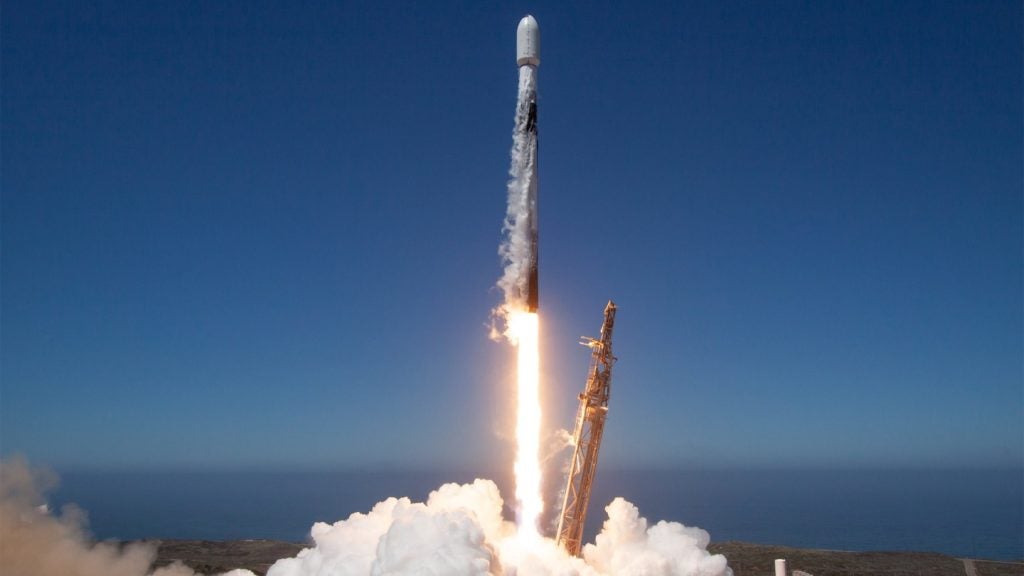
The most recent UK satellite launch – the first in 13 years – was the deployment of the first of four Tyche spy satellites in August 2024. Notably, Tyche is the first wholly MoD-owned satellite.
The Tyche constellation will perform global surveillance and intelligence for military operations under what has been labelled the UK’s ISTARI programme. The spacecraft contains a daytime electro-optical camera to provide high resolution images for use by the UK military.
Meanwhile, Oberon will use synthetic aperture radar to capture high-resolution imagery day and night, regardless of weather conditions. Oberon is scheduled for a launch in 2027.
Protection measures
The government announced it will begin to invest in a new detection technology to spot lasers that adversaries may use to dazzle satellites and intercept communications, detailed in a 3 October release, without offering any information expanding on technical capability of the project.
Nevertheless, Tedman commented: “I am delighted that in less than six months after publishing the SDR, we are investing new money into this novel technology to accelerate our space programme.”
This space-based detection system will be used to protect civilian and commercial satellites. Around 18% of Britain’s gross domestic product relies on satellite services.
The project is backed by around £500,000 in funding – the first allocated as part of the UK Space Agency’s Unlocking Space for Government programme, which aims to harness space to improve UK public services and strengthen national security.
Other protective measures are possible when it comes to securing satellite communications (SATCOM). Laurynas Mačiulis, the chief executive of Astrolight, a Lithuanian space tech start-up, told Airforce Technology that laser-based communications offer more security than the conventional radio frequencies (RF).
“In terms of security, laser links can’t be jammed and are nearly impossible to intercept. They use narrow beams of infrared lasers to transfer data, so even if an enemy satellite approaches in close proximity and attempts an electronic warfare attack in orbit, laser comms would be highly resilient to that.”
Traditional RF-based SATCOM equipment is of comparable cost to laser-based communications. However, optical links deliver ten to 100 times the data rates of comparable radio systems, so the cost per gigabytes per second is cheaper.
“In a few years, as the production and proliferation of laser communication scales, we will see the technology becoming way more accessible, especially for military and defence capabilities,” Mačiulis anticipated.


