

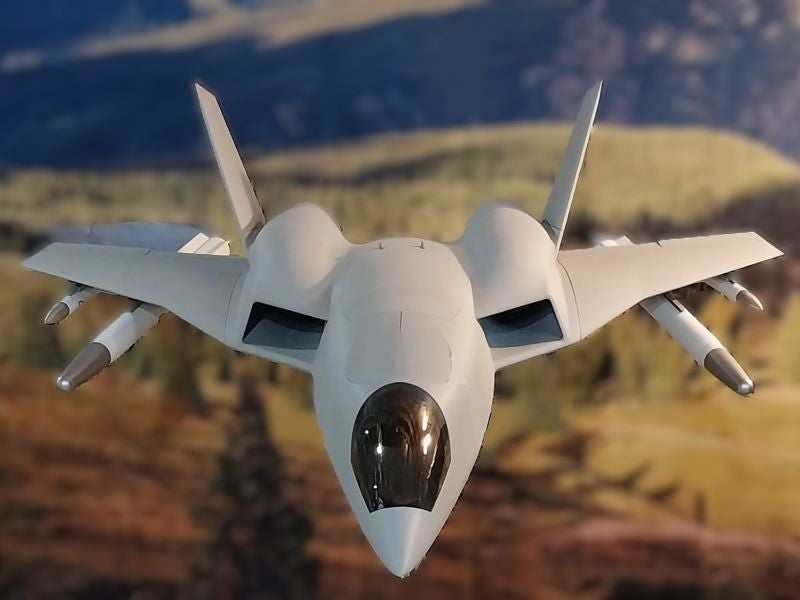
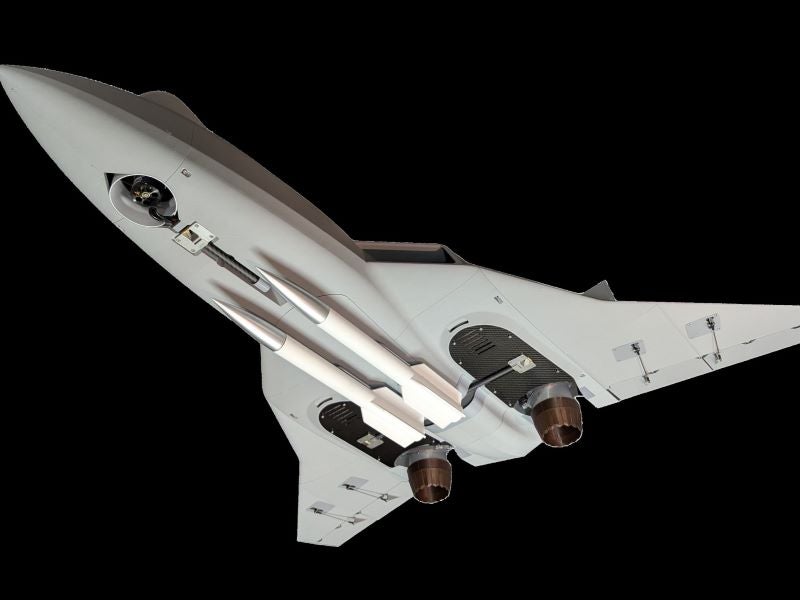
CobraJet™ is a low-observable unmanned combat aerial vehicle (UCAV) manufactured by SkyDefense, a company based in Colorado, US.
The tactical, multirole autonomous aircraft is designed to detect, track and destroy hostile drones at high speed. It is positioned for defence against drone threats to critical infrastructure, borders, airports, military bases and public venues.
Recommended White Papers
Recommended Buyers Guides

Initial manufacturing of the drone took place in September 2025, followed by a public unveiling in July 2026.
Counter unmanned aerial system (C-UAS) field trials involving CobraJet and SkyDefense’s ground control station software, Visual Realtime Area Monitoring (VRAM), are scheduled for the fourth quarter of 2026 (Q4 2026) at a UAS test site, with production expected to begin in Q1 2027.
CobraJet UCAV design and features
The CobraJet aircraft features a modular lightweight airframe structure referred to as the nucleus, which is made of 3D-printed carbon fibre composite material, and is finished with a radar-absorbing coating based on graphene.
The core structure incorporates avionics with an AI-enabled flight controller, sensors, landing gear and thrust vectoring modules and is shared across the five variants of the platform.
CobraJet includes vertical take-off and landing (VTOL) capability and thrust vectoring to improve agility and support engagements against fast-moving, evasive UAS using onboard air-to-air weapons. The thrust-vectoring swivel nozzles are spaced widely to enhance stability in crosswinds and support high manoeuvrability.
The system is intended to deploy within minutes from mobile platforms including trucks, ships and other aircraft. It is engineered to maintain reliable performance even when GPS is blocked or disrupted, including under electronic warfare conditions.
Flight control
The autonomous aircraft includes an integrated AI-enabled autopilot, while mission-level decisions are intended to remain under human supervision through VRAM Mission Control.
The AI-enabled autopilot is paired with National Defense Authorisation Act-compliant electro-optical/infra-red cameras, and additional sensors such as thermal imaging and laser designator, to support autonomous operations day and night, including in extreme weather.
For short-range tasks, it can also be operated by manual remote control with AI assistance.
Payload options
The CobraJet platform carries a suite of air-to-air interceptor payloads that are low-cost and attritable, mounted on its fuselage underside or wing hardpoints.
These payloads include the PYTHON electro-mechanical launcher firing 18mm COPPERHEAD rounds, the patented 40mm Compute Unified Device Architecture (CUDA) Mach 0.5 guided rounds, and 45mm VIPER solid-propellant powered Mach 1.0 guided missiles with kinetic and non-kinetic payloads.
The munitions are intended to counter Group 1-2-3 unmanned aerial vehicles (UAVs), fibre-optic first-person view (FPV) drones, jet-powered drones and UAV swarms, with a stated low probability of collateral damage.
Furthermore, the weapons are engineered for high-rate production, potentially thousands of units per month, through 3D printing and streamlined manufacturing processes, while maintaining consistent quality standards.
CobraJet can also be deployed as part of a layered defence concept that includes short-range man-portable 40mm M32 or M79/M203-launched CUDA guided rounds and surface-to-air 55mm RAPTOR Mach 1.0 solid-propellant-powered guided missiles that can be rail or tube-launched to engage drones that penetrate the distributed area defence.
Ground control station details
SkyDefense’s VRAM combines AI-based data analysis with a control interface intended to keep human operators in the decision-making loop.
VRAM Mission Control can be run on a robust, ruggedised laptop, enabling use in portable or on-the-move settings. It is designed to support operations in contested electromagnetic environments using AI-assisted visual navigation, SmartVision and additional anti-jam measures, while satellite communications are provided via Starlink/Starshield.
The software can also be integrated with long-range command-and-control systems and ground-based sensors.
SmartVision is an AI and machine vision capability for visual navigation intended to remain effective in jamming conditions. It supports object detection, identification and tracking, including optical lock-on, terminal guidance and the ability to follow multiple targets within a swarm.
The system applies to combat and non-combat missions and is intended to support launch-and-forget operation while retaining human oversight. Real-time AI and computer vision enable multiple CobraJet aircraft to operate as a coordinated unit during interceptions of hostile drone swarms.
Propulsion and performance
The CobraJet platform features a hybrid propulsion system comprising electric duct fan motors supported by high-energy density solid-state batteries that offer speeds of up to 360km/h (225mph).
The hybrid configuration uses gas-powered turbojets, which offer speeds of up to 560km/h.
Endurance is stated to vary by variant from more than 30 minutes to one hour.
CobraJet UCAV variants
SkyDefense offers CobraJet in five trijet variants, V4, V6, V8, V10 and VT10, aimed at C-UAS and security missions.
The V4, V6, V8 and V10 variants feature electric VTOL with three battery-powered, electric duct fans set up, while the VT10 variant offers VTOL with a hybrid power setting, which includes twin turbojet engines and a battery-powered electric duct fan. The V10 and VT10 variants are intended for longer-range flights and heavier payloads and are suitable for battlefield and homeland defence applications. The two versions can also be a drone mothership capable of releasing low-cost, attritable anti-UAS drones from a weapons bay and from an underwing carriage.
