

Confronted with pressure from allies to do more in response to Russian aircraft violating Estonian airspace last week, the country’s Minister of Defence Hanno Pevkur held firm in a press conference today (22 September) in Tallinn.
“When we take the theoretical option to shoot something down, then I would say that every action we do has to be proportionate,” Pevkur insisted.

Discover B2B Marketing That Performs
Combine business intelligence and editorial excellence to reach engaged professionals across 36 leading media platforms.
His assessment came two days after the Czech president, Petr Pavel, cautioned Nato over the weekend, suggesting the alliance ought to respond militarily to the 12-minute escapade in which three MiG-31 fighter jets flew over the Estonian island of Vaindloo on 19 September.
“When we analyse this case,” Pevkur continued sobrely, “then we see that [the Russian aircraft] were flying not towards our capital [Tallinn]… when we analyse what kind of weapon systems… they have, we didn’t see that there [was] an acute threat to our sovereignty or our security.”
At the time, Finnish F-18s began to shadow the trio until Italian F-35s, participating in Nato’s Baltic Air Policing Mission, took over and escorted them to Kaliningrad, a Russian exclave on the Baltic Coast, sandwiched between Poland and Lithuania (which creates a strategically volatile area known as the Suwałki Gap).
In response to the threat, which Moscow denies, the Estonian government invoked article four of the Atlantic Charter, which allows a member of the Nato alliance to raise an issue for consultation among the North Atlantic Council (NAC) if they believe their territorial integrity is threatened.
Pevkur confirmed that the NAC will gather at 10am on 23 September. Likewise, the UN Security Council has also begun to discuss the incident this evening.
Prior to this, Russian drones were launched into Polish airspace which prompted Nato to execute ‘Eastern Sentry’, a military activity to secure allied territory. Pevkur also alluded to the joint effort, calling for it to be expanded even further in the air domain due to the proliferation of uncrewed aerial systems.
to that end, on 20 September, two UK Royal Air Force Typhoons, assisted by a Voyager tanker, had already begun their journey to Poland to patrol its airspace.
Spending growth and capability focus
In his address to international media, Pevkur also mentioned that Estonia’s defence spending as a percentage of its gross domestic product (GDP) will exceed the target laid out in their 2026-2029 investment plan, issued just after the Nato Summit in The Hague in June.
Rather than spending 5% four years from now, the government will reach this target next year just on ‘core defence’, that is, purely military resources. Moreover, this will continue to grow to 5.6% in 2029. This spending growth, Pevkur added, has trebled since 2022.
On ammunition alone, between 2022 to 2029 – so over a period of seven years – the total amount Estonia will invest in ammunition will be around €5bn ($5.8bn).
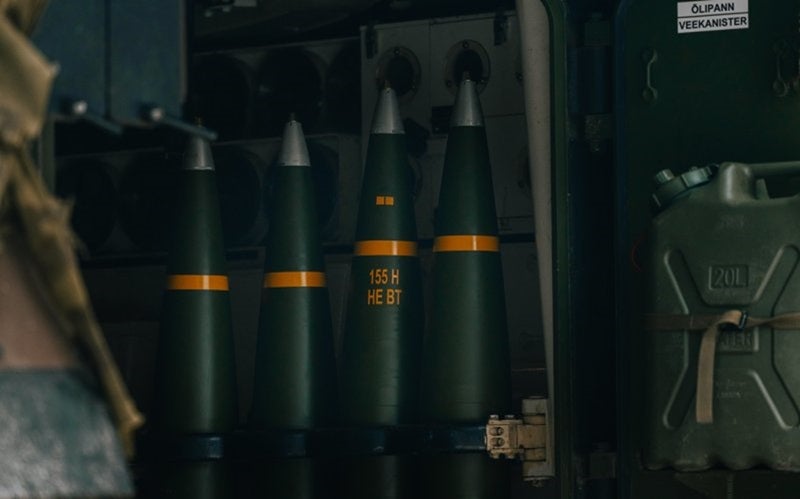
Due to the immediate nature of the threats faced in the Baltic region, Pevkur outlined the range of Estonia’s requirements: intelligence, surveillance, targeting, acquisition and reconnaissance systems; drones; deep strike capabilities; anti-ship missiles; sea mines; and air defence of all types, particularly short-range air defence systems.
Just after Nato Summit, as part of their new investment plan, the Estonian government revealed that it will conduct market research into a tactical ballistic missile capability. This is a common theme throughout Europe, with the UK unveiling plans to engage with industry for the same capability with a 600-kilometre range under Project Nightfall.
In response to a question from Airforce Technology Pevkur confirmed that it will be another five years before Estonia gets a ballistic missile capability. However, he did put forward the systems in contention:
“From our perspective today… then yes, Patriot is one of the options, David’s Sling is one of the options, IRIS-T,” he listed.
“But what we also see [is] that the market is developing so quickly and rapidly that there are already some startups who offer rockets flying to max and 70 kilometers, not yet ready, but in the test phase.
“So probably [in] a couple of years, we will see totally new options which will not cost probably one million per battery [what] Patriot costs. Let’s say we are in the analysing phase of the environment.”


