

As a leading supplier in the UK’s military space capability, Airbus Defence and Space are eager for the government to follow its own advice in prioritising sovereignty and ensure, as the government mantra goes, that UK defence remains an engine for growth.
In an exclusive interview with Airforce Technology prior to the release of the Defence Industrial Strategy (DIS), Airbus executives Martin Rowse, campaign director, and Kata Escott, managing director, welcomed signals in the Strategic Defence Review (SDR) in June, wherein the trio of authors recommended that the UK leverage the “significant untapped potential” domestically while also “boosting export potential.”
Go deeper with GlobalData


Discover B2B Marketing That Performs
Combine business intelligence and editorial excellence to reach engaged professionals across 36 leading media platforms.
While the SDR determined the government’s philosophy going forward, the DIS, which the Defence Secretary will release later today, outlines the specific approach to be taken in real terms.
“What that will do is put some meat on the bones of this big idea. I think that the really interesting bit will be in how the government then delivers on that commitment,” Escott considered.
“I think the political rhetoric is all in a great place,” she continued, “but I think there’s an opportunity here for [the government] to demonstrate a shift – some of the urgency we saw in the SDR.”
The Ministry of Defence revealed plans for increasing critical defence skills, investing £182m in the talent pipeline; launching a £250m fund for defence growth deals; and exploiting lessons in innovation coming out of Ukraine. In recent months, Nato allies have been eager to leverage and build Ukrainian designs of proven weapons systems, this includes Denmark and the UK to name a few.
Skynet
The company claims that they have up to £10bn ($13.5bn) worth of export potential with its portfolio of military satellite communications (MILSATCOM) based in the UK. This derives from years of building commercial and military satellites.
In the space community, Airbus is known for Skynet, the UK’s MILSATCOM capability, which provides a critical enabler to the United States and 17 other Nato allies too.
For a sense of the cost of the programme, it is worth noting that in 2022 the UK promised £1.4bn ($1.78bn) for space capabilities over the following ten years, apart from the £5bn to be spent on advancing Skynet.
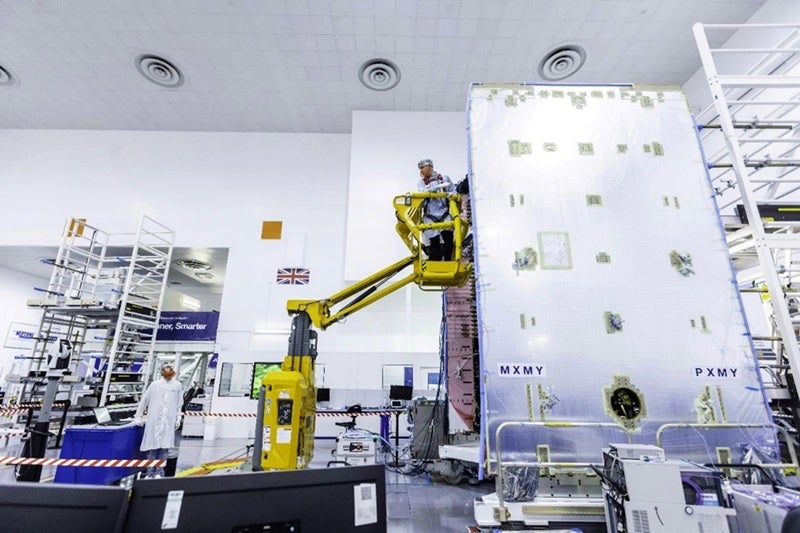
Built in Portsmouth but coming out of final tests, the first 6A satellite is booked to launch on a SpaceX Falcon 9 rocket in 2027, and will operate the British military’s communications into the 2040s.
“That’s a big wealth generator because it leads to new capability,” Rowse stated. “The enduring Skynet 5 satellites are then evolved into the Skynet 6A satellites, which will be evolved into the WSS [Wideband Satellite System] satellites.”
WSS contract
At present, Airbus Defence and Space UK is competing with Lockheed Martin UK on the nation’s WSS contract.
The procurement covers up to three tranches of geostationary (GEO) satellites, along with ground infrastructure and launch operations that are equipped with military-grade X-Band and Mil-Ka payloads to ensure high availability and hardened performance.
A second and final invitation to negotiate reflecting all the agreed changes was produced and formally released on 8 August 2025. A preferred bidder will be selected and a full business case taken forward in early 2026.
According to the government, WSS represents the “single largest space procurement nationally” – with an estimated contract value above £1.5bn – supporting the growth of the UK sovereign space sector.
While sovereignty is a key part of the SDR and, perhaps, the DIS, Lockheed Martin UK will also be able to tap into a vibrant global space industry and leverage its experience in ground terminal infrastructure and building small satellites in the past 50 years.
The company, based in the US but with a UK entity, have built more than 300 mission payloads for customers. This includes the LM 400 satellite bus, which provides a range of services both military and civil, including communications.
It is worth noting, however, that Lockheed do not currently build satellites on UK soil at present. Although, the company is pursuing production sites in the UK, Lockheed Martin does have a space technology office in Harwell that explores opportunities within the UK space sector.
Airforce Technology contacted Lockheed Martin UK about its WSS offering and the UK government about the competing companies but neither organisation responded for comment.


