
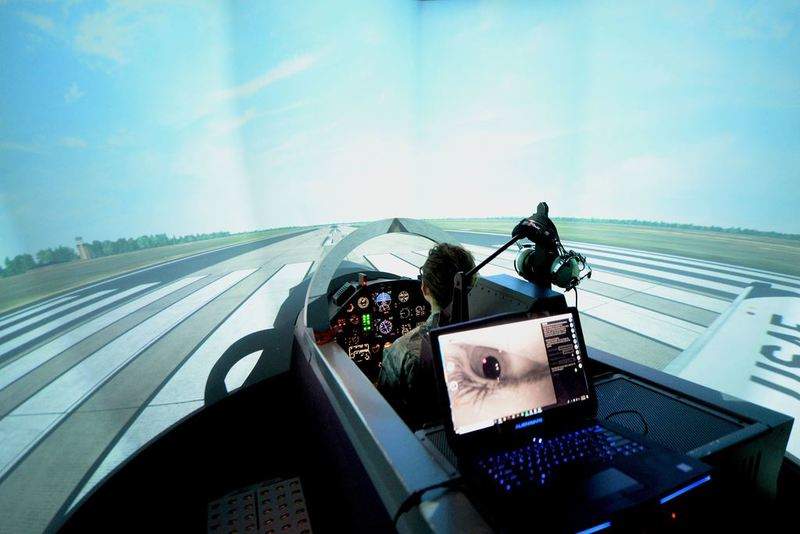
A team of student researchers from Air Command and Staff College, Air University at Maxwell Air Force Base (AFB) in Alabama, US, has carried out an adaptive flight training study at Columbus AFB to support the US Air Force’s (USAF) advancement in training and education through virtual reality (VR).
As part of the study, three test groups, with no prior T-6 flying experience, were assigned to fly a T-6 Texan II simulator.
Go deeper with GlobalData


Discover B2B Marketing That Performs
Combine business intelligence and editorial excellence to reach engaged professionals across 36 leading media platforms.
Air Command and Staff College student major Matt Elmore said: “We took the idea of learning through advanced technologies like VR, and came up with our idea of a targeted learning system.
“We are focusing on how our troops learn, using technology to measure the person, the environment and their performance, to see if we can provide better feedback both adaptively in the curriculum and to provide variables or indicators to select people for certain jobs based on the results.”
During the training, three test groups flew four simulations, with the first simulated flight establishing the baseline for the other three flights to be compared with.
The task assigned to the test groups was to fly a basic sortie around Columbus AFB and land safely.
During the virtual training sessions, the participants were given three learning environments, providing less optical and auditory cues as they progressed.
After the training sessions, the subjects would carry out a final flight in the T-6 Texan II flight simulator to determine if there was any improvement through the virtual reality training.
Elmore added: “The data we are gathering can hopefully help us start to determine the key factors of what makes individuals succeed or perform better.”
The data is being collected from the eyes, heart and lungs of the pilots, which would help find each individual’s estimated maximum cognitive loads.
The implications of the possible findings from the study can be applied to limitless training environments across the USAF.


