

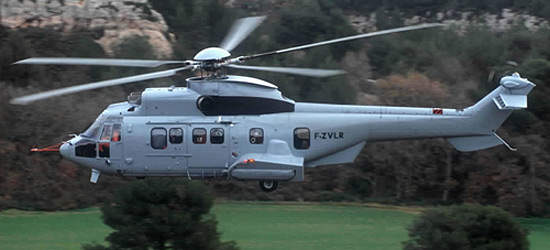
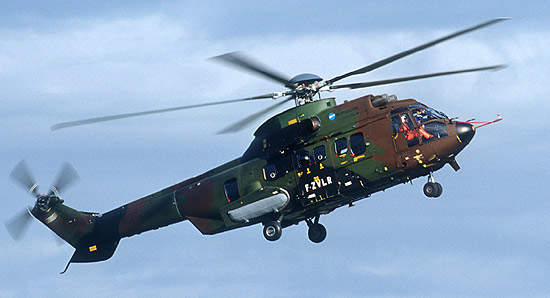
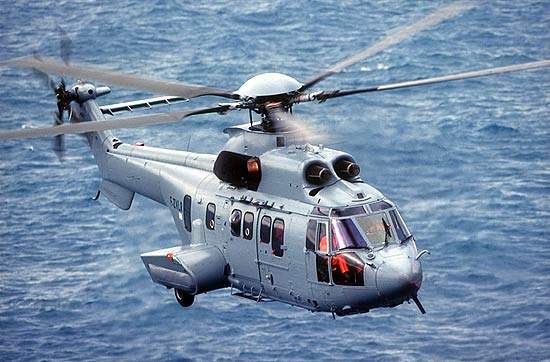
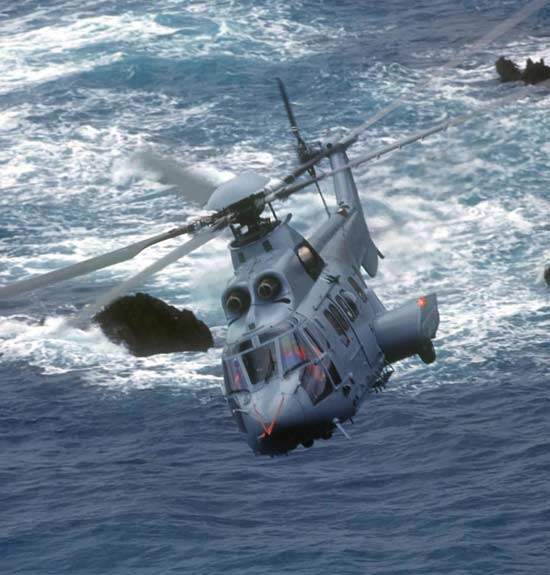
The H225M (previously known as EC 725) medium-sized (11t), twin-engine helicopter is a member of the Cougar helicopter family developed by Eurocopter. The aircraft has been developed in the military H225M version and a civil EC 225 version.
The helicopter completed its first flight in November 2000 and is now in service in ten countries worldwide. The French Air Force, the launch customer, ordered six H225Ms for use in a combat search-and-rescue (CSAR) role. The first was delivered in February 2005 and deliveries concluded in May 2007. The French Special Operations Command ordered eight H225M helicopters in November 2002.
Recommended Buyers Guides

French H225M helicopters were deployed in 2006 in Lebanon to aid evacuation of personnel, as well as in Afghanistan. Two helicopters have been stationed in Kabul since the beginning of 2007 in support of the Nato International Security Force. The H225M is used for more than 95% of operations in Kabul.
Orders and deliveries of Eurocopter’s helicopter
In April 2009, an additional five H225M helicopters were ordered by the French Defence Ministry as part of the government’s €220m ($314m) economic recovery plan. The first of five H225M helicopters was delivered in June 2011.
Two H225M helicopters have also been ordered by Dirgantara for the Indonesian Air Force. In April 2012, Eurocopter received an order from PT Dirgantara Indonesia / Indonesian Aerospace to supply six additional helicopters for the Indonesian Air Force. The delivery of the first helicopter was completed in November 2014. The Indonesian Air Force ordered an additional eight H225M helicopters in January 2019.
Malaysia announced the selection of the H225M for an initial order of 12 helicopters in September 2008. However, the contract award has been indefinitely delayed due to budgetary constraints. Eurocopter signed a cooperation contract with the Malaysian Ministry of Defence at the 49th Paris Air Show in June 2011, related to the supply of the 12 H225M helicopters to the Royal Malaysian Air Force (RMAF) for search-and-rescue (SAR) operations.
These new aircraft replaced the existing fleet of Sikorsky S-61 Sea King rotorcraft. The first two helicopters were delivered in December 2012 and the remaining units were delivered between 2013 and 2014.
In December 2008, Brazil placed a €1.9bn ($2.72bn) order for 50 H225M helicopters, 16 for the Navy, 16 for the army and 18 for the air force. The helicopters are being manufactured in Brazil by Eurocopter subsidiary Helibras. The first three H225M helicopters were delivered to Brazil in December 2010.
The first indigenously-built H225M helicopter was delivered to the Brazilian Navy in June 2014. A total of 28 helicopters were handed over to the Brazilian Armed Forces by May 2017. Deliveries are scheduled for completion by 2022.
In March 2010, the Mexican Air Force ordered six H225M helicopters from Eurocopter. These will be used for transport and civil security missions. Another six H225M rotorcraft were ordered by the Mexican Air Force in September 2010, increasing the total number of aircraft orders to 12. The Mexican Navy ordered nine H225M helicopters to carry out CSAR, medical evacuation (MEDEVAC) and troop transport missions.
In July 2009, the H225M was presented on the static display at the Royal International Air Tattoo, at RAF Fairford. In September 2009, it was displayed at Defence Systems & Equipment International event, held in London, UK.
The new H225M is based on the proven fuselage and structural design of the Cougar mk2, with a new five-bladed main rotor and reinforced main gearbox. The helicopter also has a new integrated display suite and piloting system. The new H225M version is able to carry a much higher military payload at a faster speed, while it also has an increased range.
Eurocopter received a letter of intent (LoI) from the Republic of Kazakhstan to deliver 20 H225M helicopters in May 2012.
In September 2012, the Royal Thai Air Force (RTAF) ordered four H225M search and rescue helicopters, with deliveries concluded in August 2015. Two more helicopters were ordered in 2016 and were delivered in October 2018. RTAF placed an order for next set of four H225Ms in September 2018, which will bring RTAF’s H225M fleet to 12 units by 2021.
The Kuwait Ministry of Defence ordered 30 H225M helicopters in August 2016.
In November 2016, Airbus Helicopters signed a contract with the Singapore Ministry of Defence to deliver an undisclosed number of H225M medium-lift helicopters.
Boeing secured an order from Hungary for the delivery of H225M helicopters in December 2018.
Capabilities of the H225M Cougar
The aircraft is suitable for a wide range of missions such as tactical troop transport, special operations, SAR, CSAR, maritime surveillance, humanitarian support logistic ground support, medical evacuation and shipborne operations. The ferry flight range is more than 1,200nm.
In the tactical troop transport role, the helicopter can carry 19 troops over a 250nm radius of action. In the CSAR role, the H225M is able to rescue a downed crew at a radius of action of 280nm.
Design features of the twin-engine helicopter
The fuselage is of light alloy material with a large composite intermediate structure and cowlings. The machine-milled frames are strengthened for crashworthiness. The crew and troops are protected by removable armour plating. The maximum seat capacity is two crew and 29 troops.
H225M helicopter is fitted with a dual hoist system and has a sling capacity of 5t.
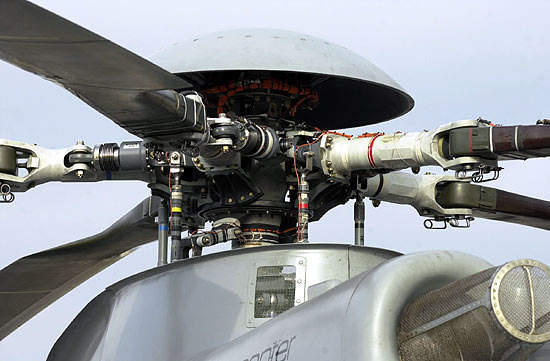
The helicopter is equipped with new ‘Spheriflex’ main and tail rotorheads with a diameter of 6.2m. The five-bladed main rotor is fully composite, with a composite spar, multiple box structure and anhedral tipcaps. The five-blade arrangement provides a very low level of vibration. The rotors and horizontal stabiliser can be equipped with an anti-icing and de-icing system.
Helicopter cockpit and weapon systems
The H225M is equipped with an all-glass cockpit, with new avionics and a new integrated display system, including a digital map.
Its display suite includes seven active matrix liquid crystal displays: four multifunction 6in x 8in displays and two 4in x 5in helicopter parameter displays.
The advanced helicopter cockpit and avionics system (AHCAS) includes an automatic flight control system developed by SAGEM, integrating the flight, navigation and tactical mission data.
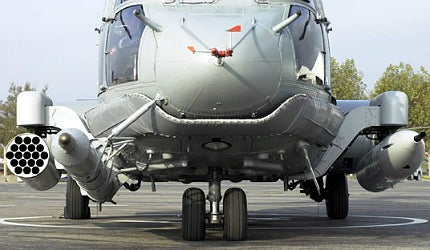
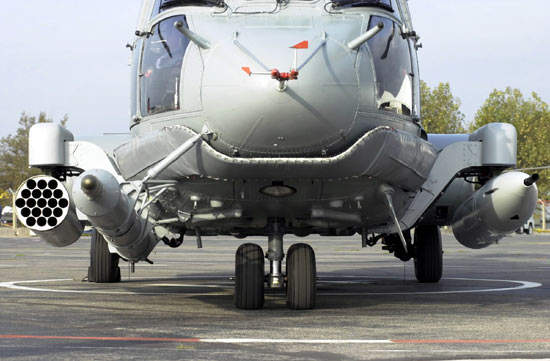
The helicopter can also be fitted with axial pods, such as two 68mm rocket launchers or two 20mm cannons
H225M is equipped with radar and FLIR (forward-looking infrared) for day and night-time SAR capabilities. The navigation suite includes Doppler radar, global positioning system and inertial navigation system.
The SAR system can be programmed to provide automatic search patterns, transition and hover.
The helicopter can carry side-firing armaments, such as two 7.62mm general purpose machine guns and a 20mm cannon. The helicopter can also be fitted with axial pods, such as two 68mm rocket launchers or two 20mm cannons.
Its electronic warfare systems include a radar warning receiver, laser warning receiver, missile approach warner and chaff and flare dispensers.
Turbomeca Makila 2A turboshaft engines
The helicopter is powered by two Turbomeca Makila 2A turboshaft engines, each providing 1,800kW of power, an increase of 14% over the previous 1A2 engine version.
Each engine, complete with systems and accessories, is independent. An infrared suppression system is installed to reduce the thermal signature of the helicopter.
The engines are equipped with dual-channel full authority digital engine control (FADEC), while protective air intake grids prevent ingestion of debris into the engines. The free turbine features blade shedding architecture for high levels of reliability and safety.
The main 2,539l fuel tanks are installed beneath the floor of the cabin. Auxiliary tanks can be installed in the cargo hook well (capacity of 324l) or at the rear of the cabin (990l). The helicopter can be equipped with a probe for air-to-air refuelling. The refuelling system has already been validated on the Cougar mk2.
Main gearbox and landing gear of Eurocopter’s H225M Cougar
H225M’s main gearbox is reinforced for compatibility with the increased turbine engine power and the increase in the helicopter’s maximum weight. The helicopter uses the gear train identical to that of the Cougar mk2. An emergency lubrication spray is installed in the gearbox to allow a 30-minute flight with no oil.
The helicopter has retractable crashworthy tricycle-type landing gear supplied by Messier-Bugatti. Each unit retracts rearward and is fitted with dual chamber oleo pneumatic shock absorbers. Emergency floatation units can be installed on the main landing gear fairings and on the forward section of the fuselage.
Performance of the Cougar-family helicopter
The H225M can climb at the rate of 3.6m/s. The maximum and cruise speeds of the aircraft are 324km/h and 277km/h respectively. The range is 1,482km and service ceiling is 6,095m.
The Global Military Rotorcraft Market 2011-2021
This project forms part of our recent analysis and forecasts of the global military rotorcraft market available from our business information platform Strategic Defence Intelligence. For more information click here or contact us: EMEA: +44 20 7936 6783; Americas: +1 415 439 4914; Asia Pacific: +61 2 9947 9709 or via email.
Related content
EC-665 Tiger Multirole Combat Helicopter
Tiger is being built by Eurocopter, a subsidiary of the EADS (European Aeronautics Defence and Space) company formed by DaimlerChrysler Aerospace of Germany, Aerospatiale Matra of France and CASA of Spain.
EC 635 Twin-Engine Light Combat Helicopter, France
The EC 635 is Eurocopter’s powerful lightweight twin-engine army helicopter designed for air-to-air combat and ground support.
