
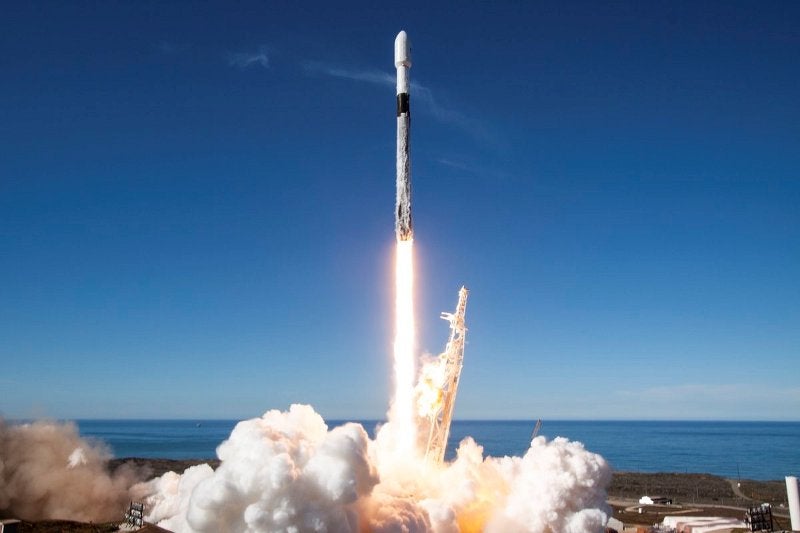
The US Air Force (USAF) has announced the successful launch of Space Test Program Satellite 5 (STPSat-5) from Vandenberg Air Force Base, California.
Launched on 3 December, the satellite was placed into orbit via Spaceflight Industries’ fully dedicated smallsat rideshare mission aboard a SpaceX Falcon 9 launch vehicle.
Go deeper with GlobalData


Discover B2B Marketing That Performs
Combine business intelligence and editorial excellence to reach engaged professionals across 36 leading media platforms.
Space and Missile Systems Center Advanced Systems and Development Directorate director colonel Timothy Sejba said: “I’m elated with today’s successful launch.
“STPSat-5 demonstrates the value of commercially procured mission management and launch services for the airforce. It also highlights the benefit of forging new partnerships with commercial space companies under SMC 2.0.
“This mission would not be possible without the combined dedication of our government and industry partners, including Nasa, Spaceflight Industries and Sierra Nevada Corporation. We look forward to evaluating STPSat-5’s performance on-orbit over the next year.”
Built by Sierra Nevada Corporation for the US Department of Defense’s (DoD) Space Test Program (STP), the satellite is managed by the USAF Space and Missile Systems Center at Kirtland Air Force Base in New Mexico.
STPSat-5 satellite contains five science and technology payloads from four government agencies.
These are strontium iodide radiation instrumentation (SIRI) and RAM angle and magnetic field sensor (RAMS) from Naval Research Lab, USAF Academy’s integrated miniaturized electro-static analyser (iMESA).
The other two payloads are the USAF Research Lab’s rad-hard electronic memory experiment (RHEME), and Space and Naval Warfare Systems Command’s high bandwidth anti-jam LPI/LPD optical network (HALO-Net).
The payloads will improve the US DoD’s understanding of the space environment and help in the development of future national security space systems.
It is the first satellite mission to fly SNC’s SN-50 bus, which has both low-Earth orbit and geosynchronous-Earth orbit capabilities.
SN-50 satellite bus platform is intended for the evolved expendable launch vehicle (EELV) secondary payload adapter (ESPA) class market.


