

- Airbus presented its fiscal year 2025 results this week in which it alluded to “uncertainties” regarding the level of A400M orders
- Although the programme is fiscally stable, the company will assess the potential impact on the programme’s manufacturing activities
- The chief executive downplayed the medium-term slump, characterising it as a “classical situation” in the transition from launch contracts to a second wave of export orders
Airbus have noted “uncertainties” when it comes to future A400M aircraft orders in its fiscal year 2025 results.
While the airlift programme remains stable at present, driven by an agreement to advance seven French and Spanish units, company executives alluded to a mid-term slump. The chief executive, Guillaume Faury, characterised this outlook as a “classical situation” for any programme transitioning from initial launch contracts to a second wave of global export orders.

Discover B2B Marketing That Performs
Combine business intelligence and editorial excellence to reach engaged professionals across 36 leading media platforms.
Despite optimistic rhetoric conveyed during the press conference, the results indicated the company would continue to assess the potential impact on the aircraft’s manufacturing activities.
A400M: present and future
So far, Airbus has delivered 137 of 178 aircraft orders from among launch customer nations (Belgium, France, Germany, Luxembourg, Spain, Türkiye, and the UK) and three export customers, Malaysia, Kazakhstan, and Indonesia.
The A400M already represents the last major shift in the global transporter market: it uniquely straddles the line between a tactical and strategic airlifter. Meanwhile, competitors scramble to find their own niche in a market that is differentiated by marginal percentage points in fuel, size and weight efficiencies.
Yet Airbus briefly touched on its plans to enhance the A400M further in the 2025 results.

US Tariffs are shifting - will you react or anticipate?
Don’t let policy changes catch you off guard. Stay proactive with real-time data and expert analysis.
By GlobalDataThis includes broadening the scope of the aircraft to new roles. Airbus is already looking into developments such as standoff jamming, a payload increase to 40 tonnes, and functionality as a “mother ship” for uncrewed air systems.
Transition or slump?
There has been a trend in the market toward competing tactical transporters, either advancing legacy Lockheed Martin C-130 aircraft or opting for Embraer’s C-390 Millennium.
The Royal Australian Air Force will benefit from new training equipment for its upgraded C-130J-30 units while last month (albeit this year) Mexico announced it will become the first latin American nation to operate the aircraft.
While there were no new A400M contracts at all last year, Embraer secured the production of eight C-390s (four for Sweden, three for Lithuania, and one KC-390 tanker for Portugal).
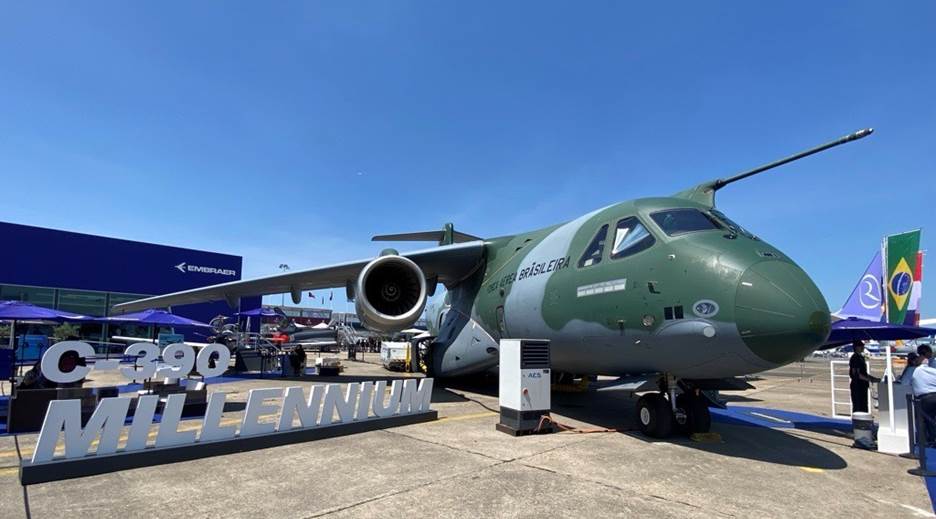
Faury summarised the potential difficulty going forward:
“We are coming not far from the end of the launch contract so we continue to have aircraft delivered but we see that this is for the next few years, and we’re… enaged with a number of campaigns that are promising but take time to materialise, especially in this overall environment.”
This is true: Airbus is moving closer to striking a deal to replace seven legacy C-130J tactical transporters still in service with the United Arab Emirates Air Force.
Airbus told Airforce Technology on the sidelines of the IDEX exhibition last year that it intends to work with Emirati suppliers – naming Strata, AMMROC, and EPI – to build between 30 to 40 of its aircraft in the Gulf nation, allowing the company to tap into a new market across the Middle East and North Africa.
Europe tackle airlift gap
“We see that Europe has defined airlift needs as one of the capability gaps,” reflected Thomas Toepfer, Airbus’ chief financial officer.
Toward the end of 2025, the European Defence Agency suggested employing an EU Civilian Reserve Air Fleet to mitigate heavy airlift shortfalls. A study is scheduled to begin in the spring which will assess operational, legal, and financial aspects of such a concept.
“So we hear very clearly that there will be a need for additional A400Ms,” Toepfer affirmed.
This is especially true since the A400 offers greater capacity and range as an aircraft that can be used in some of the same roles as a fully fledged strategic airlifter, much like the C-17 Globemaster III, a coveted capability no longer in production.
“But the timing becomes a challenge,” Faury continued, describing the A400’s tricky transition.
“That’s really the nexus of when those new campaigns kick in and how low do we need to go and for how long on the assembly of the aircraft before we see this second wave of aircraft being manufactured?”
This has not dampened any spirits just yet, however, as Faury maintained that “we think the product is strong, competitive, [and] from a military standpoint very effective.
“We’re optimistic about the medium term and the long term, but we have to navigate that transition.”


